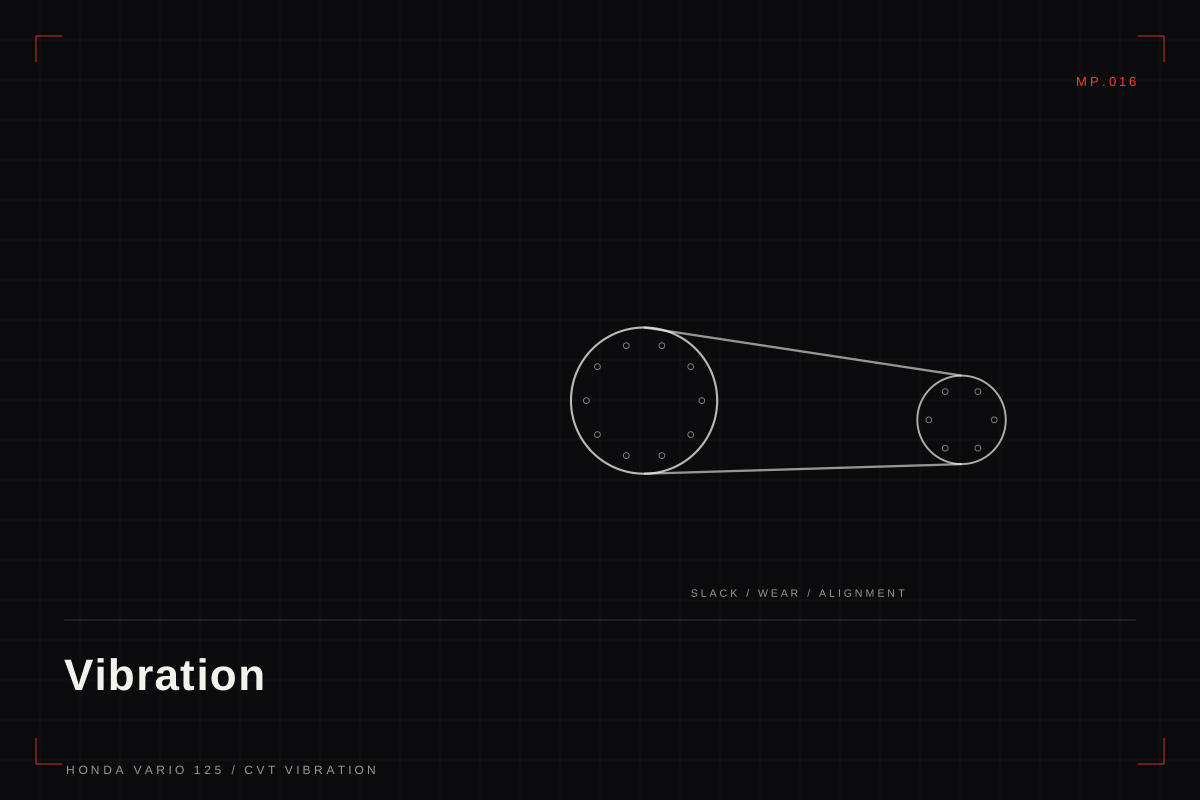
A Honda Vario 125 that vibrates is not automatically due for a belt. The frequency, the throttle position and whether the shake follows engine speed or road speed point to different parts of the scooter, and the cheapest test is a controlled ride.
Before you start
The CVT case holds a strong spring and sharp edges. Do not open it with the engine running or put fingers near the belt. If the vibration makes the scooter unstable, stop riding and arrange recovery rather than testing it at higher speed.
Machine file Honda Vario 125
- Engine
- Liquid-cooled SOHC single
- Cooling
- Liquid
- Fuel
- PGM-FI
- Transmission
- CVT
- Final drive
- V-belt
Three vibration signatures
Low-frequency judder as the scooter moves off belongs to the clutch engagement zone. A finer, faster buzz that appears at a particular road speed and stays there usually comes from the belt, the variator or a wheel. A heavy shake that follows engine speed even when the scooter is stationary points to the engine, its mounts or the exhaust.
Riders often describe all three as 'the CVT'. Separating them matters because a wheel balance fault will survive any amount of belt replacement. Write down the road speed, the throttle opening and whether the vibration disappears when you close the throttle.
Frequency band and what it points to
| Signature | Where it appears | First check |
|---|---|---|
| Slow judder | First metres from a stop | Clutch shoes and bell |
| Fast buzz | One road speed, steady throttle | Belt and variator faces |
| Heavy shake | Engine speed, even stationary | Mounts and exhaust |
| Rumble | Coasting, follows road speed | Wheel bearing and tyre |
| Snatch | Light throttle at low speed | Clutch springs and dust |
A repeatable test ride
Use a quiet, straight road and ride the same route twice. On the first pass, accelerate gently and note the exact moment the shake begins. On the second, hold a steady 40 km/h and then 60 km/h and note whether the shake stays at the same road speed or follows the engine.
Then coast with the engine idling. If the vibration continues while the CVT is not driving, the source is a wheel, tyre or bearing. If it disappears when the drive is unloaded, the CVT is back in the frame. This simple split saves a lot of panel work.
Belt slap and variator marks
The Vario 125 belt runs between two faces that must stay smooth. A belt that has narrowed or hardened can slap against the case at low speed, and a variator face with grooves will make the belt ride unevenly. The result is a fast buzz rather than a single thud.
A workshop measures the belt width and inspects the face pattern under light. Deep rings on the variator mean the belt has been running in one place for too long, often because the rollers stopped moving. Fitting a new belt to that face repeats the problem within a few thousand kilometres.
Clutch judder at engagement
Clutch judder appears in the first few metres of movement, especially on a slight incline or with a passenger. The shoes grab and release until the bell and shoes are fully engaged. Dust, glaze and a scored bell all make it worse.
The Vario 125's clutch is small and works hard in city traffic. Short repeated journeys with a lot of stopping heat the bell and leave deposits. Cleaning the bell and shoes can restore smooth engagement, but if the shoes are worn or the springs are weak, cleaning alone will not last.
Wheels, bearings and mounts
A rear wheel bearing or a worn tyre can imitate a CVT vibration convincingly. Check the tyre pressure cold, look for flat spots and cupping, and feel for play at the wheel with the scooter on its centre stand. A bearing that rumbles when turned by hand needs replacement before the next ride.
The liquid-cooled engine is heavier than the air-cooled 110 unit, and its mounts carry more load. A collapsed rubber mount lets the engine move and sends a shake through the frame. Inspect the mount bolts and the exhaust hangers as well; a loose heat shield can buzz at exactly the speed you noticed.
What the workshop should record
Ask for the measured belt width, the roller condition, the clutch shoe thickness and the bell surface. A good workshop will also note tyre pressures and wheel play. Those numbers turn a vague vibration complaint into a decision.
After the repair, repeat the same test route. The shake should be gone at the speed and throttle where it appeared. If it is still there, the measured parts were not the cause, and the next step is a wheel and bearing check rather than another belt.
Keeping it from coming back
Judder that appears under load is usually the clutch or the belt, and both last longer with smooth launches and clean air around the CVT case. Have the belt width, rollers and clutch bell measured together, and fix any oil leak from the final-drive seal before fitting new parts. A contaminated belt will glaze the new shoes.
A short checklist
- Record the road speed and throttle position when the shake appears.
- Repeat the ride and coast with the engine idling.
- Check tyre pressures and look for cupping or flat spots.
- Measure the belt width and inspect the variator faces.
- Inspect clutch shoes, springs and the bell surface.
- Check engine mounts, exhaust hangers and wheel bearings.
Questions owners ask
Why does my Vario 125 vibrate only at 60 km/h?
A vibration locked to one road speed usually comes from the belt, a wheel or a tyre, not from the engine. Coast at that speed with the engine idling: if the shake remains, check the wheel and tyre first.
Can a new belt cause vibration?
A belt of the wrong width or one fitted without cleaning the faces can vibrate immediately. So can a belt that is correct but paired with worn rollers. Compare the part number and the measured width with the specification.
Is it normal for a scooter to shudder when pulling away?
A slight engagement shudder is common when the clutch is cold or dusty. A repeatable, strong judder that worsens with a passenger is a wear signal, not normal behaviour.