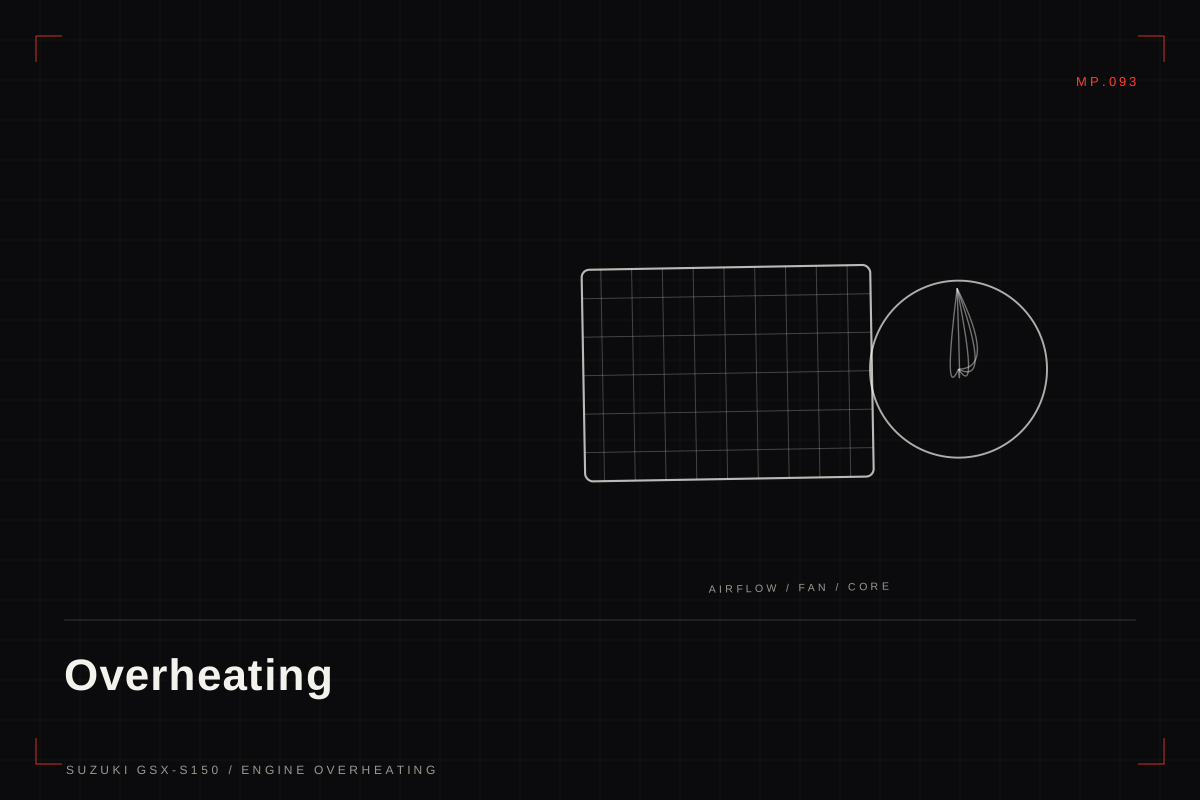
A Suzuki GSX-S150 that overheats is removing less heat than the engine produces. Because the radiator is exposed, the usual culprits are visible: a core packed with insects, a fan that does not run, a low coolant level or a cap that no longer holds pressure.
Before you start
Pressurised coolant can exceed boiling point and cause severe burns. Never open the cap or a hose on a warm engine, and never pour cold water into a hot radiator. Keep hands clear of the fan.
Machine file Suzuki GSX-S150
- Engine
- Liquid-cooled DOHC four-valve single
- Cooling
- Liquid
- Fuel
- Fuel injection
- Transmission
- Six-speed manual
- Final drive
- Chain
Where the gauge rises
Heat that builds in traffic and falls once you move is an airflow problem. Heat that keeps climbing at speed points to coolant loss, a blocked core or a circulation fault.
A warning light means stop. Pull over, switch off and let the engine cool before opening anything. Riding on with the light showing is how a fan relay becomes a cylinder-head repair.
Pattern and likely cause
| Pattern | Likely cause | Check |
|---|---|---|
| Hot in traffic, cool at speed | Fan circuit | Fuse, relay, motor |
| Hot at speed | Core, cap or pump | Core, pressure test |
| Level drops, no puddle | Cap or head gasket | Pressure and gas test |
| Radiator cool, engine hot | Thermostat | Flow check |
| Hot on a long climb | Load and airflow | Core, coolant age |
| Hot after a coolant change | Trapped air | Bleed procedure |
Coolant level and cap
Check the expansion bottle on level ground when the engine is cold, then compare it with the marks. A level that keeps falling without a puddle means coolant is escaping where you cannot see it.
The pressure cap is a spring-loaded part that weakens with age. A cap that opens early lets the coolant boil at a lower temperature, and the engine runs hot without losing much fluid.
The core is right there
Look through the radiator from the front with a torch. Insects, road film and mud block the fins, and on a naked bike the core sits where the front wheel throws everything at it.
Rinse from the front with low pressure and a soft brush. Never drive a pressure-washer nozzle into the fins, and never straighten them with a screwdriver.
Fan and hoses
Watch for the fan to cut in as the engine warms. If it never does, check the fuse, relay and connector before the motor. Keep hands and loose clothing clear, because the fan can start with the key off.
Squeeze the hoses gently when the system is cold and look for cracks at the clamps. A hose that is hard, swollen or weeping needs replacement before it fails on a ride.
Heat from load and weather
A long climb with a passenger or a fast run on a hot day asks more of the system than a city commute. If the warning only appears there, the system may be marginal rather than broken.
Look at the coolant itself, not only the level. Fluid that has been in the system too long loses its corrosion inhibitors and can leave scale in the radiator tubes, which quietly reduces heat transfer long before anything leaks. If the colour is cloudy or rusty, have the system flushed and refilled to the manual specification.
After a serious overheat
Refill with the specified coolant and bleed the system to the manual procedure, then check the level after a full heat cycle. Trapped air gives hot spots and a gauge that reads wrongly.
If the engine boiled or ran with the warning on, ask for a compression test and an exhaust-gas check in the coolant. Those measurements separate a hose from a head gasket.
Keeping it from coming back
The exposed radiator makes inspection easy, so keep the core clear and the fan working. Check the coolant cold, rinse the core from the front, and confirm the fan runs. Use the specified coolant and bleed the system after any work. A temperature warning means stop and let it cool.
A short checklist
- Note whether the temperature falls when you ride.
- Let the engine cool fully before opening anything.
- Check the expansion bottle when cold.
- Inspect the radiator core from the front.
- Watch for the fan when the engine is hot.
- Ask for a pressure test if the level drops.
Questions owners ask
Why does my GSX-S150 overheat only in traffic?
At a standstill there is no airflow through the radiator, so the fan carries the load. A fan fault, a dirty core or a low coolant level appears first in those conditions.
Can I clean the radiator myself?
Yes, from the front with low-pressure water and a soft brush, with the engine cold. Do not use a pressure washer close to the fins or bend them with a tool.
Is it safe to ride with the temperature light on?
No. The light means the engine is already too hot. Stop, let it cool and arrange a repair or recovery.