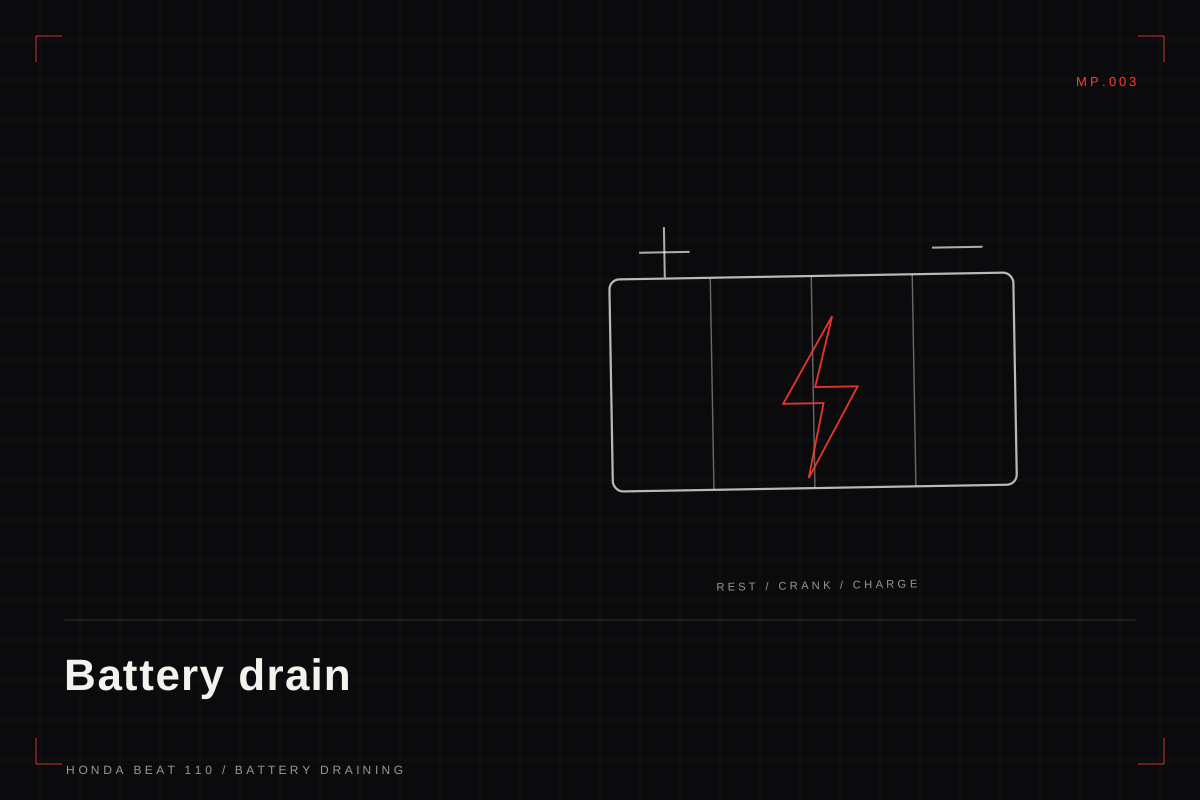
A Honda BeAT battery that goes flat is telling you one of three things: the battery has lost capacity, the charging system is not replacing what the scooter uses, or something is drawing current while the key is off. A new battery fixes only the first.
Before you start
Battery acid is corrosive and a charging battery can release hydrogen. Wear eye protection, keep sparks and flames away, and do not short the terminals with a tool. A swollen or leaking battery should be removed by a workshop and recycled properly.
Machine file Honda BeAT 110
- Engine
- Air-cooled SOHC single
- Cooling
- Air
- Fuel
- PGM-FI
- Transmission
- CVT
- Final drive
- V-belt
What draining means on a small scooter
The BeAT has a small battery relative to a car, and it cranks a high-compression single through an ACG starter. That takes a short, heavy current. A battery that still lights the panel can be too weak to crank, especially when cold.
Short trips are the other half of the story. A scooter used for two-kilometre journeys may never run long enough to replace the energy used by starting, the lights and the ECU. The battery slowly loses ground until one morning it will not crank.
Reading the test result
| Observation | What it suggests | Next step |
|---|---|---|
| Rest voltage low, rises after charge | Age or short trips | Charge and retest capacity |
| Crank voltage collapses | Battery capacity or connection | Load test and clean terminals |
| Charging voltage does not rise | Stator, regulator or wiring | Workshop charging test |
| Drain remains after sleep | Accessory or wiring | Isolate accessories one by one |
| New battery flat in days | Charging or drain | Stop replacing, test the circuit |
Test rest, crank and charge
Measure the battery at rest with everything off. A healthy lead-acid battery should sit near 12.6 volts after it has settled, but the exact figure depends on the battery type. What matters is the pattern: a rest voltage that falls quickly, a crank voltage that collapses, or a charging voltage that does not rise.
Then measure while cranking and again with the engine running at a fast idle. If the charging voltage does not rise above the rest voltage, the stator, regulator or their connectors are suspect. If it rises but the battery still goes flat, test for a drain with the key off.
Finding a parasitic drain
A drain test needs a meter that can read small currents and a way to keep the circuit alive while you measure. Disconnect the negative terminal, connect the meter in series and wait for the ECU and any accessories to go to sleep. A reading that stays high after that wait is a real drain.
Common additions are the first suspects: a USB charger wired to a permanent live, an alarm, a GPS tracker or a phone mount with a built-in converter. Disconnect them one at a time and watch the reading. Do not pull fuses at random while the meter is connected; some modules wake when power is interrupted.
Charging system checks
The stator produces alternating current, the regulator rectifier turns it into direct current and the battery stores it. A failed regulator can overcharge and cook the battery, or undercharge and leave it flat. A burnt connector between the stator and the regulator can do the same without any warning light.
Inspect the stator connector for heat marks, check the earth strap and measure the charging voltage at the battery, not at the dashboard. If the voltage is low or unstable, the workshop should test the stator output and the regulator before replacing either.
Storage, short trips and accessories
If the scooter is parked for weeks, use a charger designed for motorcycle batteries rather than repeated jump starts. A lead-acid battery left discharged sulphates and loses capacity permanently. A lithium battery has different storage rules and needs a compatible charger.
For a daily commuter, the fix may be a longer weekly run rather than a new part. Combine errands into one trip, switch off accessories you are not using and check that the USB charger is not live with the key off.
When replacement is the honest answer
A battery that is old, swollen, leaking or unable to hold a charge after a correct recharge should be replaced. Match the case size, terminal position and capacity to the model. A larger battery that does not fit the hold-down is a safety risk, not an upgrade.
If a new battery goes flat within a week, stop replacing batteries. The fault is in the charging system or the drain, and the new battery is being damaged by the same cause.
Keeping it from coming back
Work out what the scooter does between rides: a tracker, a USB socket or an alarm left on a permanent live will flatten a small battery in days. Use a smart maintenance charger during long parks, keep the battery tray dry, and check the charging voltage after any electrical accessory is fitted. A battery that has been flat twice is usually finished.
A short checklist
- Measure the battery at rest, during crank and with the engine running.
- Clean and tighten both terminals and the earth strap.
- List every accessory wired to a permanent live.
- Test the charging voltage at the battery, not the dashboard.
- Use a motorcycle-specific charger for storage.
- Replace the battery only after the charging and drain tests.
Questions owners ask
How long should a BeAT battery last?
Battery life depends on climate, charging behaviour, storage and the number of short trips. It is not a fixed number. A battery that fails a correct recharge and load test needs replacement regardless of age.
Can a USB charger drain the battery?
Yes, if it is wired to a permanent live and has a standby current. Some chargers also have a small indicator that stays on. Disconnect it and repeat the drain test to see whether the reading falls.
Why does the BeAT start after a jump but not the next morning?
The jump proves the starter and ignition can work with enough voltage. It does not charge the battery. A flat battery the next morning points to a worn battery, a charging fault or a drain that continues while the scooter is parked.