A Honda BeAT that feels slow usually has a problem on one side of the drivetrain: the engine is not making its usual power, or the CVT is not converting that power into wheel speed. The symptom feels the same from the seat, which is why owners replace the wrong part.
Before you start
Do not test acceleration in traffic or on a wet road. A dragging brake or a damaged tyre is a safety fault, not a performance inconvenience. If the scooter pulls to one side or the wheel is hot after a short ride, stop and inspect the brake system.
Machine file Honda BeAT 110
- Engine
- Air-cooled SOHC single
- Cooling
- Air
- Fuel
- PGM-FI
- Transmission
- CVT
- Final drive
- V-belt
Ride it as a test, not a commute
Find a quiet, straight road and accelerate from a standstill at a steady throttle. Note the engine speed, the speed at which the scooter starts to pull and whether the engine sounds busy without the scooter accelerating. That last combination is the signature of a slipping or mis-ratioed CVT.
Then ride at a constant speed and open the throttle. If the engine picks up cleanly but the scooter does not, the drive is suspect. If the engine hesitates, misfires or feels flat, the engine and fuel system are suspect.
Engine or drive? Read the tachometer
| What you feel | Engine speed | Likely side |
|---|---|---|
| Slow to reach speed, engine sounds busy | High for the road speed | CVT slip or ratio |
| Hesitates, misfires, flat | Does not rise cleanly | Fuel, air, spark |
| Pulls well cold, weak hot | Normal when cool | Cooling or oil |
| Slow only with a passenger | Normal solo | Load or clutch slip |
| Vibration and drag | Normal | Brake, tyre or bearing |
Air, fuel and spark on the eSP single
A clogged air filter is the simplest restriction. A dirty injector, a tired fuel pump or low fuel pressure can lean the engine and cost power. A spark plug that is worn or the wrong heat range can cause a misfire that the rider feels as slowness rather than a clear cut.
The BeAT's air-cooled engine also loses power when it is hot. If the loss is worse in traffic and improves on an open road, check the cooling path and the oil level before the fuel system. A tight valve clearance can cause hard starting and a loss of compression.
The CVT changes the gear ratio, not just the belt
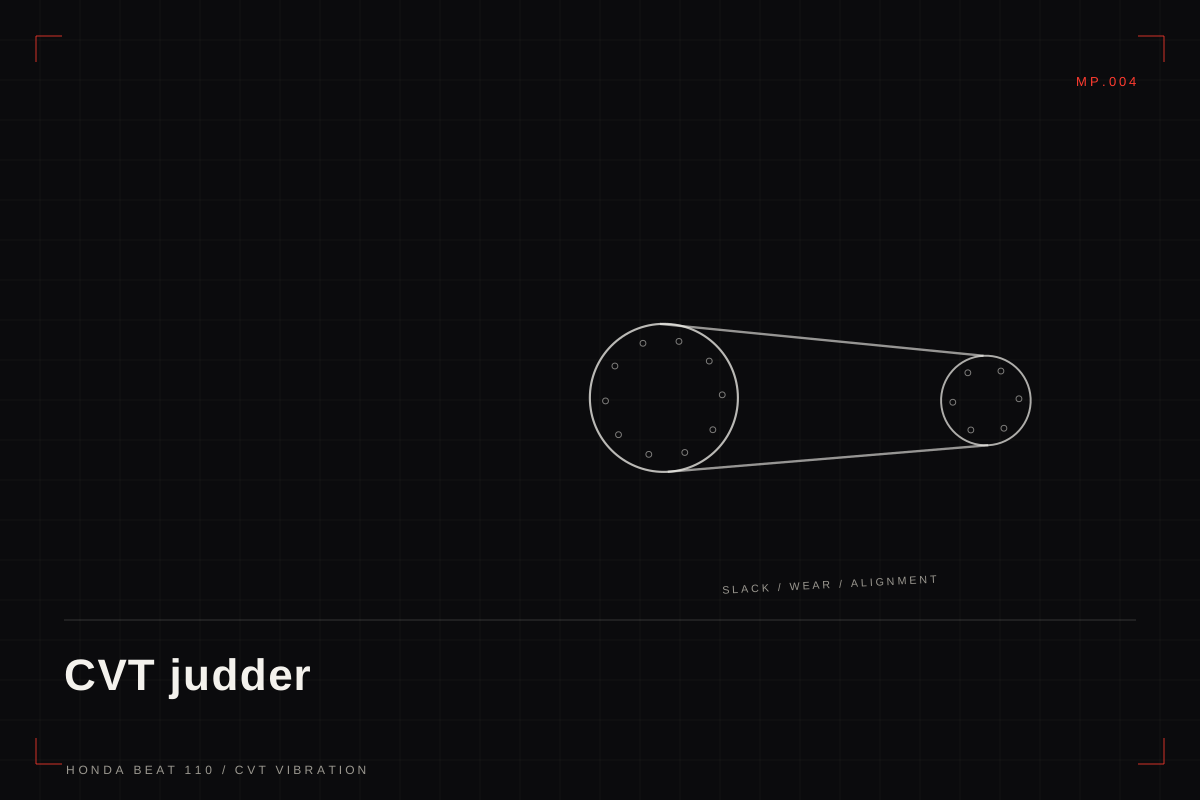
The variator and rollers decide how quickly the engine speed rises for a given road speed. Flat rollers, worn sliders or a belt that has lost width make the scooter rev higher without going faster. A glazed clutch can slip under load, especially with a passenger.
A CVT that has been tuned with much lighter rollers will also feel different: the engine revs higher and the top speed may drop. If the scooter was modified before you bought it, compare the roller weights and belt width with the standard specification rather than assuming a fault.
Brakes, tyres and rolling resistance
A brake that drags can hold the scooter back without making a noise. After a ride, compare the temperature of the front and rear discs or drums carefully. A wheel that is hot on one side suggests a sticking caliper, a misadjusted drum or a collapsed hose.
Low tyre pressure increases rolling resistance and makes the scooter feel sluggish. Check pressures cold and use the figures in the owner's manual or on the tyre information plate. A worn or square tyre also changes the way the scooter turns and accelerates.
Load, heat and expectations
A BeAT with a passenger, a top box and a headwind will not accelerate like a solo scooter. The 110-class engine is tuned for economy and low-speed control, not for sustained high speed. If the complaint appeared after a change in use, the machine may be behaving normally.
Heat, altitude and fuel quality also change performance. A loss that appears only on a hot afternoon or on a long climb is different from a loss that is present from the first kilometre. Describe the conditions when you book the inspection.
The repair order that avoids waste
Start with the cheap, reversible checks: tyre pressure, air filter, spark plug and brake drag. Then measure the CVT wear. Only after those are known should the workshop test fuel pressure, compression and the throttle body.
If the scooter is standard and well maintained, a sudden loss is more likely to be a specific fault than a worn-out engine. If it is modified, compare the build with the standard parts before diagnosing a failure.
Keeping it from coming back
Start with the things that change slowly: tyre pressures checked cold, brakes that release fully, and an air filter that is not restricted. On a CVT scooter, belt width and roller condition decide more of the acceleration than most owners expect, so have them measured rather than replaced on suspicion. Use the grade of engine oil listed in the manual.
A short checklist
- Check tyre pressures cold and inspect for uneven wear.
- Feel for brake drag after a short ride.
- Inspect or replace the air filter and spark plug.
- Measure CVT belt width, rollers and slider condition.
- Check the oil level and the cooling path on the air-cooled engine.
- Book a fuel-pressure and compression test if the engine is flat.
Questions owners ask
Why does my BeAT rev but not accelerate?
That pattern points to the CVT. A worn belt, flat rollers, worn sliders or a slipping clutch let the engine speed rise without transferring the same speed to the wheel. Inspect the CVT as a set before replacing the belt alone.
Can a dirty air filter cause poor acceleration?
Yes. A restricted intake richens the mixture and reduces airflow, which costs power. On a fuel-injected engine the ECU can compensate within a range, but a heavily clogged filter is outside that range.
Is a BeAT supposed to be slow uphill?
The 110-class engine is tuned for economy and low-speed control, so a long climb with a passenger will require more throttle and may feel slow. A sudden change from its normal behaviour is the thing to investigate.