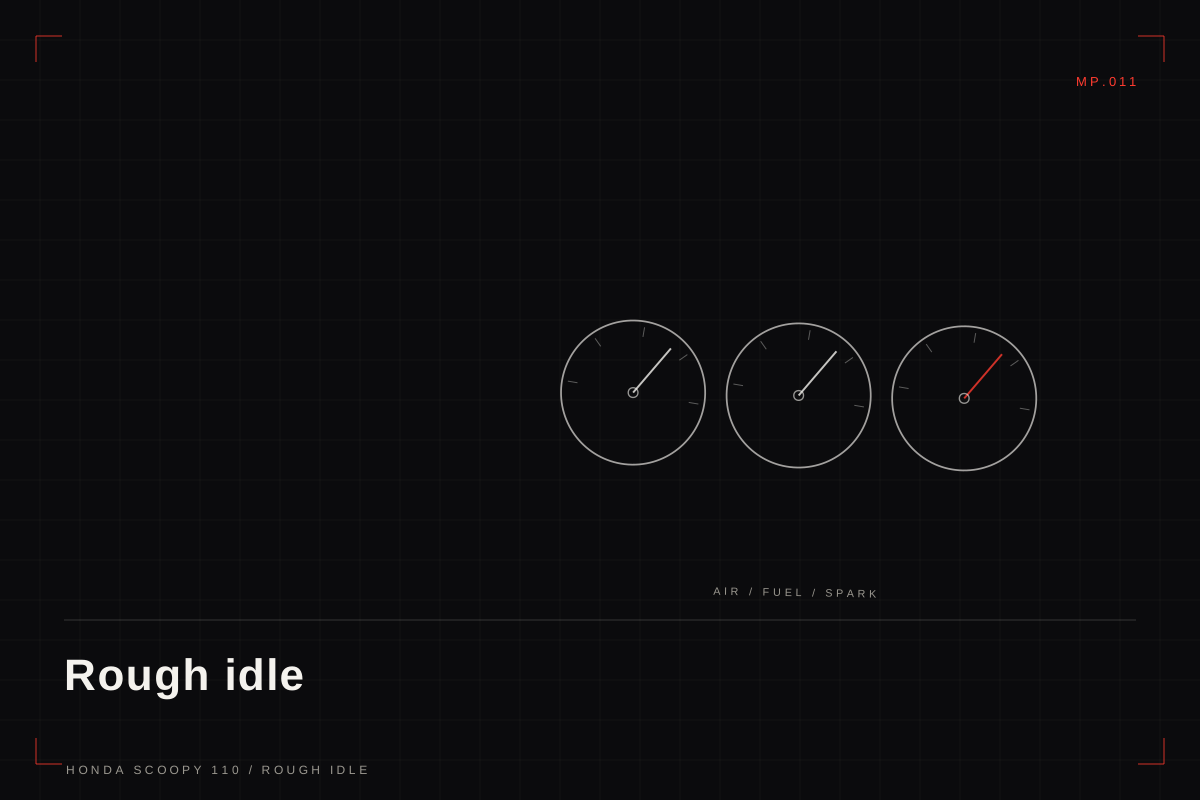
A Honda Scoopy with a rough idle is usually fighting one of four things: too little air, a weak spark, incorrect valve clearance or a mount that transmits vibration. The fuel system is on the list, but it is not the first item.
Before you start
Petrol vapour and ignition sources are a fire risk. Do not spray cleaner around a hot engine or an exposed spark. A scooter that idles roughly and smells of fuel should be switched off and inspected, not revved to clear it.
Machine file Honda Scoopy 110
- Engine
- Air-cooled SOHC single
- Cooling
- Air
- Fuel
- PGM-FI
- Transmission
- CVT
- Final drive
- V-belt
Describe the rough idle precisely
Does the engine hunt up and down, sit too low and shake, or idle evenly but vibrate the handlebars? A hunting idle points to the air-fuel mixture or the idle control. A low, lumpy idle points to a restriction or a cylinder that is not sealing. A steady idle with vibration points to mounts or bodywork.
Note whether the symptom is worse cold, hot or after a short stop. A Scoopy that idles badly only when cold may have a temperature-sensor or enrichment issue. One that idles badly only when hot may have an intake leak or a valve that is tight.
Idle symptom and first check
| Symptom | First check | Likely area |
|---|---|---|
| Hunts up and down | Intake boot and filter | Unmetered air |
| Low and lumpy when cold | Spark plug and valve clearance | Ignition or sealing |
| Rough only after rain | Plug cap and connectors | Moisture |
| Steady idle, handlebars buzz | Mounts and panels | Vibration |
| Rich smell, black plug | Injector and air filter | Mixture |
Air filter and intake path
The air filter is the first restriction to check. A clogged element makes the mixture rich, and the idle becomes slow and uneven. Remove the element, inspect it against a light and replace it if it is dirty or deformed. Do not run without it; the engine will ingest dust.
Look at the intake boot between the throttle body and the cylinder head. A crack or a loose clamp lets unmetered air in, which leans the mixture at idle and makes the engine hunt. Spraying a small amount of a suitable cleaner around the boot while the engine idles can reveal a leak, but do this only with the engine cold and away from ignition sources.
Spark plug and ignition
A worn plug, the wrong heat range or an incorrect gap can make the idle rough without causing a complete misfire. Remove the plug, read the electrode and compare the part number with the specification for your Scoopy variant. A black, sooty plug suggests a rich mixture; a white, blistered plug suggests overheating or a lean mixture.
Check the plug cap for cracks and the high-tension lead for chafing. Moisture in the cap causes a rough idle after rain that clears once the engine warms. Do not test for spark by holding the plug against the engine with a bare hand.
Valve clearance and compression
A tight valve clearance can hold a valve slightly open, which makes the idle rough and the cold start difficult. On a small single, the clearance is checked with the engine cold and a feeler gauge. That is a workshop job for most owners because access and torque values matter.
If the idle is rough and the engine also feels down on power, ask for a compression test. A burnt valve or a worn piston ring changes the idle more than a sensor does. The compression result tells you whether further fuel-system work is worthwhile.
Mounts, bodywork and vibration
A Scoopy has a small engine that moves under load. Worn engine mounts, a loose exhaust heat shield or a body panel that has lost a clip can make the handlebars buzz at idle. Hold the scooter still and listen; a rattle that stops when you press a panel is bodywork, not combustion.
Check the mount bolts and the exhaust hangers before adjusting the idle. A vibration that appears only at a certain engine speed is often a resonance rather than a misfire. Do not raise the idle speed to hide it; that masks the symptom and increases fuel use.
Fuel system and the idle control
A dirty injector, low fuel pressure or a faulty idle-air control can make the idle rough. Those faults usually come with hard starting or a rich smell. A diagnostic scan can show the idle control command and the fuel trim, which is more useful than replacing sensors one by one.
If the scooter has been stored, stale fuel and a varnished injector are plausible. Have the injector cleaned and the fuel pressure measured. Do not add a fuel additive to a modern fuel-injected scooter without checking that it is suitable for the system.
Keeping it from coming back
Rough idle on a small single usually starts with intake air. Replace the air filter at the specified interval, keep the throttle body and idle passage clean, and use the plug type listed in the manual. Avoid short, repeated cold starts that leave condensation in the engine and exhaust, and have the valve clearance checked when the rough idle comes with hard starting.
A short checklist
- Note whether the idle is rough cold, hot or all the time.
- Inspect and replace the air filter if restricted.
- Check the intake boot for cracks and loose clamps.
- Read the spark plug colour and confirm the correct type.
- Check engine mounts, exhaust hangers and panel clips.
- Book a valve-clearance and compression check if the idle stays rough.
Questions owners ask
Why does my Scoopy idle rough only when cold?
A cold engine needs extra fuel and a slightly higher idle. A dirty idle-air passage, a weak battery or a temperature-sensor fault can upset that. If the roughness clears as the engine warms, the cold-start enrichment path is the place to look.
Can a dirty air filter make the idle rough?
Yes. A restricted filter richens the mixture and can make the idle slow and uneven. The filter is cheap to inspect and replace, which is why it comes before the fuel system.
Should I turn up the idle to stop the shaking?
No. Raising the idle hides the symptom and increases fuel consumption and CVT creep. Find the cause: air, spark, valve clearance, mount or mixture.