A Honda Scoopy that will not start usually has a flat battery, a brake or side-stand interlock fault, or a fuel-pump problem. The retro bodywork makes access slower, so the first checks should be the ones that need no tools.
Before you start
Fuel and battery work carries fire and acid risks. Do not test for spark near the tank or an open injector. Wear eye protection when working near a lead-acid battery, and disconnect the negative terminal before removing panels that contain wiring.
Machine file Honda Scoopy 110
- Engine
- Air-cooled SOHC single
- Cooling
- Air
- Fuel
- PGM-FI
- Transmission
- CVT
- Final drive
- V-belt
What is different about the Scoopy
Under the styling, the Scoopy uses the same air-cooled 110-class eSP layout as the BeAT: fuel injection, an ACG starter and a CVT. The difference for diagnosis is access. The battery and fuses sit behind panels that are easy to crack if they are levered in the wrong place.
Some Scoopy variants have an idle-stop system. That system can make a healthy scooter feel as if it has stalled at a junction because the engine stops by design. It should restart instantly when the throttle is opened. If it does not, the fault may be in the idle-stop logic rather than the engine.
Scoopy no-start: first test
| Symptom | First check | Likely area |
|---|---|---|
| Panel dim, slow crank | Battery and terminals | Battery or earth |
| Bright panel, no crank | Brake light and stand switch | Interlock |
| Crank strong, no fire | Pump prime, plug, fuel | Fuel or ignition |
| Starts then stops at idle | Idle-stop system | Idle-stop logic |
| Click only | Relay and start circuit | Start circuit |
The no-tool checks
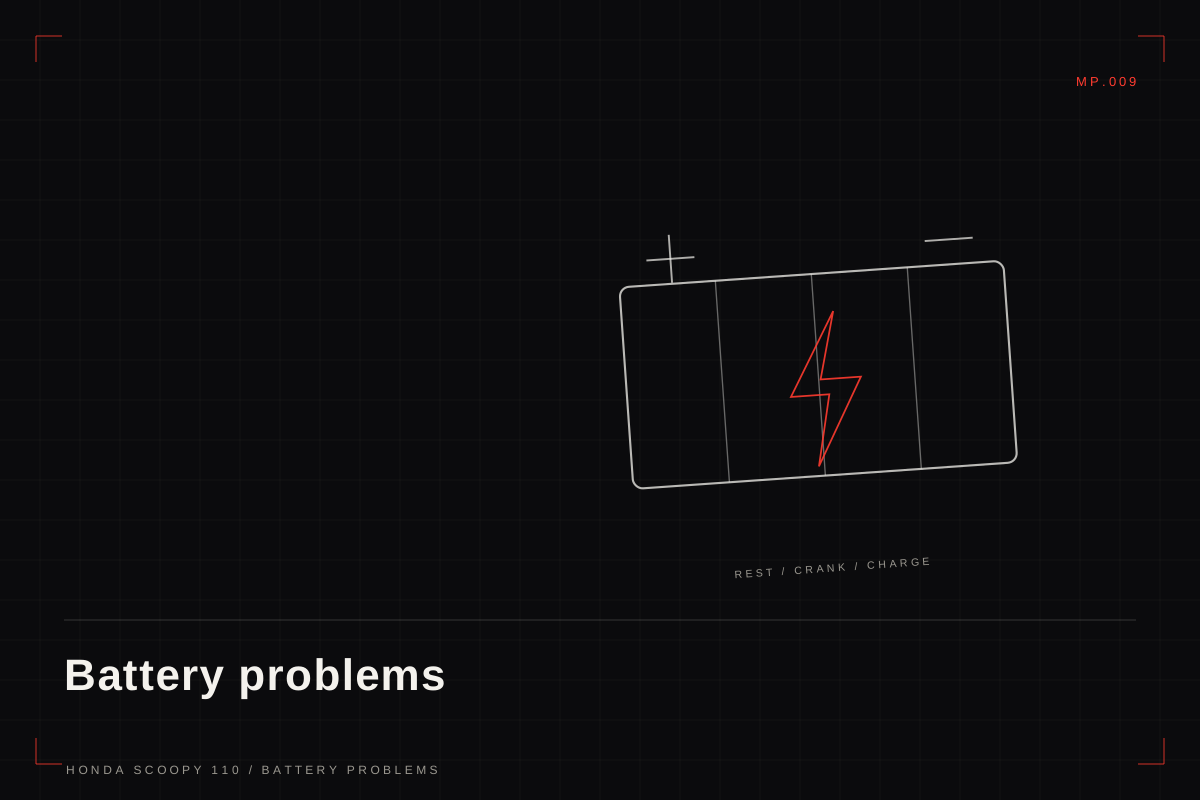
Switch on the key and watch the panel. Dim or flickering lights suggest a weak battery. Listen for the fuel pump prime. Hold each brake lever in turn and watch the brake light; a dead brake-light switch can prevent the start signal even though the bulb is fine.
Check the side stand. A stand that is down, or a switch that thinks it is down, will prevent starting on the safety interlock. Move the stand through its full travel and look for a loose spring or a damaged plunger.
Cranks but does not fire
If the engine turns over strongly but does not catch, the battery is probably not the problem. Check the fuel level, the fuel freshness and the spark plug. A Scoopy that has been stored for months may have stale fuel and a plugged injector.
A wet plug after cranking suggests fuel is present. A dry plug suggests the injector is not delivering. Do not remove the injector and crank the engine to watch the spray; pressurised fuel can spray into the face and ignite.
No crank at all
Check the battery terminals, the main fuse and the earth connection. Corrosion under a tightened terminal is common on a scooter used in rain. Remove the bolt, clean the contact surfaces and reassemble with a light film of protective grease.
If the battery is healthy and the brake light works, the start button, relay or the ACG circuit needs testing. That is a workshop job because it needs a meter and access to the relay. Do not bridge terminals with a screwdriver to see whether it starts.
Jump-starting and the idle-stop system
A Scoopy can be jump-started from a 12-volt battery with the correct polarity, but the same cautions apply as any motorcycle: no sparks near the battery, connect the negative lead to a solid earth, and remove the leads in reverse order. A swollen or leaking battery should not be jumped.
If the scooter has idle stop, check that the system is not switched off or inhibited by a low battery. Some systems disable idle stop when the battery is weak. A scooter that starts normally but refuses to idle-stop is not necessarily faulty; read the owner's manual for the conditions.
When to stop and call a workshop
Stop if you smell fuel, see smoke or find a swollen battery. Stop if the starter turns slowly and the battery is new; that points to a connection or a starter fault that can overheat. Stop if the scooter has been flooded, because water in the electrical connectors can cause faults that move from one circuit to another.
A workshop will test the battery under load, the charging voltage, the start circuit and the fuel pressure. Those tests are quicker than removing panels twice.
Keeping it from coming back
The Scoopy's small battery and idle-stop system reward a little attention. If the scooter has idle stop, make sure the battery is healthy before blaming the system, and switch idle stop off when the battery is weak or the bike is stored. Keep the key fob battery fresh on smart-key variants, and charge rather than crank when the starter sounds slow.
A short checklist
- Check the key, the kill switch and the side stand.
- Listen for the fuel pump and watch the panel brightness.
- Test both brake lights and the start button.
- Clean and tighten the battery terminals and earth.
- Inspect the spark plug and the air filter.
- Use the correct jump-start procedure or call for recovery.
Questions owners ask
Why does my Scoopy not start after rain?
Water can enter the spark-plug cap, a connector or the start switch. Dry the area and inspect the cap for cracks. Do not spray water into the electrics to clean it. If the fault repeats, a workshop should check the connectors and the earth points.
Does the Scoopy have a kick starter?
It depends on the variant and model year. Check the owner's manual for your scooter. A kick starter can help with a low battery but will not overcome a fuel or interlock fault.
Can the idle-stop system stop the engine at a traffic light?
Yes, that is what it is designed to do. The engine should restart when you open the throttle. If it does not restart immediately, switch the system off if the variant allows and have the battery and idle-stop circuit checked.