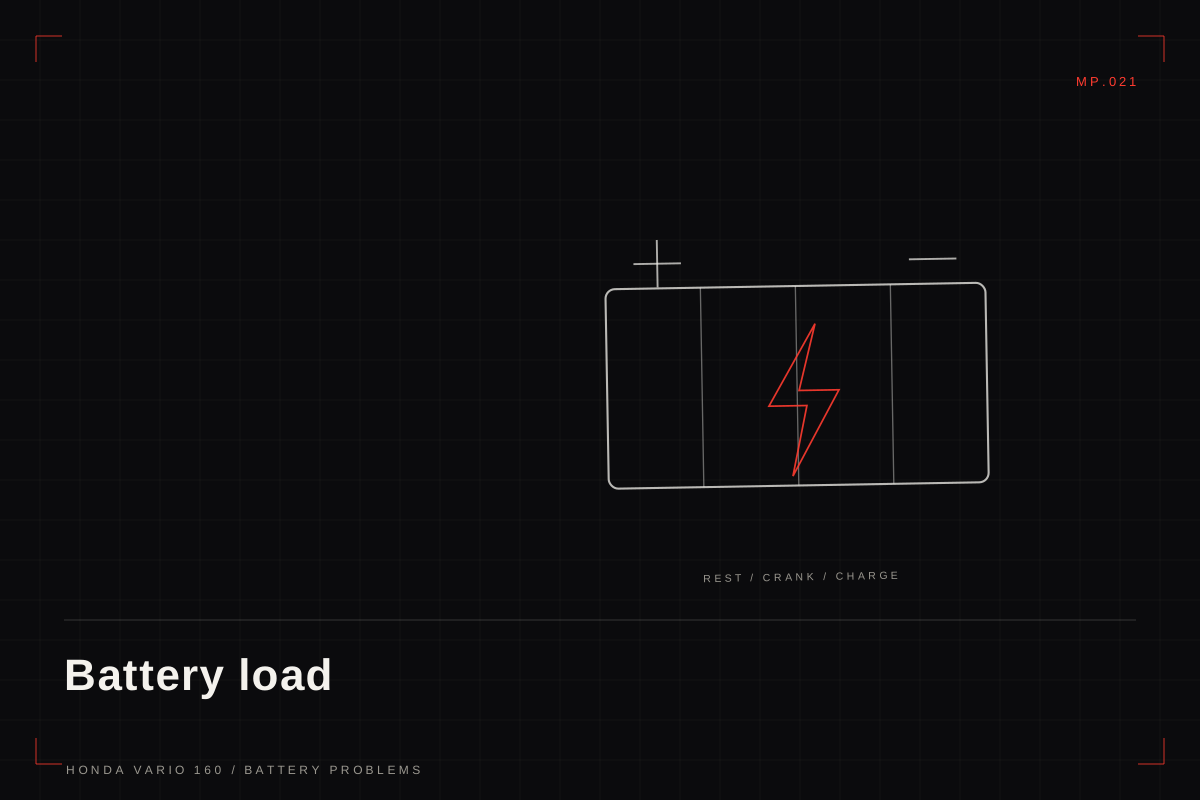
A Honda Vario 160 with a battery problem usually complains in one of three ways: a slow crank, a flat battery after parking, or a battery that never seems to recover. The 160's electrical load makes each pattern worth testing rather than guessing.
Before you start
Battery acid is corrosive and a charging battery can release hydrogen. Wear eye protection, keep sparks away and never short the terminals with a tool. A swollen battery should be removed by a workshop and recycled, not opened.
Machine file Honda Vario 160
- Engine
- Liquid-cooled four-valve SOHC single
- Cooling
- Liquid
- Fuel
- PGM-FI
- Transmission
- CVT
- Final drive
- V-belt
Two features that change the load
If your Vario 160 has idle stop, the engine restarts many times in traffic. Each restart takes a burst of current, and the battery must recover between stops. A battery that is merely adequate for a conventional scooter can look weak here.
A keyless system keeps a receiver listening when the ignition is off. That standby load is small but continuous. Add a USB charger, an alarm or a tracker and the total can exceed what a short daily commute replaces.
Symptom and the test that separates it
| Symptom | Test | What it means |
|---|---|---|
| Slow crank when cold | Load test | Capacity or connection |
| Flat after two days parked | Standby current | Drain or keyless load |
| Flat after short trips | Charging voltage | Charge balance |
| Idle stop disables itself | Battery condition | Low capacity |
| Voltage climbs too high | Charging at revs | Regulator fault |
Capacity before chemistry
The battery must match the case size, terminal layout and capacity specified for the model. A battery with the right voltage but less capacity will crank more slowly and may not tolerate idle stop. A physically larger battery that does not sit in the hold-down is a safety risk.
A battery that has been on a shelf for months may need a full charge before it can be judged. Test it after charging, not straight out of the box. A load test is more informative than a voltage reading alone.
Charging under real conditions
Measure the charging voltage at the battery with the engine running. Then switch on the lights and, if fitted, the heated grips or other accessories, and measure again. A charging system that only works with everything off is not healthy.
Look for discolouration at the stator plug and corrosion on the earth strap. A regulator that has failed can leave the battery undercharged or cook it with excess voltage; either way, stop and test before riding.
Standby drain and accessories
A drain test needs the keyless receiver and ECU to settle. Connect a meter in series with the negative terminal, wait, then read the current. Compare it with the expected standby figure rather than assuming any reading is a fault.
Disconnect accessories one at a time. A charger with a permanent live, a camera converter or an alarm siren can each add a small load. A clamp meter around a single wire is a safer way to trace a suspect circuit than pulling fuses at random.
Jump-starting a keyless scooter
A jump start from a 12-volt battery is possible with the correct polarity and a solid earth for the negative lead. Remove the leads in reverse order. Do not jump a swollen, leaking or frozen battery.
After a jump, the keyless system may need a moment to recognise the fob. If the scooter starts but the dash shows a key warning, check the fob battery and the procedure in the manual. Do not keep jumping; charge the battery properly and test the charging system.
Replace only after the tests
A battery that will not hold a charge, has a swollen case or leaks has reached the end of its life. Fit the specified size and terminal layout, and hand the old one to a recycler.
A new battery that goes flat within a week is evidence of an unresolved charging or drain fault. Keep the test readings and the receipt. A warranty claim is easier when the failure is documented.
Keeping it from coming back
Idle stop, a smart key and a small battery all compete for charge on short trips. Check the battery voltage at rest and while cranking, keep the terminals clean, and have the charging system measured if the scooter is used mainly after dark. Fit the specified battery rather than a larger one that the charging system cannot fill.
A short checklist
- Record whether the problem is slow crank, parking flat or repeated jumps.
- Charge the battery fully before testing it.
- Measure charging voltage with and without accessories.
- Check the stator connector and earth strap.
- Measure standby current after the systems settle.
- Match the replacement to the specified capacity and fitment.
Questions owners ask
Does idle stop wear out the battery faster?
Idle stop adds restart cycles, so the battery works harder in traffic. A healthy battery and charging system are designed for it. If idle stop keeps disabling itself, have the battery and charging voltage tested.
Why does my Vario 160 battery go flat when the key is off?
A keyless receiver draws a small standby current, which is normal. A flat battery after a short park points to a weak battery or an extra accessory. Measure the standby current before replacing anything.
Can I fit a bigger battery to support accessories?
Only within the space and charging capacity the scooter was designed for. A larger battery does not fix a charging fault and can be damaged by the same undercharge. Reduce the load or upgrade the charging system properly.