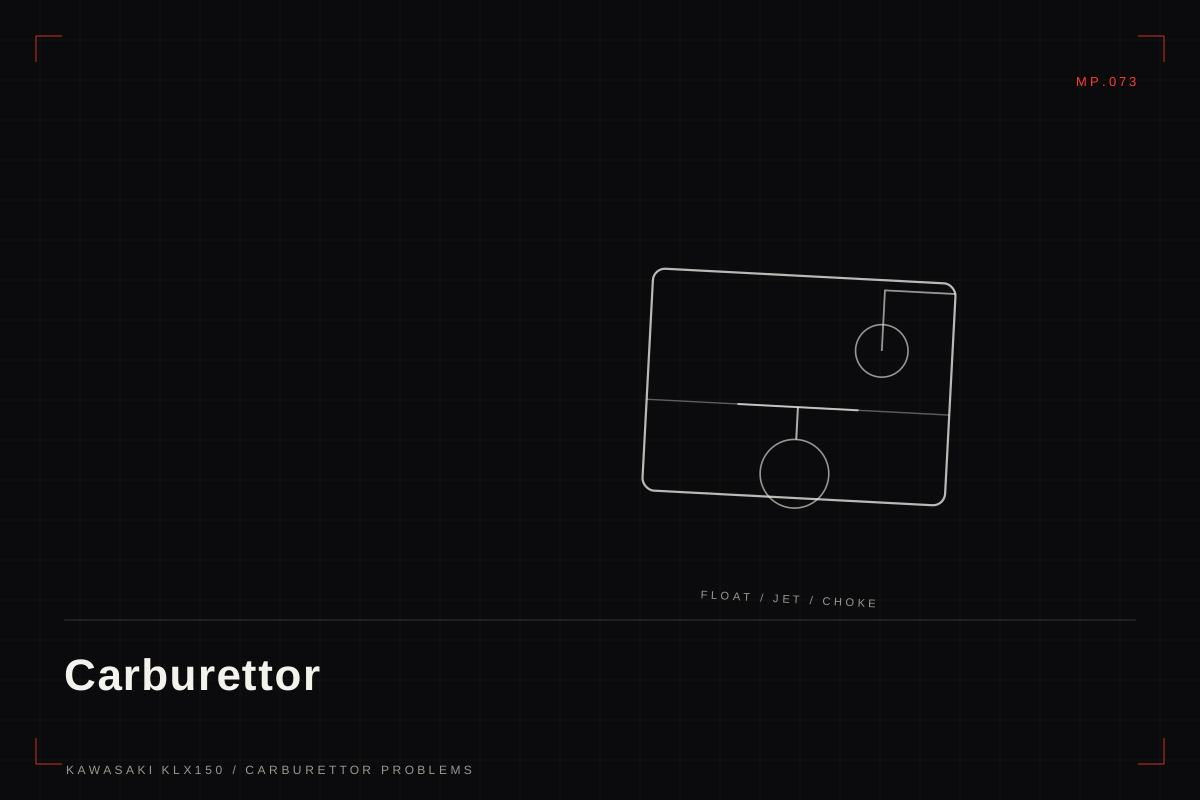
A Kawasaki KLX150 with carburettor problems is usually breathing dirt or holding water. The 144cc air-cooled single is simple and tolerant, which means most running complaints trace back to filtration, float level or a pilot jet rather than to the main jet.
Before you start
Petrol vapour ignites readily and a carburettor bowl holds fuel even with the tap off. Work outdoors, drain into a proper container and keep flames away. Never use petrol as a cleaning solvent.
Machine file Kawasaki KLX150
- Engine
- Air-cooled SOHC single
- Cooling
- Air
- Fuel
- Carburettor
- Transmission
- Five-speed manual
- Final drive
- Chain
Read the plug before the jets
A sooty black plug points rich, a white or blistered plug points lean, and a plug that is wet without smelling of petrol suggests water. Read it after a normal ride rather than after idling in the yard.
On a dirt bike the plug is also a dust indicator. Grit around the insulator or in the cap recess means the engine has been breathing dirty air, and the carburettor is probably dirty too.
Symptom and carburettor cause
| Symptom | Mixture | Likely cause |
|---|---|---|
| Black sooty plug | Rich | Float level, filter, choke |
| White plug, hot running | Lean | Blocked jet, air leak |
| Starts then dies | Water or rich | Bowl drain, choke |
| Flat just off idle | Lean | Pilot jet or screw |
| Floods on a slope | Rich | Float level, needle seat |
| Throttle will not return | Safety fault | Slide or cable |
The air filter seal matters more than the element
A clean filter that does not seal against the air box passes dust around its edges. That dust reaches the slide, the needle and the pilot jet, and it also wears the cylinder and rings.
Check the filter cage, the sealing lip and the box for cracks. Oil the foam evenly and squeeze out the excess; a dripping filter restricts air and a dry one passes dust. Replace a filter that has lost its shape.
Water in the float bowl
Water enters through a fuel cap that does not seal, a tank breather that swallows spray, or a crossing deep enough to flood the air box. It collects at the bottom of the bowl and starves the pilot jet first.
Drain the bowl into a glass and let it settle. Water forms a distinct layer. If water keeps reappearing, the cap seal or the tank breather is the source, and no amount of carburettor cleaning will fix it.
Float level and the needle valve
The float level sets the fuel height for every circuit. A level that is too high richens the mixture and can flood the engine on a slope; one that is too low leans it and causes a hesitation when you pick up the throttle.
The needle and seat wear with grit, and a worn seat overfills the bowl. Both are set and checked with the carburettor off the bike, to the specification in the manual. Bending the tang by eye is how a small fault becomes a large one.
Jetting, altitude and modifications
Riding at altitude or in very hot weather leans the mixture, and a bike jetted for sea level can feel flat or surge. The correction is a jetting change, but only after the filter, float level and air leaks are known to be sound.
An aftermarket exhaust or an opened air box changes the mixture too. Do not compensate with a bigger main jet on a guess. A workshop with gas analysis or a dyno sets jetting from measurement, and it keeps the original parts for resale.
Cleaning without damage
Carburettor cleaner and compressed air clear varnish and grit from the passages. A wire or a drill bit enlarges a calibrated jet permanently, and no adjustment afterward will restore it.
Replace the bowl gasket if it is hardened, and check the slide for scoring. A slide that does not return freely is a safety fault, because the throttle can hang open on the trail.
Keeping it from coming back
Dust and water are the enemies, and the air filter seal is the first defence. Oil the foam evenly, check the sealing lip and the air box for cracks, and drain the float bowl after wet rides. Use fresh fuel and never clean a jet with wire. A filter that does not seal will undo every carburettor repair.
A short checklist
- Read the spark plug after a normal ride.
- Check the filter seal and the air box for dust.
- Drain the bowl and look for a water layer.
- Inspect the float level and needle valve.
- Check the slide returns freely.
- Record jet sizes before any change.
Questions owners ask
Why does my KLX150 keep getting water in the carburettor?
Usually a fuel cap seal or a tank breather that lets spray in. Draining the bowl treats the symptom; resealing the cap or rerouting the breather fixes the cause.
Does the KLX150 need rejetting for altitude?
A significant altitude change leans the mixture, and a carburetted engine may need a jetting correction. Confirm the filter, float level and air leaks first so you are not jetting around a fault.
Can I clean the pilot jet with a wire?
No. A wire enlarges the calibrated hole and the jet cannot be restored. Use carburettor cleaner and compressed air, and replace the jet if it stays blocked.