Motorcycles arrived in Indonesia as imported machines, became locally assembled in the 1970s, and then dominated the market through small underbones and, later, automatic scooters. The vehicle succeeded because it was affordable, repairable and able to move through traffic and narrow streets that buses could not serve.
Before the boom
Motorcycles existed in Indonesia long before they were common. Early machines were imported and expensive, used by officials, traders and enthusiasts rather than by families. Bicycles, becak and walking did most of the short-distance work.
The turning point was not a single model but a manufacturing decision. Local assembly reduced the price and the import burden, and a dealer and workshop network made spare parts available outside the biggest cities.
The 1970s assembly era
Honda began assembling motorcycles in Indonesia in 1971 through PT Federal Motor, a joint venture with local partners. Yamaha established a local manufacturing presence in the mid-1970s. Suzuki and Kawasaki built their own distribution and production arrangements in the same period.
These companies did not only sell bikes. They trained mechanics, set up dealers, published parts catalogues and financed purchases. The workshop network that still defines Indonesian ownership was built in this era, not online.
The underbone years
The step-through underbone, known locally as the bebek, became the family vehicle. Its semi-automatic transmission made it easier to ride in stop-start traffic, its small wheels and low seat suited short riders, and its bodywork protected clothing from rain and chain oil.
Models in the 100-125 cc class were cheap to run and easy to repair. A generation learned to ride on a family underbone, often before getting a licence, a fact that shaped both the market and the road-safety problem.
The automatic scooter shift
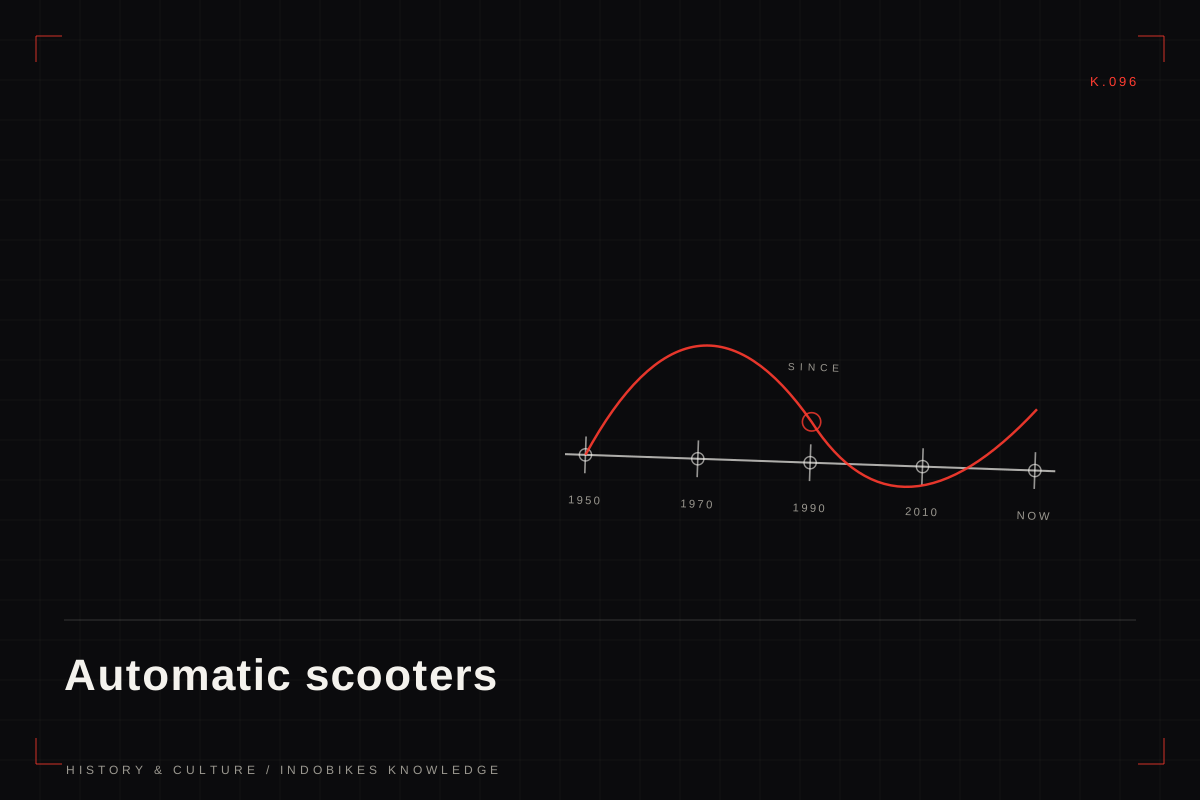
From the 2000s, automatic scooters with continuously variable transmissions took a growing share of the market. They removed the clutch and gear lever entirely, added storage under the seat and appealed to riders who wanted a simple commuter.
The scooter did not replace the underbone overnight. It changed the default for new buyers, especially in cities, and pushed the market toward larger, more expensive models with more electronics. The workshop had to learn CVT belts, variators and fuel injection.
Racing, custom and community
Racing gave the industry a performance story: road racing at Sentul, national championships and, later, international events. Custom workshops gave it a visual language, turning commuter bikes into cafe racers, scramblers and local styles.
Communities organised rides, charity events and model-specific clubs. Some became a social network; others became a consumer market for parts and accessories. Both changed how owners thought about a vehicle that had started as basic transport.
What the numbers can and cannot tell you
Market statistics for Indonesia are widely quoted and often inconsistent. Registration totals, production figures and sales reports measure different things: a produced bike may be exported, a registered bike may be unused, and a sales figure may include fleet purchases. A single number rarely describes how people actually ride.
Treat any specific market share as a snapshot with a date and a source. The categories also blur: an underbone with an automatic clutch, a maxi-scooter and a small sport bike can all be called a commuter. The history is more reliable than the percentages.
What is not in doubt is the scale. Motorcycles carry a large share of daily trips in Indonesian cities and towns, and the aftermarket, repair trade and fuel network reflect that. A policy or a product that ignores this reality tends to fail in practice, whatever the forecast says.
The present
Indonesia is one of the largest motorcycle markets in the world, and the bike remains the most practical way for many households to reach work, school and markets. That success also produces the country's road-safety burden and its traffic congestion.
Electrification is the next chapter. Electric scooters and battery-swap services are growing, but the petrol underbone and scooter will remain the majority for years. The infrastructure of repair, resale and spare parts built around them is not disappearing quickly.
One more consequence is worth naming: the motorcycle became a household asset that could be used to earn. A rider can carry goods, work for a delivery platform or take a passenger. That economic role is why the vehicle survived fuel price shocks and why it is still the first motorised purchase for many families.
Checklist
- Treat dates as historical context, not as current regulation.
- Check current registration and licensing rules with the authorities.
- Use the owner's manual for model-specific service data.
- Support claims about the local market with current data.
- Remember that a widespread practice is not necessarily legal.
Questions
When did Honda start making motorcycles in Indonesia?
Honda began local assembly in 1971 through PT Federal Motor. The corporate structure and model line have changed many times since.
Why are underbones called bebek?
Bebek means duck in Indonesian, a reference to the step-through frame and the riding position. The term became the common name for the whole category.
Are automatic scooters now more popular than underbones?
Automatic scooters have taken the majority of new sales in recent years, but underbones remain common and both categories are still sold. Exact shares change by year and source.