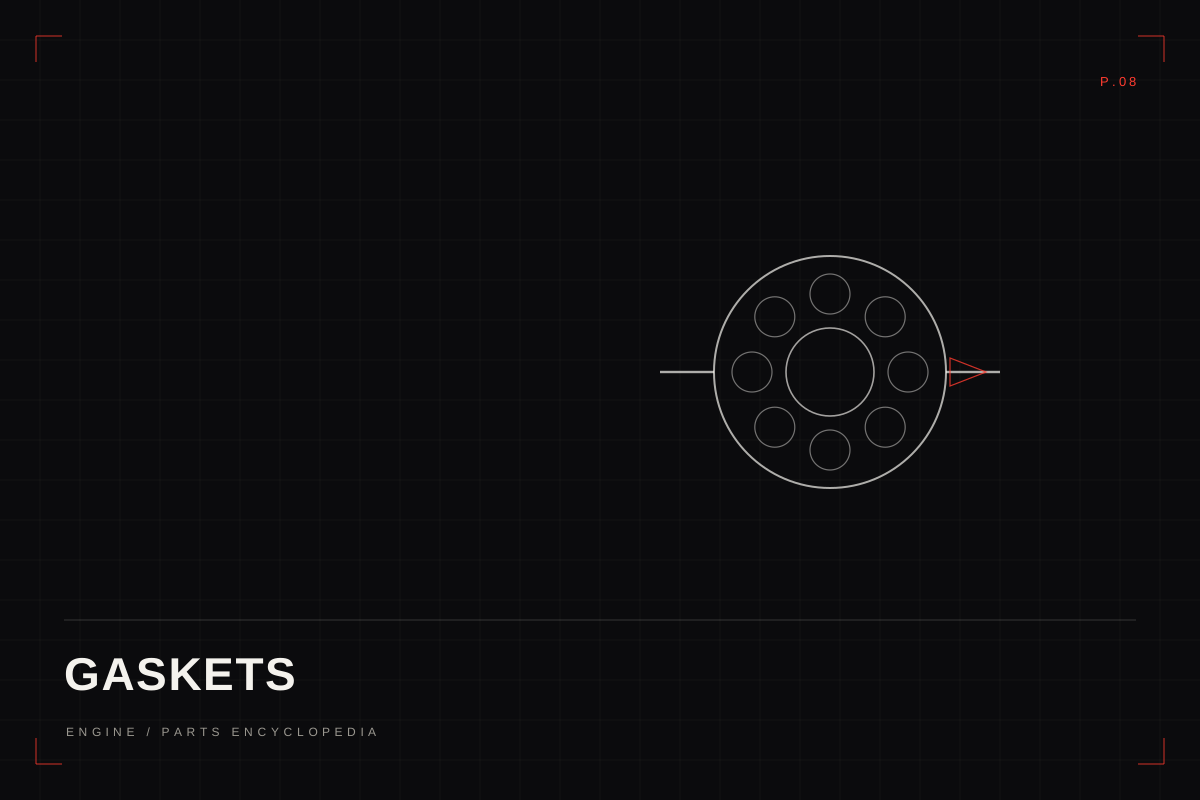
A gasket is a shaped seal that fills the microscopic gap between two surfaces. It has to hold combustion pressure, oil, coolant or air while the engine heats and cools. Most gasket failures are really surface, torque or thickness problems, not a bad gasket.
What it does
Gaskets seal joints between the cylinder and head, crankcase halves, covers, exhaust ports and water pumps. A head gasket has to contain combustion pressure and separate oil and coolant galleries at the same time. A cover gasket only has to keep oil in.
Some gaskets also set a dimension. A head gasket's compressed thickness affects compression ratio and valve clearance. A base gasket affects deck height. Replacing a gasket with a different thickness changes the engine.
How it works
When the fasteners are tightened, the gasket is compressed between the surfaces. It flows into small imperfections and creates a seal. The fastener torque and sequence control how evenly that compression is applied. A gasket cannot compensate for a warped head or a dirty surface.
Multi-layer steel head gaskets use embossed beads and a coating to seal. Composite gaskets use a fibre or graphite material with a binder. Copper gaskets need a specific surface finish and often a sealant. Rubber gaskets rely on elasticity and a clean groove.
Types and variations
- Multi-layer steel (MLS). Common on modern engines. Strong, stable and reusable only if the maker allows it. Surface finish matters.
- Composite fibre. Common on older engines and air-cooled machines. Compresses well and tolerates minor imperfections.
- Copper. Used in high-performance and vintage engines. Needs correct surface finish and often a sealant.
- Rubber and formed seals. Valve cover, crankcase and water-pump seals. Usually reusable if not hardened or torn.
- O-rings and crush washers. Seal small joints, oil lines, fuel lines and drain plugs. Often one-time parts.
Wear and failure signs
- Oil weeping at the joint, especially after a heat cycle.
- Coolant in the oil or oil in the coolant. a failed head gasket or a cracked casting.
- Compression loss or bubbles in the radiator. combustion gas escaping into the cooling system.
- A visible blow-by stain at the head or base gasket.
- Hardened, flattened or torn rubber seals that no longer spring back.
- Leaks that return after retorquing. a warped or damaged surface.
Choosing a replacement
- Use the gasket specified for the engine and the repair. Thickness and material are part of the design.
- Check whether the head gasket is standard or oversize for a rebored cylinder.
- For a high-compression or turbo engine, use the gasket the builder recommends rather than a generic one.
- Replace one-time gaskets and crush washers. Do not reuse an MLS gasket unless the maker says it is reusable.
- Buy a complete set for the job. Missing a small O-ring causes a large leak.
Fit and compatibility
- Clean both surfaces. Remove old gasket material, oil and carbon without gouging the metal.
- Check flatness with a straight edge and feeler gauge. A warped head needs machining.
- Fit the gasket dry or with the specified sealant. Do not add sealant to an MLS gasket that is designed to be fitted dry.
- Tighten in the specified sequence and in stages. Use a calibrated torque wrench.
- Check that oil and coolant passages line up with the gasket holes.
- Let the engine cool and recheck torque if the manual requires it.
Inspection and care
- Find the source of a leak before adding sealant. A stop-leak product can block a radiator or oil passage.
- Keep the cooling system at the correct mixture. Corrosion damages sealing surfaces.
- Do not overheat the engine. Heat warps heads and hardens gaskets.
- Inspect the joint after the first heat cycle following a repair.
- Use new crush washers on drain plugs and banjo bolts.
Safety and limits
A fuel or oil leak onto a hot exhaust is a fire risk. Fix leaks before riding.
A failed head gasket can overheat the engine and contaminate the oil. Stop riding if the temperature climbs or the oil looks milky.
Do not use sealant on fuel system parts unless it is rated for fuel. Loose sealant can block an injector.
Questions
Can I reuse a head gasket?
Only if the manufacturer explicitly says it is reusable and it is undamaged. Most head gaskets are one-time parts. Reusing one risks a leak that costs more than the gasket.
Do I need sealant on a head gasket?
Follow the gasket maker's instruction. MLS gaskets are usually fitted dry. Copper gaskets often need a specific sealant. Adding the wrong sealant can cause a leak.
Why does my new gasket still leak?
The surfaces may be warped, dirty or damaged, the torque sequence may be wrong, or the gasket may be the wrong thickness. A leak after a new gasket is a diagnosis, not a reason to add more sealant.
Does head gasket thickness matter?
Yes. It changes compression ratio and valve clearance. Use the thickness specified for the engine and the work done.