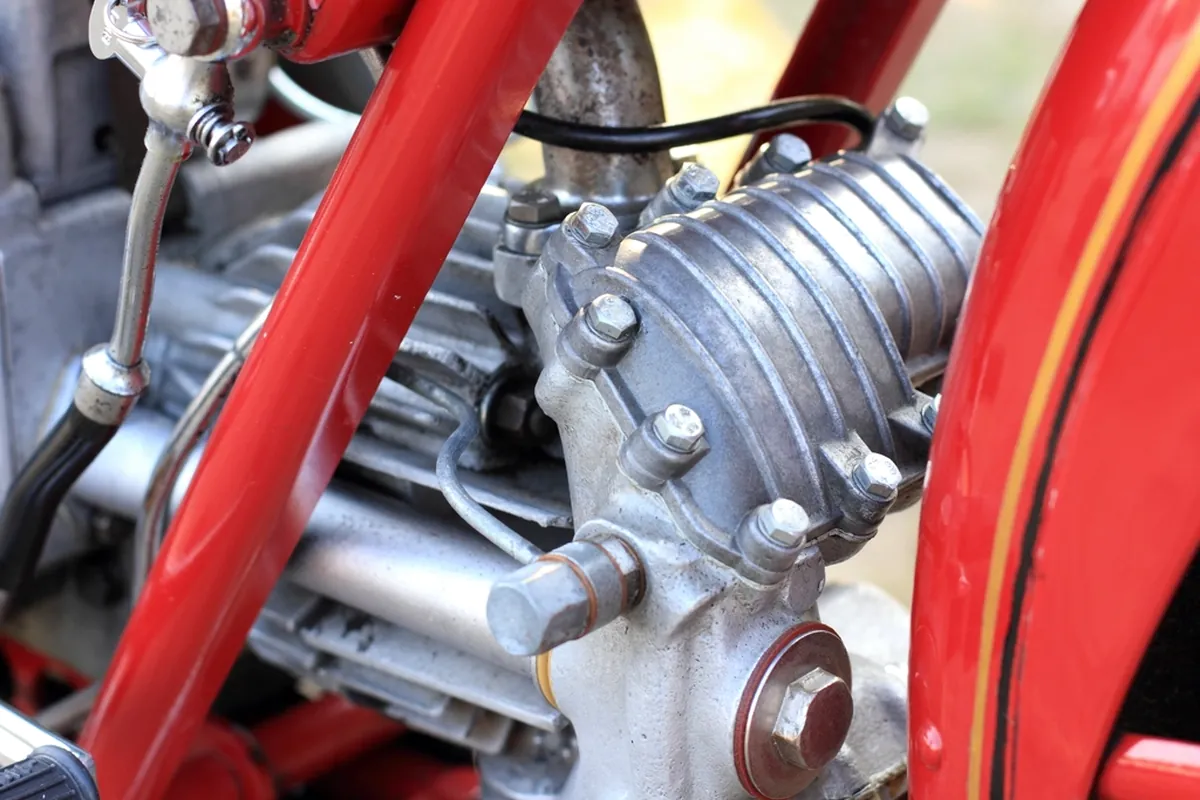
A cylinder looks simple: a tube with a piston in it. In practice it has to stay round and straight while it heats unevenly, hold a hard surface against a moving ring and pass heat into the air or coolant. Boring, honing and plating decisions are what separate a rebuild that lasts from one that smokes in a month.
What it does
The cylinder is the guide and the pressure vessel for the piston. It also forms the upper half of the crankcase seal and provides the surface the rings seal against. In an air-cooled engine the fins are the radiator; in a liquid-cooled engine the jacket and coolant carry heat away.
The bore surface is not smooth in the way glass is smooth. It is honed to a cross-hatch that holds oil and helps rings bed in. Plated bores use a hard coating instead of a cast iron liner. Both need the correct piston clearance and the correct ring face.
How it works
The piston travels up and down inside the bore. Gas pressure above the piston is contained by the head gasket, the piston rings and the cylinder wall. Heat passes from the piston through the rings into the cylinder, then into the fins or coolant.
The bore is measured at several heights and in two directions, front-to-back and side-to-side. A cylinder that is wider at the top than the bottom is tapered; one that is wider in one direction is out of round. Both cause ring flutter, oil use and poor sealing.
Types and variations
- Cast iron liner. Durable, rebuildable and tolerant of minor wear. Common in older and utility engines. It can be rebored and honed.
- Plated aluminium bore. Hard coating on an aluminium cylinder. Light and good heat transfer. It cannot usually be rebored; it is replated or replaced.
- Steel or iron sleeve in an aluminium cylinder. A replaceable liner pressed or cast into the aluminium. Can be rebored within the liner's limits.
- Air-cooled and liquid-cooled. Air-cooled cylinders rely on fins and airflow; liquid-cooled ones use a jacket and coolant. The cooling system changes warm-up and clearances.
- Single and multi-cylinder blocks. Some engines use separate barrels; others use one block with several bores. Machining and deck work differ.
Wear and failure signs
- Vertical scoring from a broken ring, grit or a piston seizure.
- A lip at the top of the bore where the rings stop. A pronounced lip can break new rings during assembly.
- Taper and out-of-round beyond the service limit, causing smoke and poor compression.
- Plating worn through to the aluminium underneath. The bore looks patchy and rings wear quickly.
- Cracks between the bore and a valve seat, or around a stud, often after overheating.
- A warped or pitted deck that will not seal a new head gasket.
Choosing a replacement
- Measure the bore before deciding between honing, reboring and replating. A light hone is only enough if the bore is still straight and within limits.
- Match the piston first, then machine the bore to that piston's clearance. Do not order an oversize piston after boring.
- For a plated cylinder, check whether local replating is available. Otherwise a good used or new cylinder may be the practical route.
- Check the deck for flatness and the stud threads for damage. A cylinder that will not torque down is not a core.
- On a multi-cylinder engine, keep bores matched and use the same piston batch where possible.
Fit and compatibility
- Bore clearance is measured at the skirt height and axis stated by the manufacturer. It is not a single universal number.
- Ring end gap must be checked in the finished bore. If the bore is rebored, the ring gap changes.
- Deck height and head gasket thickness affect compression and valve clearance. Measure after machining.
- Clean the bore with hot soapy water and a white cloth until the cloth stays clean. Honing grit left behind will wear the rings.
- Oil the bore lightly before assembly. Do not use grease that can block ring movement.
Inspection and care
- Keep the cooling system clean. Blocked fins, a failed fan or a stuck thermostat can warp a cylinder.
- Warm the engine before hard use. Pistons and cylinders expand at different rates.
- Change oil and filter on schedule. Dirty oil accelerates bore and ring wear.
- If the engine has overheated, check the deck and bore before reusing the cylinder.
- On a plated bore, avoid abrasive cleaners and do not hone unless the plating maker specifies it.
Safety and limits
A cracked or warped cylinder can leak coolant into the bore or combustion gas into the cooling system. Both can cause overheating and engine damage.
Machining errors can make a cylinder unusable. Use a machine shop that measures the piston and documents the clearance.
Do not run an engine with a known coolant leak or a scored bore. The damage gets more expensive quickly.
Questions
Can a scored cylinder be repaired?
Sometimes. A light score can clean up with a hone if it does not catch a fingernail and the bore stays within limits. Deep scores need a rebore and oversize piston, a new liner or a replacement cylinder.
How do I know if my cylinder is plated or sleeved?
Look at the bore and the top edge. A liner usually has a visible edge or a different colour at the top. A plated bore is a thin, hard coating over aluminium. The manual or a machine shop can confirm.
Is honing always necessary after new rings?
A used bore in good condition usually needs a light hone to restore the cross-hatch. A plated bore may not. Follow the ring and plating maker's instructions.
Can I bore only one cylinder on a multi-cylinder engine?
It is possible, but matched bores and pistons are better for balance and compression. Discuss it with the machine shop.