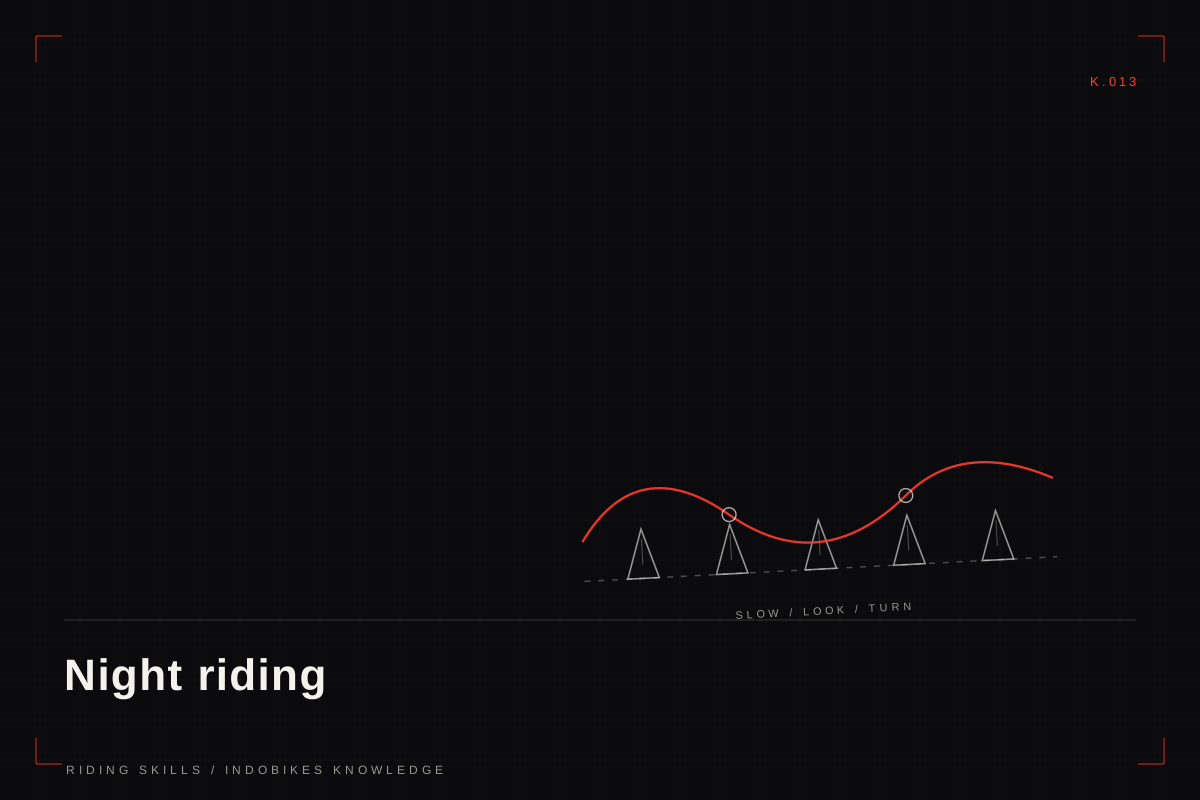
At night your headlight illuminates a limited stretch of road, and everything outside that cone is unknown. The safe speed is the one that lets you stop within the distance you can see, not the speed limit and not the speed you rode in daylight. Reflective gear, a clean visor and a planned route matter as much as the beam.
Your headlight is a cone, not a force field
A motorcycle headlight throws most of its light ahead and slightly down, with a cut-off that protects oncoming drivers. The result is a bright patch close to the bike, a dimmer stretch beyond it and darkness after that. On a straight road the cone reaches further; in a corner it points at the verge until the bike turns.
The cut-off also means that a rise in the road, a crest or a dip can hide an obstacle until it is inside the lit area. Riders who treat the edge of the beam as the edge of the world tend to arrive at hazards with no time to respond. Treat the far edge as the point where your planning should already have happened.
Speed, reaction and the distance you can see
Stopping needs distance for reaction and distance for braking. At night both are affected: the hazard is detected later because it is unlit, and the surface may be wet or uneven. If you can only see thirty metres, then thirty metres is your total budget, and the speed must leave room for the thinking part inside it.
This is why night riding feels faster than it is. With less visual information, the brain fills gaps with expectation, and expectation is often wrong. Reduce speed enough that the lit area is longer than your stopping distance, and reduce it further when the road is unfamiliar, wet or lined with entrances. Treat every unlit gap as a possible hazard until proven otherwise.
Being seen: reflective material and light discipline
A headlight makes you visible from the front, but from the side and rear you are a dark shape. Reflective panels on a jacket, a reflective strip on a bag and reflective material on boots or gloves catch headlights long before a dark textile does. This matters most at junctions, where a driver looks briefly and then commits.
Use low beam in traffic and dip early for oncoming vehicles. High beam is for empty road, and it should come off before the other driver is close enough to be dazzled. A modulator or flashing light is not a substitute for positioning and speed discipline, and in some places its use is restricted, so check local rules before fitting one.
Glare, dirty visors and the eye's slow adaptation
The eye takes time to adjust between the bright pool of a headlight and the darkness beyond it, and much longer when an oncoming vehicle's lights fill your view. Looking toward the left edge of your lane rather than into the beam helps preserve some night vision and keeps your reference point stable. A tinted or dirty shield makes that adjustment slower still.
A dirty, scratched or fogged visor turns every light source into a starburst. Clean it before the ride, carry a cloth, and deal with fog by improving airflow rather than wiping with a gloved hand while moving. If you wear glasses, keep them clean too; a smear close to the eye is worse than a smear on the shield.
Hazards that only appear after dark
Pedestrians in dark clothing, cyclists without lights, parked vehicles pulling out, animals and unlit carts are all harder to see and often closer to the lane than in daylight. Potholes and broken edges disappear in shadow. Roadworks may be marked by a single lamp or nothing at all. Slow enough that a shadow can be identified before it is close.
Ride with a margin to the edge of the road, not on it. A rider who hugs the verge has nowhere to go when a shadow turns out to be a person. On unfamiliar roads, reduce speed further and use the centre of your lane where the surface is usually better and you are more visible in mirrors.
Checks before a night ride
Test the headlight, tail light, brake light and indicators before you leave, and check that the beam is aimed correctly. A light pointing too high dazzles others and wastes light on trees; one pointing too low shortens your view. Carry a spare bulb only if your bike uses one that you can change at the roadside.
Clean the visor, charge your phone, and tell someone the route if you are riding alone. Layer clothing so you can adjust without stopping in an unlit place, and keep your documents and a light where you can reach them without unpacking everything. Small preparations remove reasons to ride faster than you should. A small torch and a charged phone are part of night-riding equipment.
When the right decision is to stop
Fatigue, rain and darkness compound each other. A rider who is tired sees less, reacts later and is more willing to accept a risky gap. If you find yourself surprised by the road, blinking hard or losing track of the last few kilometres, stop somewhere safe and rest, or end the ride. A roadside stop is cheaper than a hospital visit.
No destination is worth riding blind. A night ride that ends early is a better story than one that continues on the assumption that the road will stay empty. Supervised training on a closed course is the right place to explore the limits of your lights and your own night vision. Practise on familiar roads before planning a long night journey.
Checklist
- Test headlight, tail light, brake light and indicators.
- Clean the visor and check the beam aim.
- Wear reflective material on the body and bag.
- Ride at a speed that fits inside the lit distance.
- Dip the beam early for oncoming traffic.
- Stop and rest if you blink hard or lose concentration.
Questions
Is high beam always better at night?
No. High beam gives more reach on an empty road, but it dazzles oncoming drivers and can wash out your own perception of the surface. Dip it early, and use low beam whenever there is traffic ahead or approaching.
Do I need auxiliary lights?
They can widen the lit area and improve being seen, but they must be aimed and used within local rules. More light does not raise the speed you can safely ride at if your reaction time and the surface stay the same. Fix the beam aim before adding lamps.
How do I deal with glare from oncoming traffic?
Slow down, look toward the edge of your lane rather than into the light, and keep your visor clean. If the glare is total, reduce speed until you can see again. Do not close your eyes or trust that the road is clear.