Specification sheet — Yamaha
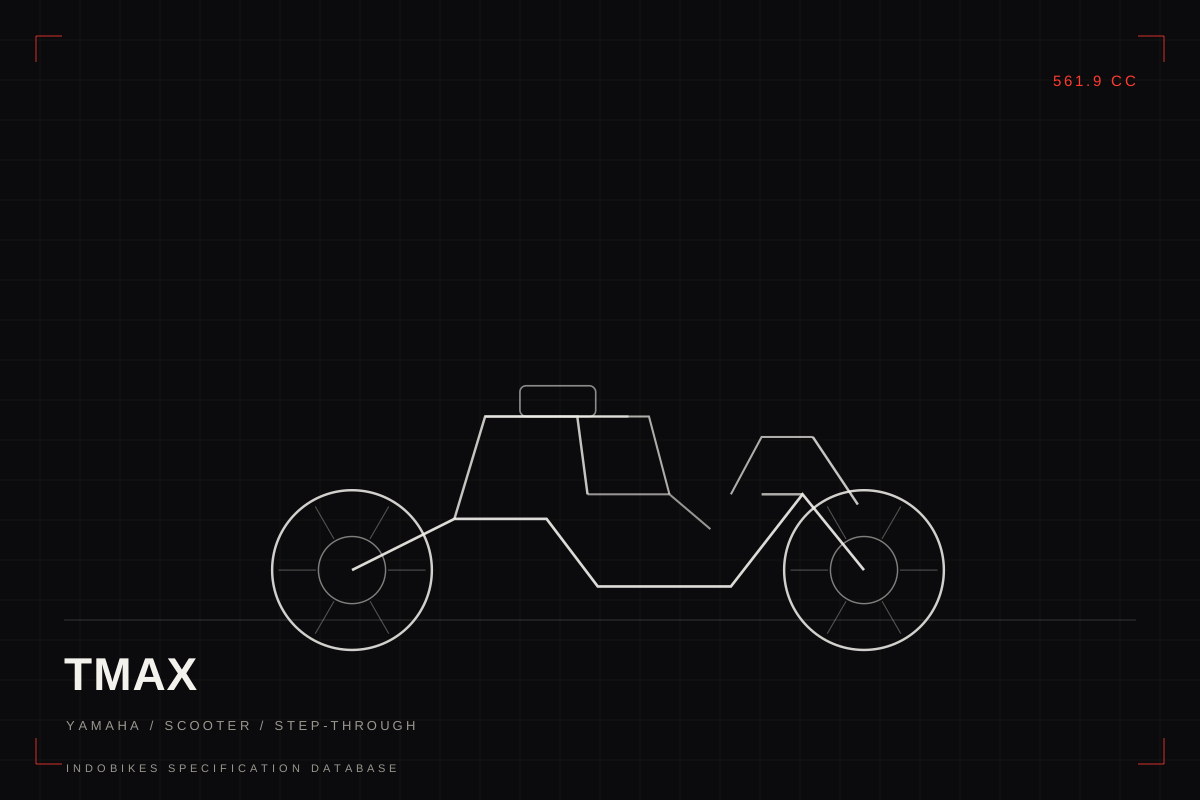
Yamaha TMAX 560 specifications
Yamaha's 560 cc twin-cylinder maxi-scooter, the largest machine in this database.
- Displacement
- 561.9 cc
- Peak power
- 35.0 kW / 7,000 rpm
- Peak torque
- 55.0 N·m / 5,250 rpm
- Curb weight
- 221 kg
- Seat height
- 800 mm
- Fuel tank
- 15 L
Overview
The published sheet lists a 561.88 cc engine, peak power of 35.0 kW / 7,000 rpm, peak torque of 55.0 N·m / 5,250 rpm. It carries a curb weight of 221 kg, an 800 mm seat height and a 15 L tank.
On the published figures it works out to 15.8 kW per 100 kg, above the median for the other 5 scooters in this database (9.1 kW per 100 kg).
Market and trim notes
This sheet covers the Yamaha TMAX 560 as listed in the Indonesian distributor’s current catalogue. Market-specific equipment can differ from the same nameplate in another country, so the figures are not interchangeable.
Distributor trim label: Tech Max.
Full specification
Every row below is a published figure. Rows the manufacturer does not publish are marked rather than estimated.
Engine and performance
| Engine type | 4 Langkah, Pendingin Cairan, 4 Katup, 2 Silinder |
|---|---|
| Displacement | 561.88 cc |
| Bore × stroke | 70.0 mm X 73.0 mm |
| Compression ratio | 10.9 : 1 |
| Cooling | Liquid derived |
| Fuel system | Fuel Injection |
| Maximum power | 35.0 kW / 7,000 rpm |
| Maximum torque | 55.0 N·m / 5,250 rpm |
| Starting | Elektrik Starter |
| Ignition | T.C.I |
| Lubrication | Kering |
| Oil capacity | Ganti berkala = 2.6 L, Dengan Filter Oli = 2.9 L |
Transmission and final drive
| Transmission | : V-Belt Otomatis |
|---|---|
| Final drive | V-belt derived |
Chassis, suspension and brakes
| Frame | Double-cradle frame |
|---|---|
| Front suspension | Telescopic fork |
| Rear suspension | Swingarm |
| Front brake | Hydraulic dual disc brake, Ø267 mm |
| Rear brake | Hydraulic single disc brake, Ø282 mm |
| Front tyre | 120/70R15M/C |
| Rear tyre | 160/60R15M/C |
Dimensions, weight and capacity
| Length × width × height | : 2.195 mm x 780 mm x 1.415 mm-1.525 mm (E - windscreen) |
|---|---|
| Wheelbase | 1,575 mm |
| Ground clearance | 135 mm |
| Seat height | 800 mm |
| Curb weight | 221 kg |
| Fuel tank | 15 L |
What the numbers mean
The 800 mm seat is a middle-of-the-road height: most riders will get the balls of both feet down.
At 221 kg it is heavy: use the side stand deliberately and avoid loose surfaces at low speed.
The 15 L tank is touring-sized, which matters more on a bike that can sit at highway speed. The manufacturer does not publish a consumption figure, so this page does not quote a range.
Tyres are 120/70R15M/C front and 160/60R15M/C rear. Check that your local shop stocks both before a long trip.
Closest alternatives
| Model | Capacity | Power | Torque | Weight | Seat |
|---|---|---|---|---|---|
| Yamaha XMAX 250 | 249.8 cc | 16.8 kW / 7,000 rpm | 24.3 N·m / 5,500 rpm | 184 kg | 795 mm |
| Yamaha NMAX 155 | 155.1 cc | 11.3 kW / 8,000 rpm | 13.9 N·m / 6,500 rpm | 130 kg (Standard & Connected Version), 132 kg (Connected/ABS Version) | 765 mm |
| Yamaha NMAX Turbo | 155.1 cc | 11.3 kW / 8,000 rpm | 14.2 N·m / 6,500 rpm | 135 kg | 770 mm |
Nearest alternatives by category and capacity in this database. These are published figures, not a road test or a recommendation.
Ownership and maintenance notes
- The V-belt and rollers are the parts that change the feel of a CVT scooter. Inspect them at the interval in the owner's manual, and sooner if acceleration flattens or the engine revs without matching speed.
- Engine oil and the air filter do most of the work in keeping a small scooter consistent. Check the oil level cold, on level ground, and use the grade listed for the model.
- Liquid cooling adds a coolant level and condition check. Do it when the engine is cold, and never open the radiator cap on a hot engine.
Source and verification
Figures are taken from Yamaha Motor Indonesia, the Indonesian distributor, on 13 November 2026.
Source page: yamaha-motor.co.id/product/tmax-tech-max/.
Cooling, final drive is inferred from the published layout rather than printed as a separate field.
Wording is quoted as published; spacing and unit symbols are normalised. Specification databases go stale: if a figure here differs from the current distributor page, the distributor page wins, and this sheet records what was published on the verification date.