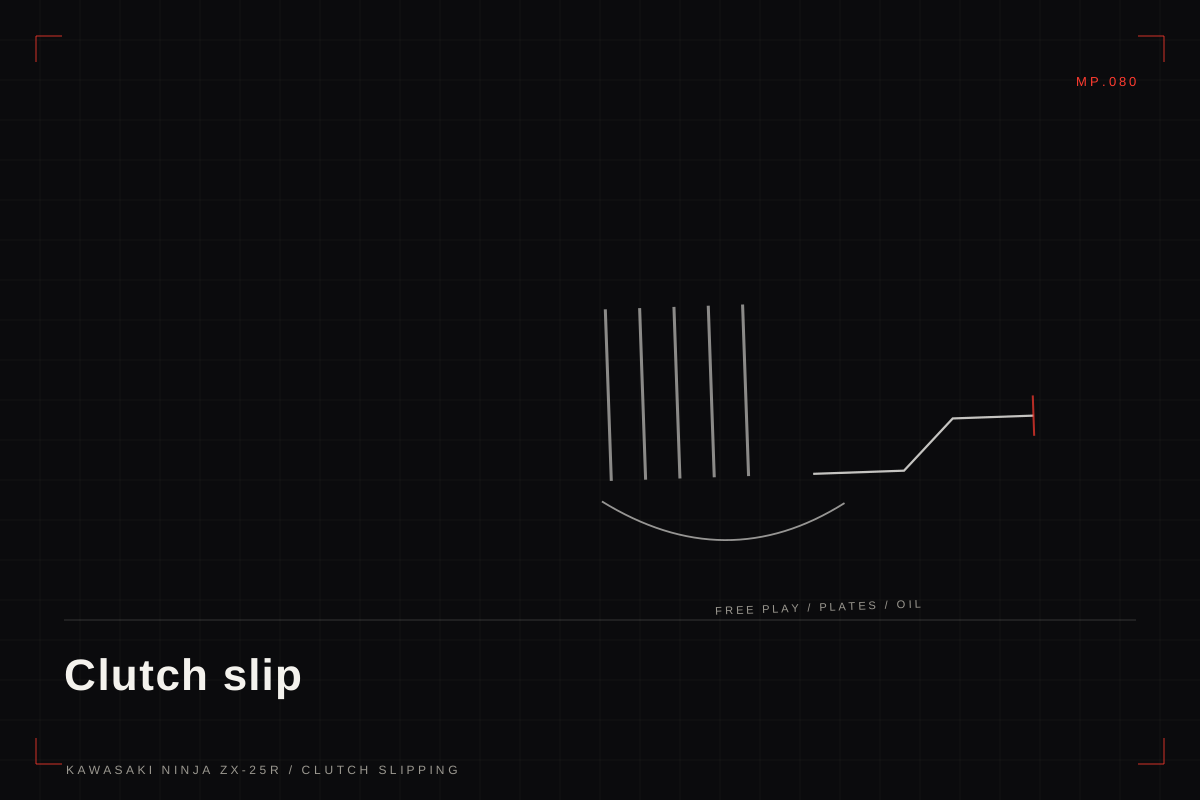
A Kawasaki ZX-25R whose clutch slips lets engine speed rise faster than road speed under load. The clutch is a wet multiplate unit sharing engine oil, so free play and oil specification come before any thought of replacing plates.
Before you start
A slipping clutch can remove drive in traffic. Test it away from traffic. Keep hands away from the sprocket and the clutch cover while the engine runs, and recycle used oil at a proper collection point.
Machine file Kawasaki Ninja ZX-25R
- Engine
- Liquid-cooled DOHC inline four
- Cooling
- Liquid
- Fuel
- Fuel injection
- Transmission
- Six-speed manual
- Final drive
- Chain
Prove it on a quiet road
Ride at a moderate speed in a high gear and open the throttle firmly. If the tachometer climbs faster than the speedometer, the clutch is slipping. If both rise slowly together, the engine is simply short of torque at that rpm.
Repeat after twenty minutes of riding. A clutch that only misbehaves when hot is further down the wear curve, because heat reduces the friction the plates can generate.
Slip pattern and likely cause
| Pattern | Likely cause | Check |
|---|---|---|
| Slips in top gear at full throttle | Early wear or adjustment | Free play, plate thickness |
| Slips from cold | No free play or wrong oil | Lever play, oil grade |
| Slips when hot | Worn plates or springs | Measurement |
| Grabs or judders | Notched basket | Basket grooves |
| Slips after an oil change | Oil specification | Manual grade |
| Slips at full lock | Cable or line routing | Route and play |
Free play and the release mechanism
The lever needs a small amount of free play before the release begins to move. With none, the pressure plate stays partly lifted and the clutch slips as soon as the engine makes torque.
Check the free play with the bars straight and again at full lock. A cable or hydraulic line that tightens at full lock is routed or adjusted incorrectly, and the slip will appear in tight turns.
Oil specification and level
A wet clutch depends on the friction behaviour of the engine oil. An oil outside the specified grade, or one with friction modifiers, can reduce grip and cause slip under load.
Read the level with the machine upright and the engine warm, following the manual procedure. Overfilling aerates the oil, and aerated oil transmits pressure poorly as well as finding its way past seals.
Plates, springs and basket
Worn friction plates lose thickness and grip, and tired springs reduce clamp load. A notched basket stops the plates sliding smoothly, which feels like a grab or a judder rather than a clean slip.
A workshop measures plate thickness and spring free length and inspects the basket grooves. New plates in a notched basket give a short-lived repair, and the notch returns.
Hard use and heat
Repeated hard acceleration and high-rpm launches raise clutch temperature. Heat reduces friction, so a marginal clutch announces itself first on a fast run rather than in traffic.
If the slip appears only after repeated hard starts, the clutch may be adequate for normal use. Ask for a measurement before replacing a set that still has life in it.
Listen as well as watch. A slipping clutch often produces a rise in engine noise without a matching change in wind noise, and on a four that difference is easy to hear at a steady throttle. A whine or a scrape from the clutch cover is a different problem and should be investigated before the bike is ridden hard again.
After the repair
Reset the lever free play to the manual figure, confirm the oil level and test the bike warm. Repeat the high-gear pull after a few hundred kilometres of ordinary riding.
Fresh plates bed in against the steels over that period. Avoid full-throttle launches until the high-gear test is clean, then treat the repair as complete only when it stays clean.
Keeping it from coming back
Use the specified oil, keep the lever free play in spec, and check the cable route at full lock. A wet clutch on a high-revving four can slip under hard launches before the plates look worn. Have the plates and springs measured, and fix a tight cable rather than replacing parts on suspicion.
A short checklist
- Prove the slip in a high gear at moderate speed.
- Repeat the test once the engine is hot.
- Check lever free play at standstill and full lock.
- Inspect the cable or line route.
- Confirm the engine oil grade and level.
- Ask for plate and spring measurements.
Questions owners ask
Why does my ZX-25R clutch slip only at high rpm?
High rpm and a wide throttle ask the plates to transmit the most torque. Early wear or a lever with no free play fails there first, before the slip is obvious at low speed.
Can the wrong oil make a wet clutch slip?
Yes. A wet clutch relies on the friction characteristics of the engine oil. Oil with friction modifiers or the wrong grade can reduce grip, so use the manual specification.
How long should ZX-25R clutch plates last?
It depends on riding style, load and oil maintenance rather than a fixed distance. Judge the plates by measured thickness, not by the odometer.