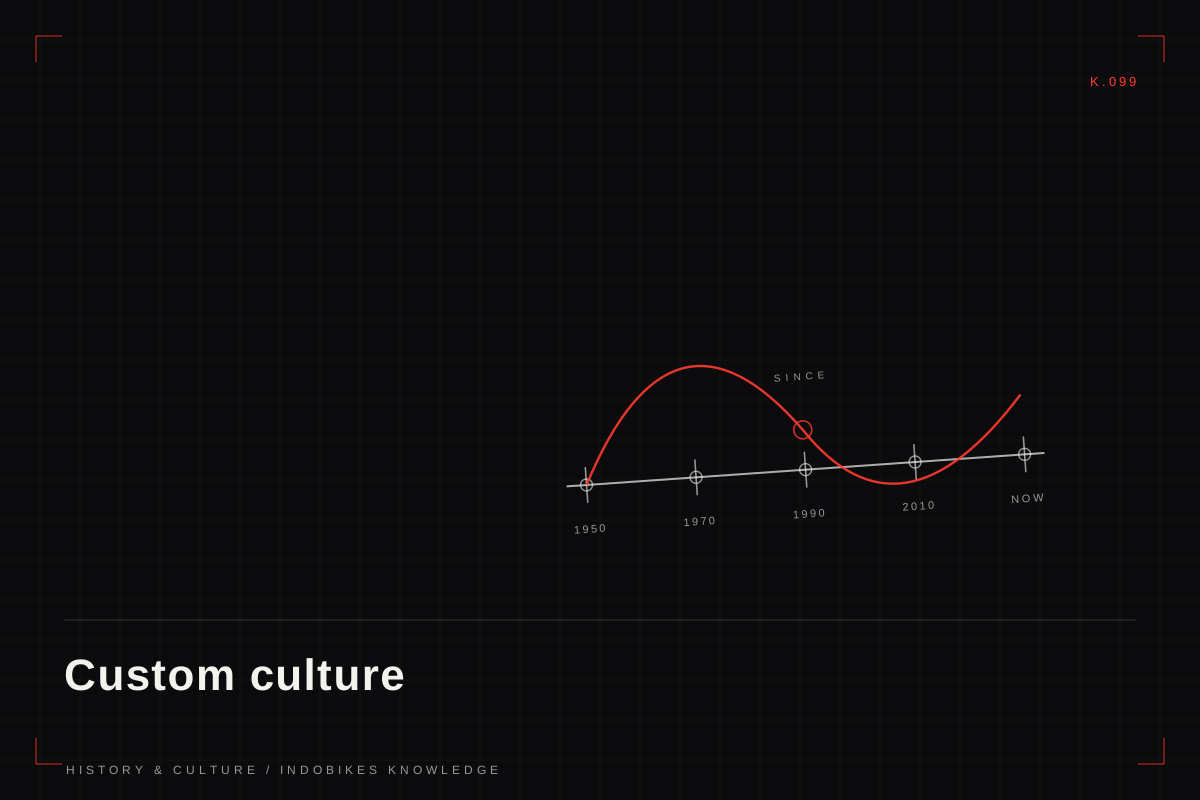
Custom motorcycle culture in Indonesia developed around small-capacity underbones and scooters, modified by local workshops with limited budgets and abundant ingenuity. Trends arrived from abroad but were adapted to small engines, local parts and everyday use. The best builds respect the machine's limits; the worst trade safety for appearance.
The donor bikes
Unlike the American or European custom scenes, which drew on large-capacity machines, the Indonesian scene often starts with a 100-150 cc commuter. That changes everything: the frame is light, the engine is small and the budget is modest.
Small donors make the scene accessible. A student can afford a used underbone and a set of parts, and a local workshop can build something visually striking without importing a chassis.
The workshop network
Customising grew alongside the repair trade. Many builders started as mechanics, and many shops still do service work to fund builds. That practical base is why Indonesian custom bikes are often ridden, not only displayed.
The network also includes specialists: painters, airbrush artists, seat upholsterers, chrome platers and machinists. A build is usually a collaboration rather than the work of one person.
The trends
Cafe racer and scrambler styles became popular in the 2010s, followed by bobber and tracker influences. Each was adapted: a small tank, a shortened seat and a round headlight on a 150 cc frame.
Airbrush and graphic work is a strong local signature, especially on scooters and drag-style builds. The visual language is louder than the mechanical changes, which is a fair description of much of the scene.
The engineering limits
A small engine cannot support a heavy frame, a wide rear tyre or an extreme riding position without consequences. Lowering a bike reduces suspension travel; a wider tyre can rub the chain guard; a stripped front fender throws water.
The most common mistake is treating appearance as the only goal. Brakes, suspension, lighting and tyre clearance are safety systems, not styling details. A build that cannot stop or be seen is not finished.
Legal and practical realities
Modifying a motorcycle can affect its registration and insurance. Changes to the frame, engine capacity or lighting may require approval, and rules differ by region. A builder should check with the local authorities before assuming a modification is legal.
Noise is another issue. An open exhaust may sound good to the owner and be illegal or antisocial. Enforcement varies, but the risk of a fine or a failed inspection is real.
Paint, airbrush and the local visual language
Airbrush work is one of the clearest local signatures. Builds often carry detailed murals, lettering or graphic themes that would be unusual on a European custom. The paint is a communication, not just a finish.
That visual language has its own hierarchy. A show bike may have extensive artwork and chrome; a street build is more restrained. The two scenes overlap but do not have the same standards, and a builder should know which one the bike is for.
Paint is also the most expensive cosmetic item after the build itself. A good painter will discuss the design on the panel, not only the colour, and will prepare the surface properly. A cheap respray over a dent or a rust patch will fail, however good the artwork.
Finally, the local scene values community. A build is often shown at gatherings, discussed in group chats and photographed at night. That social layer is part of the culture, and it explains why style changes spread quickly from workshop to workshop.
Building well
Start with a sound donor and a clear purpose. Decide whether the bike is for daily use, weekend rides or display, and let that decide the tyres, seat, lighting and suspension.
Spend on safety before style: brakes, tyres, suspension and lighting. Then choose a visual direction and keep it coherent. A bike with a clear idea looks better than one with every trend applied at once.
Keep the original parts. A build that can be returned to standard is easier to sell and easier to pass through inspection. A box of standard parts in the workshop is not nostalgia; it is an asset.
Checklist
- Start with a structurally sound donor and valid documents.
- Decide the bike's purpose before choosing parts.
- Keep brakes, tyres, suspension and lighting effective.
- Check tyre and chain clearance after any wheel change.
- Verify registration and insurance implications of modifications.
- Keep noise within local limits.
Questions
Why do Indonesian custom bikes use small engines?
Because small commuters are affordable and abundant. The scene grew from what riders could buy, not from imported large-capacity machines.
Is modifying a motorcycle legal in Indonesia?
Rules exist and vary by region and by the type of modification. Changes to frame, engine or lighting can affect registration. Check with the local authorities.
What should I upgrade first?
Brakes, tyres, suspension and lighting. These affect control and visibility. Cosmetic changes can follow once the bike is safe.