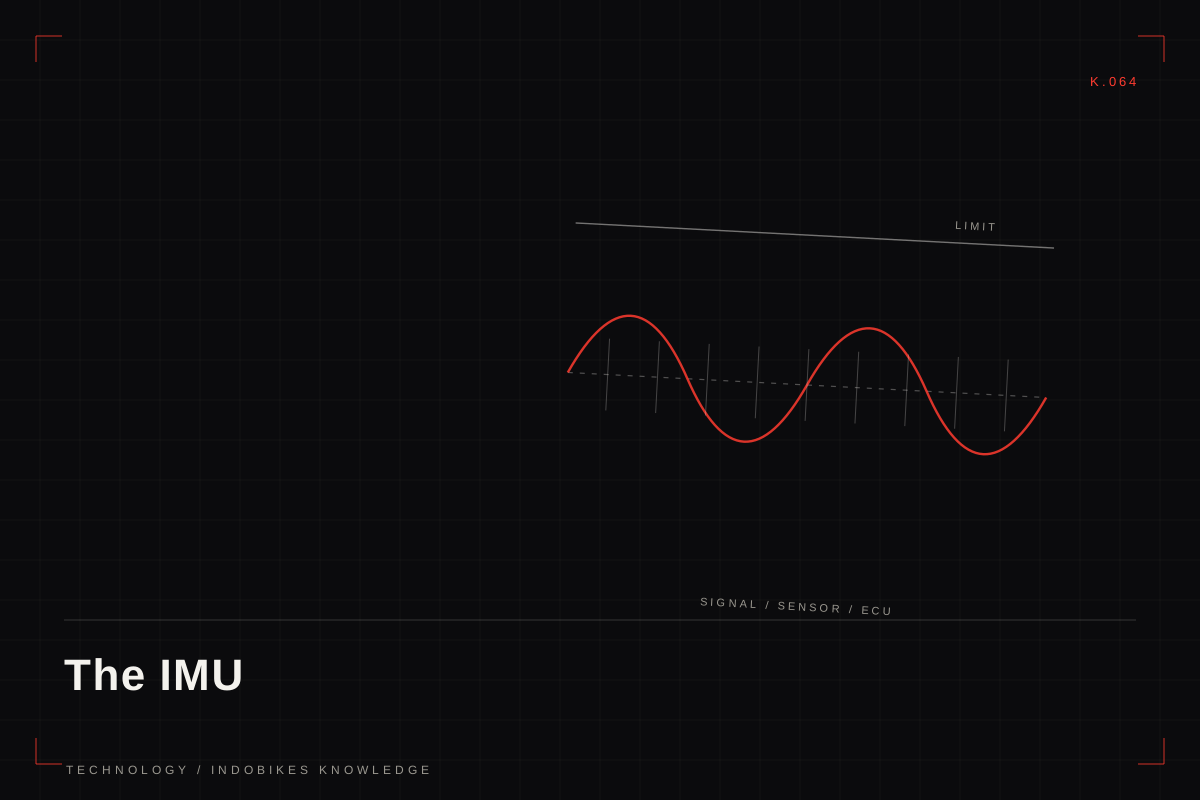
An inertial measurement unit combines accelerometers and gyroscopes to report how a motorcycle is moving and how it is oriented. Rider aids use that report to estimate lean angle, pitch and yaw, then decide how much brake or engine torque the tyres can take. The unit senses motion; it does not sense grip.
What an IMU measures
A six-axis IMU contains three accelerometers and three gyroscopes. The accelerometers measure acceleration along three perpendicular axes, including the constant pull of gravity. The gyroscopes measure rotation rate around the same three axes. Together they describe motion in space, not position on a map. The distinction is easy to forget when the output looks like a neat number.
That distinction matters. The IMU can tell that the bike is leaning and rotating, but it cannot tell where the bike is, what the surface is like or how much grip remains. It supplies motion data to other systems, which combine it with wheel speeds, throttle position, brake pressure and their own models. The IMU is one input among several, not the whole decision.
From raw signals to a lean angle
Raw sensor data is noisy and drifts. A gyroscope can report rotation accurately over short intervals but accumulates error over time. An accelerometer gives a stable reference for gravity but is disturbed by bumps and acceleration. Sensor fusion combines the two so that each corrects the other's weakness. The filtering that makes this possible also adds a small delay.
The result is an estimate of lean angle, pitch and yaw rate, updated many times per second. It is good enough for rider aids to make useful decisions, but it is still an estimate. Bumps, kerbs, wheelies and abrupt weight shifts all disturb the model, which is why the systems are designed with margins rather than exact thresholds.
The systems that consume the estimate
Cornering ABS uses lean angle to decide how much brake pressure it can allow without asking the tyre for more grip than it has. Traction control uses lean angle and yaw to decide how much wheelspin is acceptable and how abruptly it can cut torque. Wheelie control uses pitch to detect and limit a front wheel lifting.
Launch control, hill-hold and semi-active suspension may also consume IMU data. On some bikes the same unit feeds a data logger or a riding app. The common thread is that all of these systems need to know the bike's orientation, not just its speed. The IMU is the shared source of that knowledge, which is why a mounting fault can affect several systems at once.
Why the estimate is difficult
A motorcycle leans, pitches and yaws at the same time, and the rider's body moves relative to the machine. The IMU is mounted to the chassis, so it sees the bike's motion but not the rider's weight shift directly. The suspension adds another layer: the chassis moves up and down while the wheels stay in contact with a changing surface.
Vibration is the other problem. A single-cylinder engine or a rough road can inject high-frequency noise that swamps the signal the system needs. Mounting position, isolation and filtering are part of the design. That is why the unit is not a generic part that can be relocated or replaced with any similar-looking sensor. The bracket is part of the measurement, not just a holder.
Mounting, calibration and crash damage
The IMU must be mounted at the angle the manufacturer specifies, usually with a defined orientation relative to the chassis. A unit fitted upside down, rotated or with a distorted bracket will report the wrong axis and can make rider aids behave incorrectly. After a crash, inspect the mounting and the connector, not just the bodywork.
Some systems require a calibration or zeroing procedure after replacement or after certain repairs. The procedure is model-specific and may need a diagnostic tool and a level surface. Do not assume that fitting the part is enough; an uncalibrated unit can be worse than a failed one because it reports plausible but wrong data, and wrong data is harder to spot than no data.
What the IMU cannot know
It cannot measure grip, tyre temperature, tread depth or the coefficient of friction of the road. It cannot see oil, sand or a wet painted line. Every rider aid that uses it is working from motion plus assumptions, and the assumptions are set by the manufacturer for a nominal tyre and a nominal surface. Change the tyre or the load and the assumptions no longer quite fit.
That is why a worn tyre or a cold morning changes the margin without changing the dashboard. The system will still intervene, but its model of the world is less accurate. The rider remains responsible for the condition of the machine and for choosing a pace that leaves room for the estimate to be wrong.
Checklist
- Never relocate or re-angle the IMU without the service procedure.
- Inspect the mounting bracket and connector after a crash.
- Have calibration checked after replacement or frame repair.
- Keep tyres and pressures within the manufacturer's specification.
- Treat a rider-aid warning light as a system fault.
- Remember that lean angle is an estimate, not a grip measurement.
Questions
Does the IMU measure grip?
No. It measures acceleration and rotation, which the system uses to estimate lean, pitch and yaw. Grip depends on the tyre, the surface, temperature and load. Rider aids infer what is available from motion and wheel speeds, which is why they cannot guarantee a save on a slippery surface.
Can I fit an IMU to a bike that did not have one?
Not as a simple add-on. The unit needs a mounting point, wiring, calibration and software that knows how to use the data. Retrofitting the sensor alone does not create cornering ABS or traction control, because those functions live in the ECU calibration and the braking hardware.
Why does my bike's lean-angle display differ from a phone app?
A phone app uses a different sensor, mounting and filtering, and it is not calibrated to the motorcycle's chassis. The bike's own display is fed by the IMU the rider aids use. Neither is a precision instrument, and small differences are normal.