A quickshifter lets a rider change gear without the clutch by briefly interrupting engine torque while the next gear engages. A sensor detects the movement of the shift linkage, the ECU cuts fuel or ignition for a moment, and the dogs in the gearbox slide into place under reduced load. It is a timing aid, not an automatic transmission.
The milliseconds inside a shift
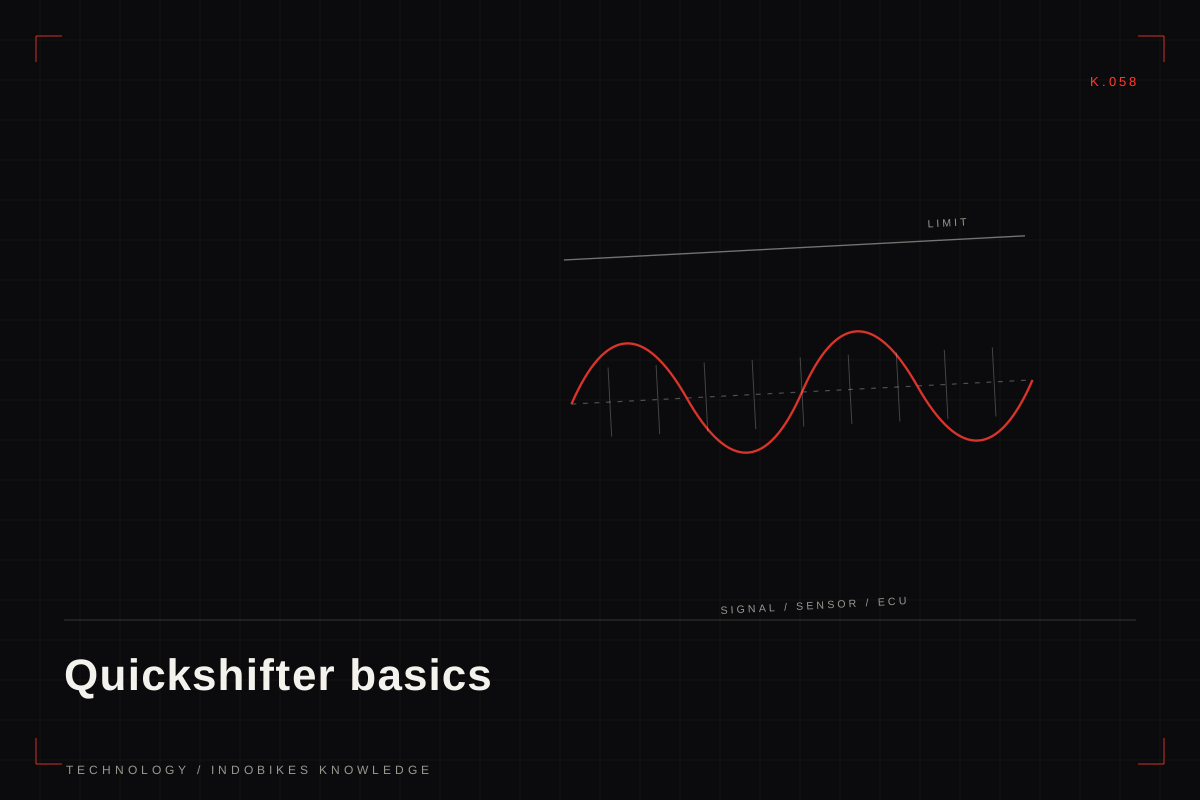
A conventional clutchless upshift works because the rider momentarily unloads the gearbox by easing the throttle. A quickshifter automates that moment. When the lever moves, the ECU interrupts torque for a calibrated interval measured in milliseconds, long enough for the next pair of gears to engage and short enough that the bike barely slows. The rider's foot never leaves the lever and the clutch stays engaged.
The quality of the shift depends on that interval matching the engine speed and the gearbox. Too short and the dogs clash; too long and the bike lurches when torque returns. Because the correct interval changes with rpm and gear, the calibration is a table rather than a single setting, and it is set by the manufacturer or a competent tuner.
Two ways to detect the request
The common arrangement is a strain gauge or a switch built into the shift linkage or the lever assembly. A strain gauge senses the pressure of the rider's foot before the lever has travelled far, which allows the cut to begin early. A simple switch triggers at a set point of lever movement and is cheaper but less precise.
Either way, the sensor is a wear-prone external part. It sits where road spray, chain lube and clumsy boots reach it. A quickshifter that becomes inconsistent, triggers on its own or stops working after a chain adjustment often has a linkage or connector problem rather than an ECU fault, so inspect the simple parts first.
Downshifts need a different trick
An upshift only needs torque removed, which an ignition cut provides. A downshift needs the engine speed raised to match the lower gear, otherwise the rear wheel is asked to spin the engine up and may skip or lock. A downshift blipper therefore needs an electronically controlled throttle: it closes the cut and opens the plate to blip the revs.
That is why downshift blippers appear mainly on throttle-by-wire machines. A bike with a cable throttle can have a quickshifter for upshifts but cannot blip the throttle electronically without extra hardware. Some aftermarket systems add their own actuator, but the principle is the same: match the revs before the gear engages. The extra hardware is one reason the feature is associated with higher-specification models.
What a quickshifter is not
It is not an automatic gearbox. The rider still chooses the gear and moves the lever. It is not a substitute for a working clutch at low speed, from a standstill or during a slow manoeuvre. Most systems are disabled below a threshold rpm or in first gear precisely because the torque interruption would be unpleasant or harmful.
It is also not a cure for a dragging clutch, worn gearbox dogs or a misadjusted chain. Those faults produce false neutrals and clunky shifts that no calibration can hide. If the gearbox is already unhappy, a quickshifter will make the symptom more frequent, not less. Fix the mechanical fault before asking the electronics to cover it.
Wear, mis-shifts and the gearbox
Every clutchless shift still loads the engagement dogs and the shift forks, even when the torque cut is clean. A well-calibrated system on a modern gearbox is designed for it. A poorly calibrated one, or a rider who shifts without lifting the throttle at all on a bike that expects it, adds impact and heat to the same parts.
The practical signs of trouble are a growing clunk, false neutrals between specific gears, or a lever that needs more force than it did. Stop using the function and have the linkage and calibration checked. Continuing to force shifts because the electronics usually cover them is how a cheap sensor problem becomes a gearbox repair.
Setup, calibration and honest limits
Installation position matters. The sensor or switch must see the intended direction of travel and must not be preloaded by the linkage. After changing rearsets, a shift lever or the chain adjustment, check that the quickshifter still triggers cleanly and does not fire while cruising. Those checks are mechanical and do not require a laptop.
Calibration itself is model-specific and should follow the manufacturer's procedure. There is no universal cut time, no universal minimum rpm and no universal behaviour for first gear. Treat any advice that quotes a single setting for all bikes with suspicion, and treat a quickshifter as a convenience that rewards good mechanical condition rather than compensating for a tired one.
Checklist
- Inspect the shift linkage for play before blaming the electronics.
- Check that the sensor is not preloaded or fouled by road debris.
- Confirm the system is enabled only above its intended rpm.
- Recheck trigger behaviour after fitting rearsets or a new lever.
- Stop using it if false neutrals or hard shifts appear.
- Keep the clutch available for low-speed and standing starts.
Questions
Can I use a quickshifter in every gear?
Most systems are designed for upshifts above a minimum rpm and often lock out first gear. Behaviour varies by model and calibration. Using it at very low speed or from a standstill asks the gearbox to engage under conditions the system was not designed for, so use the clutch there.
Does a quickshifter damage the gearbox?
A correctly calibrated system on a gearbox designed for it is part of normal use. A badly calibrated system, a worn linkage or a rider forcing shifts adds impact to the dogs and forks. Watch for new noise, false neutrals or increased lever effort rather than assuming the electronics will cover it.
Why does my quickshifter cut out mid-corner?
It should not trigger without lever movement, so a mid-corner cut usually points to a sensor, linkage or connector fault, or to a calibration that is too sensitive. Have it checked before riding further; an unexpected torque interruption in a bend is a real hazard.