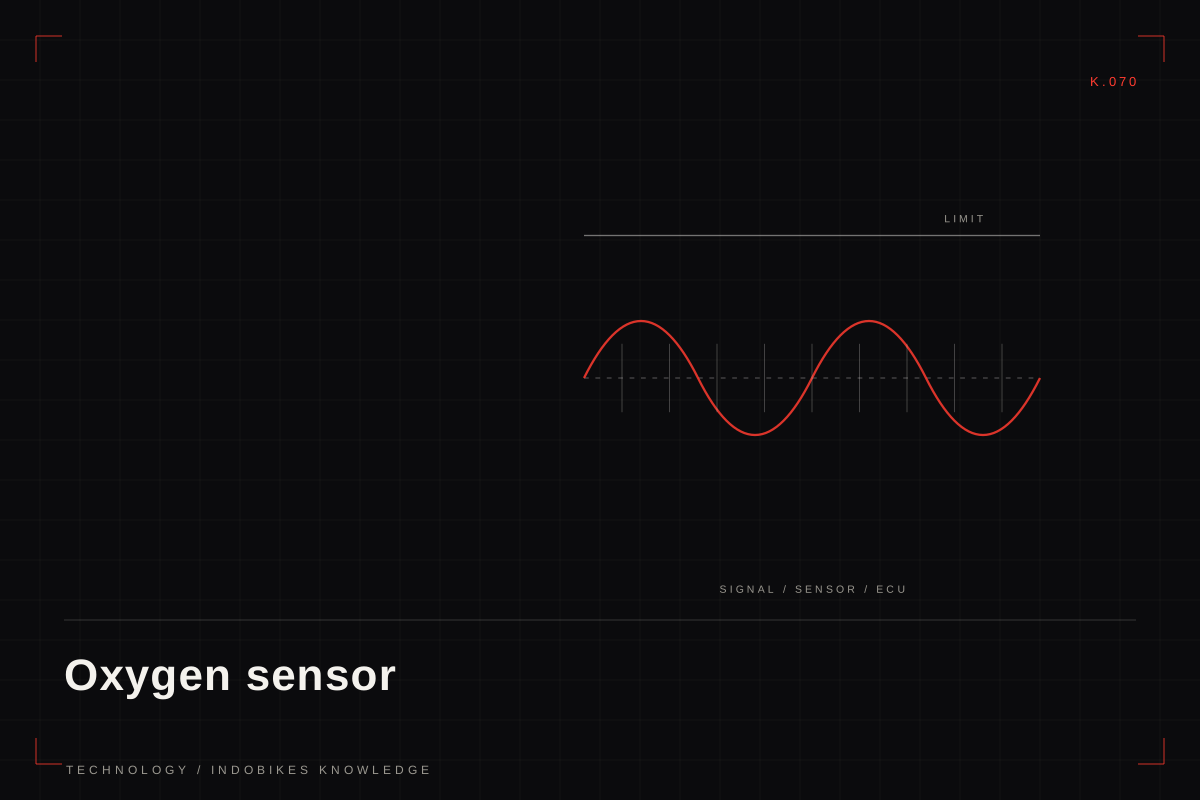
A motorcycle oxygen sensor measures the oxygen left in the exhaust and turns that into a signal the engine management system uses to adjust fuelling. In closed loop, the system trims the mixture toward its target. When the sensor is contaminated, unheated or disconnected, the system falls back on pre-programmed fuelling.
Sensor faults and what they look like
| Symptom | Possible cause | What to check |
|---|---|---|
| Signal stays flat or switches slowly | Contamination or ageing | Service history, oil or coolant consumption, live data |
| No heater activity | Heater circuit, fuse or relay | Power, ground and heater resistance against the manual |
| Lean reading at idle | Intake or exhaust leak | Inlet rubbers, vacuum hoses, exhaust joints |
| Rich trim at cruise | Leaking injector, fuel pressure or sensor drift | Fuel pressure, injector balance, sensor response |
| Catalyst efficiency code | Downstream sensor or catalyst | Compare upstream and downstream signals |
What the sensor is measuring
An oxygen sensor sits in the exhaust stream, upstream of the catalytic converter on most systems. Its sensing element is exposed to exhaust gas on one side and to reference air on the other. The difference in oxygen concentration produces a small voltage, and the engine management system reads that voltage as a report on the mixture.
A rich mixture leaves little oxygen in the exhaust; a lean mixture leaves more. The sensor does not measure fuel directly, and it does not know why the mixture changed. It reports the result, and the control unit decides whether to add fuel, remove fuel or store a fault. That division of labour matters when diagnosing: the sensor is a witness, not a mechanic.
Narrowband, wideband and the heater
The common narrowband sensor switches sharply between a low and a high signal around the stoichiometric mixture. That sharp switch is useful for keeping a three-way catalyst working efficiently, but it tells the controller only whether the mixture is on one side of the target or the other. It is a switch, not a meter.
A wideband sensor uses a more complex element and a controller to report the mixture across a range, which is why it is used for precise fuelling and for diagnostics. Most sensors also contain a heater so they reach operating temperature quickly after a cold start. The heater is a common failure point and has its own circuit and fault code.
Open loop and closed loop
Closed loop is the mode in which the engine management system uses the sensor signal to correct fuelling. It usually becomes active once the sensor is warm and the engine is running under steady conditions. The corrections are stored as fuel trims, short-term and long-term, so the system can adapt to wear, altitude and small intake leaks.
Open loop is the mode in which the system ignores the sensor and uses programmed values. Cold starts, hard acceleration, deceleration fuel cut and some fault conditions can all put the engine into open loop. A sensor that is slow to heat, or one whose heater has failed, keeps the engine in open loop for longer and increases emissions and fuel use.
How a sensor fails
Sensors are poisoned by substances that coat the sensing element. Silicone from some sealants and coolant, ash from burning oil, and excessive carbon can all reduce or block the response. A sensor can also be damaged by impact, by an excessively rich mixture, or by contamination from a failed internal engine part. Once the element is coated, no amount of cleaning restores it reliably.
Wiring is just as common a cause. A sensor with a damaged connector, a rubbed wire or a poor ground can report a plausible but wrong signal. An exhaust leak upstream of the sensor draws in fresh air and makes the reading lean, so the controller adds fuel to an engine that is not actually lean. That is a mechanical fault, not a sensor fault.
What live data shows
Live data is more useful than a fault code alone. A scan tool can show the sensor signal, the heater status, the fuel trims and whether closed loop has been achieved. A narrowband signal that stays flat, switches slowly, or never moves is a clue; so is a trim that sits at an extreme while the sensor looks normal.
Compare the readings with the conditions. A cold engine, a wide-open throttle or a deceleration cut changes what the system should do. Reading one frame at idle and condemning the sensor is how good parts get replaced. The next step is to check the intake for leaks, the exhaust for leaks and the wiring for damage.
The second sensor and catalyst monitoring
Many modern motorcycles have a second oxygen sensor downstream of the catalytic converter. Its job is not primarily to set fuelling. It compares the exhaust leaving the catalyst with the exhaust entering it, which lets the system judge whether the catalyst is storing and releasing oxygen as it should. That is emissions monitoring, not mixture control.
A downstream sensor can therefore trigger a catalyst efficiency code even when the engine runs well. On a motorcycle with only one sensor, that monitoring is absent, and diagnosis relies more on the upstream signal, the fuel trims and the emissions result. The number and position of sensors are model-specific, so check the layout before ordering parts.
Repair order: find the cause before the sensor
The repair order matters. Confirm that the sensor is receiving power and ground, that its heater circuit is intact, and that the exhaust has no leak before the sensor. Check for oil consumption or coolant loss that could contaminate the element. Only then replace the sensor, and use the type specified for the motorcycle, with the correct connector and thread.
After replacement, clear the fault and let the system complete its monitors. A new sensor on an engine with an intake leak will simply report the same problem. And a sensor is not a tuning device: fitting one does not add power or fix a rough idle that comes from a mechanical fault. It restores the feedback the system needs to do its job.
Checklist
- Read the fault code and the live data before buying a sensor.
- Check the intake and exhaust for leaks upstream of the sensor.
- Confirm the heater circuit has power, ground and continuity.
- Look for oil burning or coolant loss that can contaminate the element.
- Use the sensor type specified for the motorcycle.
- Clear codes and let the monitors complete after a repair.
- Do not use silicone sealant upstream of the sensor.
Questions
Does a faulty oxygen sensor always cause a fault code?
Not always. A slow or lazy sensor can degrade fuelling and emissions without setting a code immediately, especially if the system has adapted around it. Live data and fuel trims often reveal the problem before the warning light does.
Can I clean an oxygen sensor?
Cleaning is not a reliable repair. The sensing element is delicate, and contamination is often inside the element rather than on the surface. Solvents can damage it further. Replace a contaminated sensor and fix the cause.
Will a new oxygen sensor improve fuel economy?
It can restore the closed-loop correction if the old sensor was slow or dead, but it will not fix an intake leak, a stuck injector or a mechanical fault. Expect fuel economy to return toward normal, not to improve beyond the motorcycle's design.