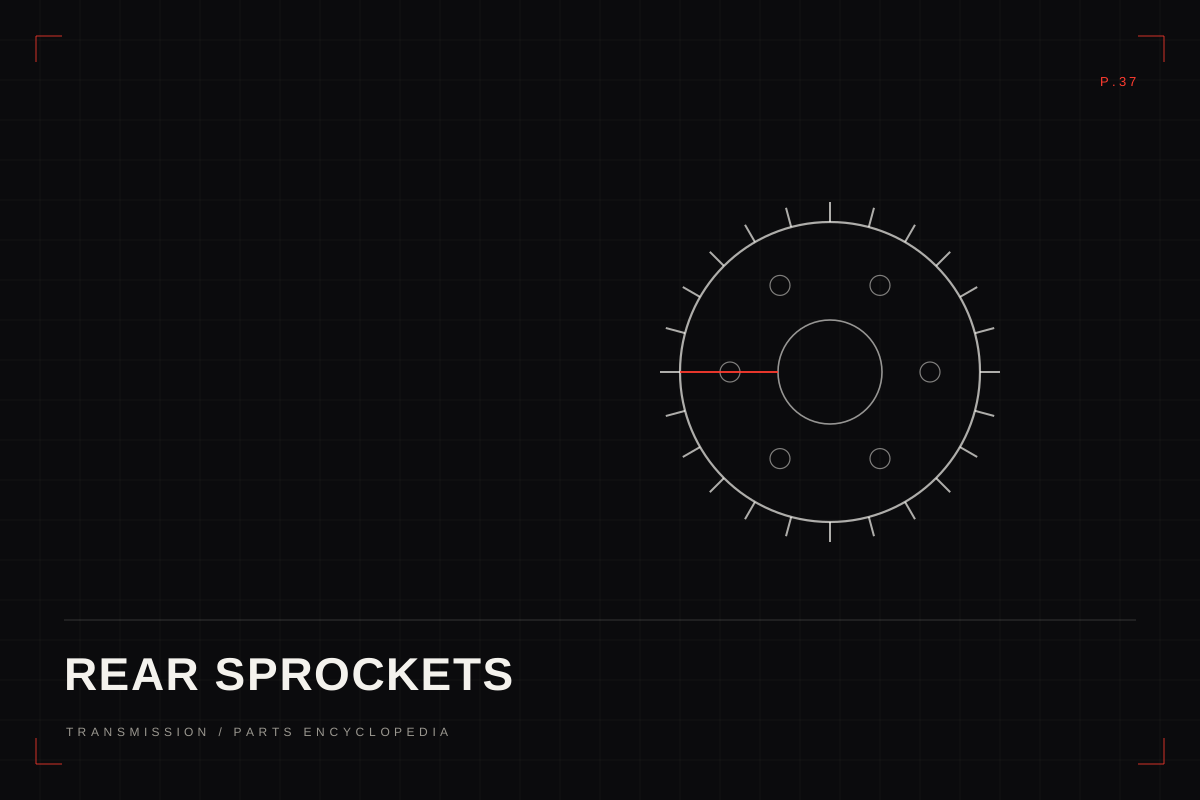
The rear sprocket is bolted to the wheel hub, often through a cush drive. It has more teeth than the front, so each tooth sees less load, but it is larger, heavier and more exposed to dirt. Changing it changes gearing more noticeably than changing the front.
What it does
The rear sprocket receives the chain's pull and turns the wheel. Its tooth count, divided into the front sprocket's count, gives the final drive ratio. A larger rear sprocket lowers gearing and increases acceleration.
It mounts to the hub through bolts and often a cush drive. The cush drive rubbers absorb shock from the drivetrain. Worn rubbers make the bike clunk when the throttle is opened.
How it carries power
The chain wraps around the sprocket and pulls the teeth. Because the sprocket is large, the chain has more teeth in contact, so wear is spread out. The sprocket must run true; a bent or badly mounted sprocket makes the chain surge.
The cush drive sits between the sprocket carrier and the wheel. It takes the shock of gear changes and throttle application. If the rubbers harden, the drivetrain feels harsh and the sprocket carrier rocks.
Types and variations
- Steel sprocket. Long lasting and quiet. The usual road choice.
- Aluminium sprocket. Light, but wears quickly on the road. Common in racing.
- Hybrid sprocket. An aluminium centre with a steel tooth ring. Lighter than steel with better wear than aluminium.
- Standard tooth count. Original gearing. A safe baseline.
- Changed tooth count. Alters gearing. Check chain length and adjuster range.
Wear and failure signs
- Hooked, pointed or asymmetric teeth.
- Teeth worn more on the drive side than the coast side.
- A sprocket that does not run true when the wheel is spun.
- Loose or corroded mounting bolts.
- Hardened or cracked cush drive rubbers, causing drivetrain clunk.
- A chain that will not sit flat on the sprocket.
Choosing a replacement
- Match bolt pattern, offset, tooth count and chain pitch.
- Choose steel or hybrid for road use. Aluminium is a race part, not a mileage part.
- If changing tooth count, check the chain length and the axle adjuster range.
- Replace the cush drive rubbers if they are hardened or loose.
- Replace the sprocket with the chain and front sprocket when the set is worn.
Fit and compatibility
- Clean the hub face and the sprocket mounting surface.
- Fit the sprocket with the correct offset and torque the bolts in a cross pattern.
- Use new lock nuts or threadlocker as the manual specifies.
- Check runout after fitting.
- Set chain slack and alignment before riding.
Inspection and care
- Check the mounting bolts at every tire change.
- Keep the chain clean and correctly tensioned to reduce sprocket wear.
- Inspect the cush drive rubbers when the rear wheel is off.
- Replace hooked teeth before they damage a new chain.
- Avoid pressure washing directly at the hub seal.
Safety and limits
A loose rear sprocket can damage the hub and lock the wheel. Check the bolts.
A worn sprocket can throw the chain. Replace it.
Keep hands clear of the chain and sprocket when the engine runs.
Questions
Does a bigger rear sprocket make the bike faster?
It makes it accelerate harder and lowers top speed. The engine reaches its limit sooner in each gear.
How many teeth can I change without a new chain?
A small change may fit within the adjuster range. A large change needs a longer or shorter chain.
Are aluminium sprockets worth it?
For racing, yes. For road mileage, they wear too fast and cost more over time.
Why does the rear clunk when I open the throttle?
Worn cush drive rubbers, a loose sprocket or a worn chain. Check the rubbers and the mounting bolts.