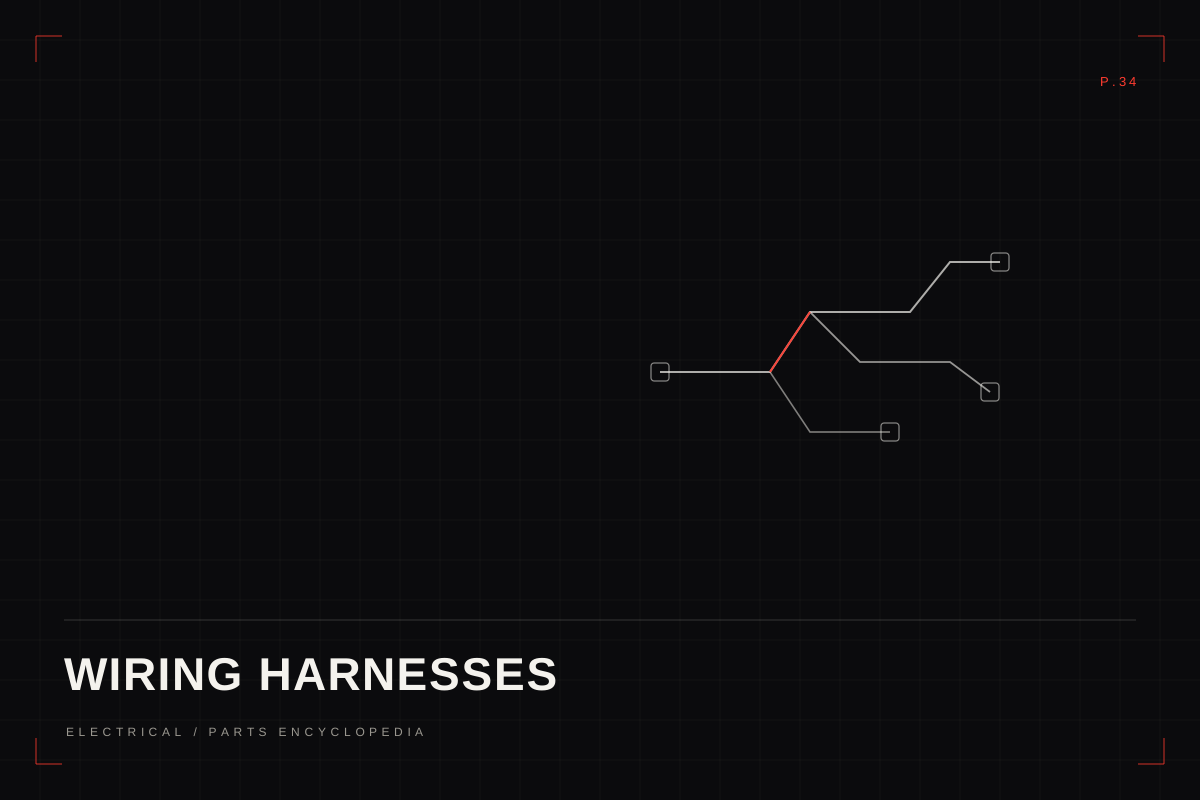
A wiring harness is a bundle of wires with connectors, wrapped in tape or a sleeve. It has to survive vibration, heat, water and movement. Most electrical faults are not in the components at all; they are in a connector, an earth point or a wire that has rubbed through its insulation.
What it does
The harness distributes power from the battery and charging system and carries signals between sensors, switches and the ECU. It also provides the earth return, which is just as important as the live side.
A harness has to be routed correctly. Wires that are too tight at the steering head or the swingarm pivot break inside their insulation, which is hard to see and hard to find.
How the circuit works
Current flows from the battery through a fuse, a switch and a load, then back to earth. Every connection adds resistance. A corroded connector drops voltage, so the load is dim or slow and the wire heats up.
The ECU reads signals as voltages. A poor earth shifts those voltages, which can cause false sensor readings and fault codes without any sensor being faulty.
Types and variations
- Main harness. The central loom from the battery and ECU to the rest of the bike.
- Sub-harness. Separate looms for the front end, rear lights or accessories.
- CANbus wiring. A twisted pair carrying digital messages. Needs the correct termination and repair methods.
- Sealed connectors. Weatherproof plugs with seals. Common on modern and off-road bikes.
- Aftermarket accessory loom. A separate fused circuit for lights, chargers or heated gear.
Failure signs
- Intermittent faults that appear over bumps or in the rain.
- A melted connector or a fuse that blows repeatedly.
- Dim lights or slow accessories from voltage drop.
- Green corrosion in a connector or a broken wire at a bend.
- Multiple unrelated faults at once, often an earth problem.
- A previous repair with tape and twisted wires, which will fail again.
Choosing a replacement
- For a repair, use wire of the same gauge and insulation type.
- Use sealed connectors and the correct crimping tool. Soldered joints need support and sealing.
- For an accessory circuit, use a separate fused feed and a relay rather than tapping an existing wire.
- Match the harness to the bike if replacing a main loom. Connector and length differences matter.
- Keep the original colour codes so the next person can read the diagram.
Fit and compatibility
- Disconnect the battery before any harness work.
- Route the loom along the original path, with slack at the steering head and suspension pivots.
- Keep wires away from exhaust heat and sharp frame edges.
- Use the correct clips and ties. Do not crush the loom with cable ties.
- Check voltage drop across a repair under load before calling it done.
Testing and care
- Keep connectors clean and dry. Use dielectric grease on the seals, not the contacts.
- Check the earth strap and main earth points at every service.
- Fix chafed loom tape before the wire is exposed.
- Do not pressure wash directly into connectors or the back of the dash.
- Add a drip loop where water can run down a wire into a connector.
Safety and limits
A short circuit can start a fire. Fit the correct fuse and never bypass it with wire or foil.
Do not run unfused accessory wiring through the frame without protection.
If a fuse blows repeatedly, find the fault. A larger fuse does not fix a short.
Questions
How do I find an intermittent electrical fault?
Reproduce the conditions, then check for voltage drop and wiggle the loom at suspected points while watching a meter. Look for chafe marks and corroded connectors.
Can I repair a broken wire with tape?
Only as a roadside temporary fix. Use a proper crimp or a soldered, sealed joint for a permanent repair.
Why do multiple lights fail at once?
A shared earth point or a common connector. Check the earth before replacing lamps.
Are CANbus electrical systems different?
Yes. They use digital signals and need the correct wire and termination. Tapping into a CAN wire can disrupt the network.