A motorcycle corner goes well when the rider finishes braking before the lean, picks a line they can see through, and holds a steady throttle until the exit opens. Most cornering errors begin earlier than the moment the bike feels wrong: too much speed on entry, a late look, or a throttle that is neither on nor off.
The four decisions inside every bend
Every corner is a sequence of four decisions: how fast to arrive, where to place the bike, when to lean and how to leave. They are made in that order, and each one constrains the next. A rider who arrives too fast has already spent the margin needed for the line, the lean and the exit, which is why many cornering problems look like steering errors but begin at the brake lever.
The order also explains why cornering feels easy on some days and clumsy on others. When the first decision is right, the rest follows almost automatically. When it is wrong, the rider is correcting through the whole bend, and every correction uses grip that the tyres needed for turning. Good cornering is mostly the art of arriving prepared.
Reading the bend before you commit
Look for the exit, not the entrance. The point where the two edges of the road appear to meet tells you how tight the bend is from where you are, and as you approach, that point moves. If it moves away from you, the corner is opening. If it moves toward you, the corner is tightening, and the speed that felt fine a second ago may no longer be.
Surface matters as much as geometry. Sand, gravel washed across the road after rain, wet leaves, painted markings and repaired patches all offer less grip than dry tarmac. In Indonesia a bend can be clean on the approach and covered in loose material at the apex, especially after heavy rain or near construction. Treat the surface as a separate question from the shape of the corner.
Speed is decided on the straight
Almost all braking should be finished before the bike leans. Braking upright keeps the front tyre loaded and the steering neutral, and it lets the suspension settle before you ask for lean. Once the bike is tipped in, the front tyre is already using much of its grip to turn, so any additional braking has to be gentle and adds risk.
If you arrive too fast, the honest options are to lean further, to accept a wider line, or to run wide and recover. Braking hard mid-corner is the option that most often ends badly. Skilled riders do brake into corners, but that is a trained technique with its own limits, not something to improvise on a public road with traffic coming the other way.
A line you can actually see through
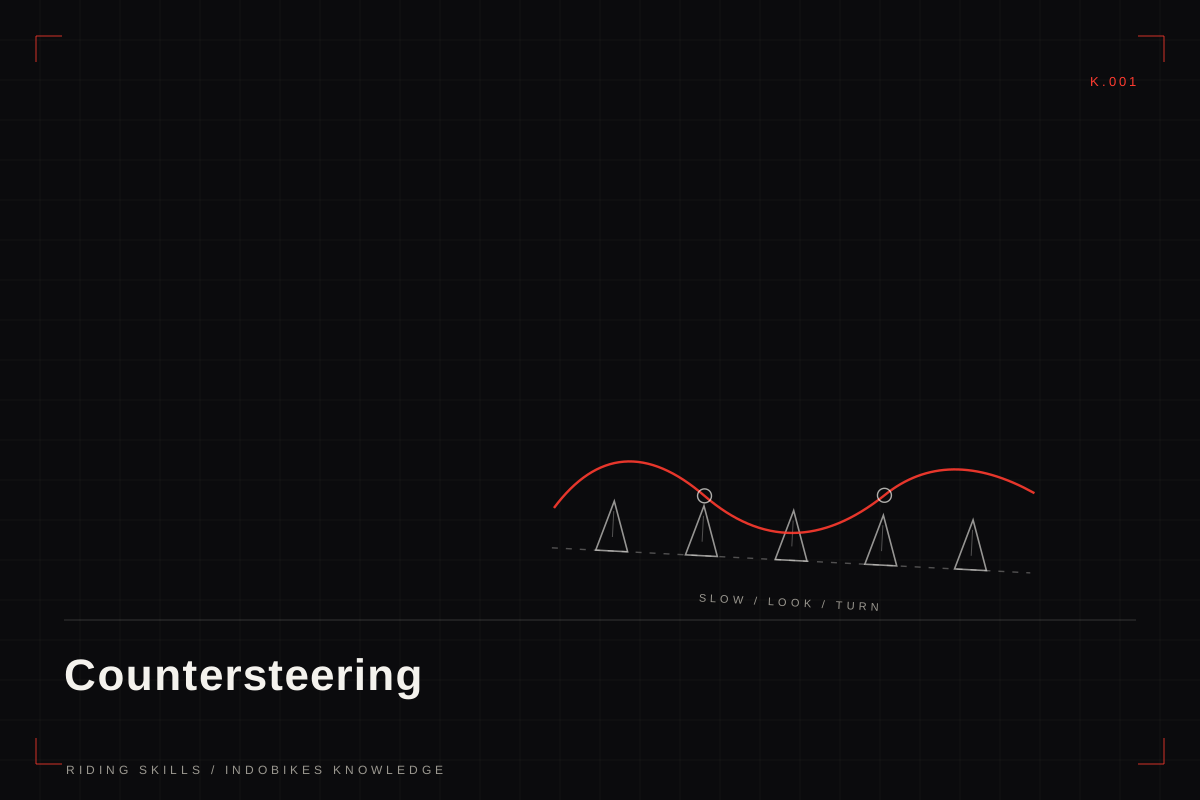
The familiar outside, inside, outside line exists because it straightens the curve, which reduces lean angle for a given speed. On a public road, though, the ideal line is the one that keeps you visible and leaves room for a mistake. That often means staying away from the centre line on a blind right-hander, where an oncoming vehicle may be cutting the corner.
On a left-hand bend the risk is different: the inside is where gravel, oil and debris collect, and where a late apex puts you close to the edge. A slightly earlier, wider entry costs a little speed but buys sight distance and space. On an unfamiliar road, that trade is almost always worth making, however confident the bike feels.
Lean, grip and the throttle
A tyre has a finite amount of grip, shared between turning, braking and accelerating. At a modest lean angle there is plenty left over. As lean increases, the share available for anything else shrinks, which is why a small throttle change that feels harmless upright can upset a bike that is already deep into a corner.
The steady-throttle habit is the beginner's version of good cornering. Pick a gear that lets the engine pull cleanly, roll on gently as the lean settles, and hold it until the exit opens. Chopping the throttle mid-corner pitches weight onto the front and can make the bike stand up or the front tuck, and both outcomes arrive without warning.
When the corner tightens unexpectedly
The most common surprise is a bend tighter than it looked. The instinct is to brake and straighten, which is exactly what makes the bike run wide. The better response is to look further around the corner, press the inside bar a little more and keep the throttle steady or slightly open. The bike will usually turn more than the rider expects.
If the bike is already at its lean limit, or the surface has changed, there may be no grip left for more lean. That is why entry speed and sight distance matter so much: they are the only tools that prevent this situation. Cornering ABS and traction control can help a rider who is already in trouble, but they cannot create grip where the road has none.
Learn it on a course, not in traffic
Cornering is best learned on a closed course with an instructor, on a bike with sound tyres and brakes. A course provides run-off, a controlled surface and someone who can see what your hands and eyes are doing. Public roads provide none of those, and the consequences of a mistake are shared with everyone around you.
In Indonesia, a valid licence and formal training are the baseline for riding at all. Treat the techniques here as things to develop under supervision, on a course with run-off, rather than as permission to ride faster than the road and conditions allow. The skills transfer to the road; the risk of learning them there does not have to.
Checklist
- Check tyre pressures and tread before a ride in the hills.
- Finish braking before you turn the bars into the corner.
- Look for the exit and the road surface, not the front wheel.
- Choose a gear that pulls cleanly without snatching.
- Keep a light grip and a steady throttle through the lean.
- Reduce speed when the corner tightens instead of braking hard mid-lean.
- Book a closed-course session before exploring your limits.
Questions
Should I brake into a corner?
For most riders the safer habit is to brake upright before the turn and carry a steady speed through it. Trail braking is a real technique, but it needs instruction and a good surface, and it leaves less grip for the turn itself.
Why does my bike run wide even when I am slow enough?
The usual causes are looking at the outside of the bend, holding the bars too tightly, or closing the throttle mid-corner. A late, hesitant turn-in also forces a wider arc than the rider intended.
Is the racing line the safest line on the road?
No. A racing line assumes a closed road and full visibility. On a public road, a line that keeps you away from oncoming traffic and leaves room for a mistake matters more than the shortest arc.