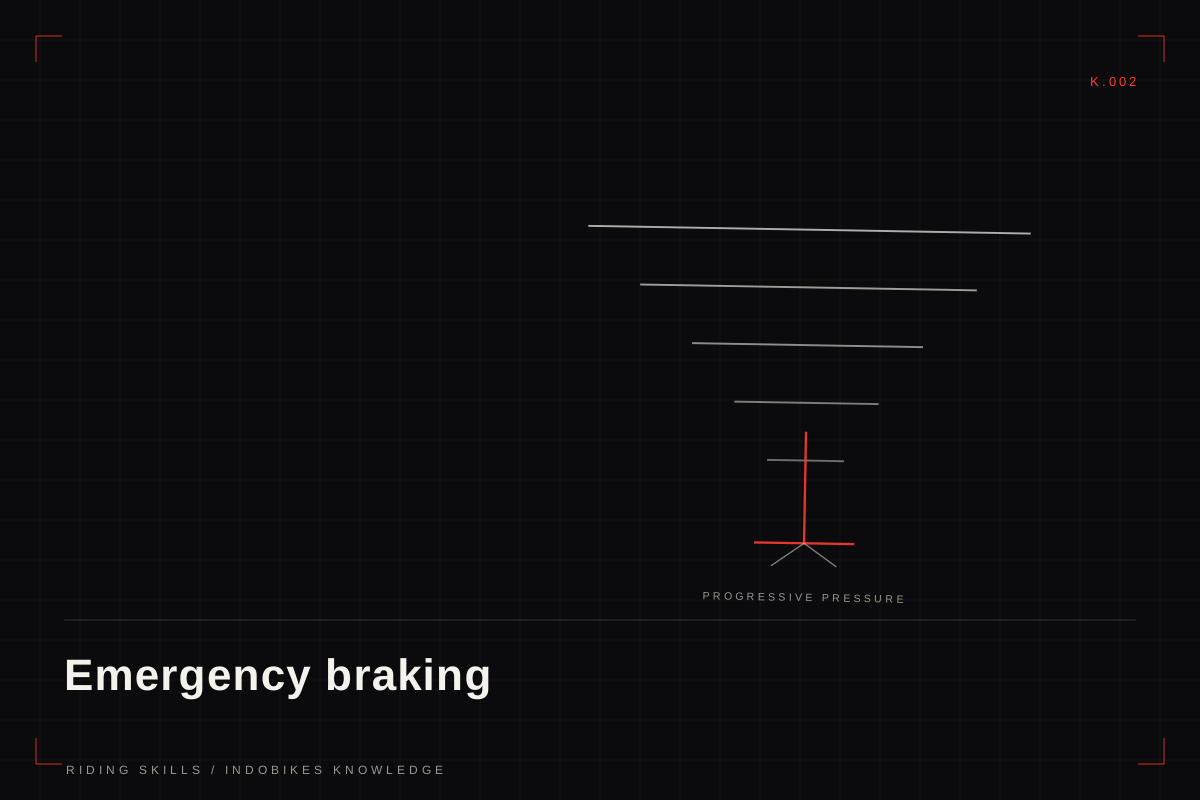
The shortest stop on a motorcycle comes from a straight, progressively squeezed front brake, a light rear brake for stability and a rider who keeps looking for an escape. Grabbing the lever, stamping the pedal or braking mid-lean all lengthen the stop or cause a fall.
The stop, phase by phase
| Phase | Action | What it is doing |
|---|---|---|
| Scan | Look for the gap and the surface | Chooses the plan before the hands move |
| Set up | Throttle off, clutch in, fork settles | Transfers load to the front tyre |
| Squeeze | Progressive front pressure, light rear | Uses the available grip without locking |
| Hold | Firm pressure, eyes up, arms bent | Keeps the bike stable while it slows |
| Release | Smooth release at walking pace | Prevents a last-metre tip-over |
What emergency braking is not
It is not a single hard grab. A cold tyre and a loaded fork need a moment to accept the weight. Snatching the lever asks the front contact patch for maximum grip instantly, before the suspension has transferred load, and the wheel can lock or the fork can dive and upset the steering.
It is not rear-brake-only either. Under hard deceleration the rear wheel carries very little load, so the rear brake contributes a small share of the stopping force and locks easily. Its job is stability and low-speed control, not the main event.
Why the front brake does the work
When a motorcycle decelerates, load shifts forward. The front tyre gains vertical load and therefore grip; the rear unloads. On a clean, dry surface the front brake can use most of the available traction, which is why a straight-line stop is dominated by the front.
That transfer is also why the sequence matters. The fork compresses, the front tyre's contact patch grows and the bike settles. A progressive squeeze lets that happen. A grab arrives before the grip does.
The sequence, in order
Scan first. Look for the gap, not only the obstacle. A stop is a plan, and the plan may be to swerve rather than to stop.
Straighten the bike if you can. Braking while leaned uses part of the tyre's grip for cornering, leaving less for deceleration. If you must brake in a lean, use less pressure and accept a longer stop.
Close the throttle, pull the clutch, and apply the front brake progressively: light, then firm, then maximum as the fork settles. Add light rear brake if the bike is upright and the surface is consistent.
Keep your eyes up and your arms slightly bent. A rider who locks their elbows cannot feel the front tyre and cannot make a small correction.
Release smoothly as you stop. Snapping the lever off at walking pace can unload the fork and drop the bike, especially with a passenger.
What ABS changes
ABS modulates brake pressure when it detects wheel slip. On a motorcycle with ABS, the correct technique is still a progressive squeeze, but you can hold firm pressure once the system is working; the pulsing you feel at the lever is normal and is not a reason to release.
ABS is not a shorter-stop guarantee on every surface. On gravel, sand or a badly broken surface, a locked wheel can build a wedge of material that actually slows the bike, and the ABS may intervene earlier than a skilled rider would. The system also cannot overcome tyres that are worn, cold or overloaded.
Cornering ABS adds a lean-angle dimension, but it is a safety net, not permission to brake later into a turn. The limit of grip is still the limit of grip.
Surface and conditions
On wet tarmac, reduce the initial pressure and lengthen the squeeze. Water sits between rubber and road, and the front tyre has less warning before it lets go.
On gravel and sand, the front brake is easier to lose than the rear. Upright, straight-line braking with more rear bias and gentle front pressure is often more stable, but the stopping distance will be long. This is a case for reading the surface early rather than for a heroic last-second stop.
Painted lines, metal covers, oil and wet leaves offer far less grip than the surrounding road. If you can see them coming, finish the heavy braking before you reach them.
How to practise, and where
Practise on a closed area with a clean, dry surface, an instructor and a machine with good tyres and working brakes. Start at low speed and build gradually. Mark a braking point, measure where the bike stops, and repeat. The goal is a smooth, repeatable sequence, not a single dramatic stop.
Do not practise maximum braking on a public road, and do not practise it with a passenger until you are competent solo. A pillion changes the weight distribution, the fork load and the consequences of a mistake.
Tyres also matter. A cold tyre, an old tyre or one at the wrong pressure will not give the same feedback. Check pressures before a practice session and inspect the tread and sidewalls.
Common errors
Two-finger panic on a stiff lever: the pressure arrives faster than the weight transfer. Use the whole hand, or the fingers your bike's lever and brake are designed for, and squeeze.
Braking with the bars turned at low speed: the bike wants to fall. Straighten first, then brake.
Target fixation: staring at the hazard keeps the bike pointed at it. Look for the escape route.
Releasing the brake immediately after a lock or an ABS pulse: the bike is still slowing, and releasing removes the force that was helping. Hold pressure and let the system work.
Checklist
- Check tyre condition and pressures before practising.
- Use a closed area with run-off and no traffic.
- Start slow and increase speed only when the sequence is smooth.
- Squeeze progressively; do not grab.
- Look for the escape route, not only the obstacle.
- Stop practising when concentration drops.
Questions
Should I use both brakes in an emergency?
On a good surface, yes: the front provides most of the stopping force and a light rear brake adds stability. On gravel or sand, the balance changes and the rear often does more useful work. The common rule is progressive front pressure, light rear, and eyes on the escape route.
Does ABS mean I can brake as hard as I like?
No. ABS prevents sustained wheel lock, but it cannot create grip that is not there. Tyres, surface, lean angle and load still set the limit.
How often should I practise?
A short session every few months keeps the reflex usable. Most riders never practise, which is why the first real emergency stop is also the first attempt.