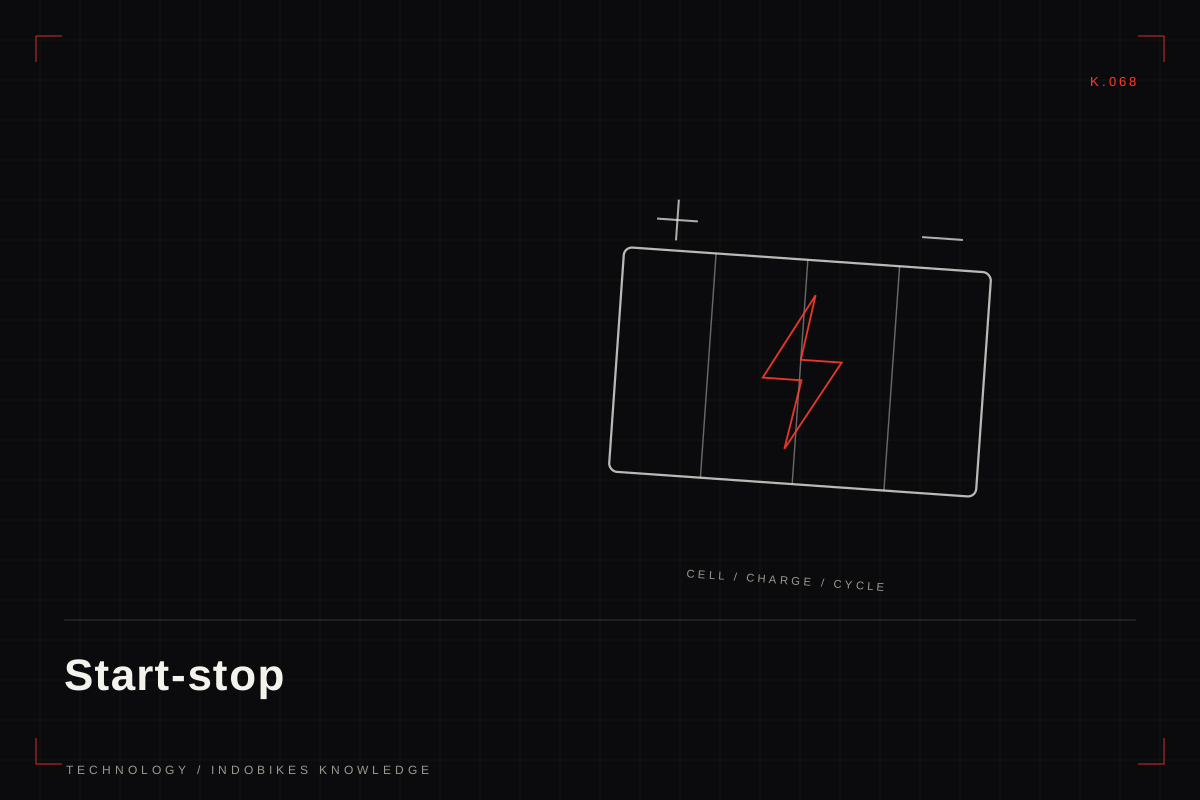
An automatic start-stop system shuts the engine down when the motorcycle is stationary and restarts it when the rider opens the throttle or releases a brake. It saves fuel that would otherwise be burned at idle, but only at stops long enough to matter, and it puts extra demand on the battery, starter and sensors.
Conditions that permit a stop
| Input | Typical requirement | If it is not met |
|---|---|---|
| Engine temperature | At operating temperature | Engine keeps running until warm |
| Battery condition | Enough charge to restart | Stop is suppressed; short trips may never qualify |
| Throttle | Closed | No stop while the rider is asking for power |
| Brake or clutch | Brake held on a scooter; clutch pulled or neutral on a manual | System waits for the expected input |
| Sidestand | Retracted | Stop inhibited for safety |
| Fault memory | No active fault | System disabled until the fault is cleared |
The stop and restart sequence
At a standstill, the control unit cuts fuel and spark once its conditions are met. On a scooter with a conventional automatic transmission, the usual trigger is a closed throttle with the brake held and the machine stationary. On a motorcycle with a manual gearbox, neutral or a pulled clutch is typically part of the logic.
Restart is triggered by the rider's next input: a twist of the throttle, release of the brake, or a press of the starter depending on the design. Some systems use a strengthened starter motor, others an integrated starter-generator that also charges the battery. The restart should feel immediate; a long delay is a sign to have the system checked.
The conditions that must agree
The system will not stop the engine just because the bike is stationary. It checks that the engine is at operating temperature, that the battery has enough charge to restart, that the throttle is closed, that the sidestand is not deployed, and that no fault is present. On scooters, the brake switch is part of the permission.
If any condition is missing, the engine keeps running. That is why a start-stop system may work at one traffic light and not the next: a short run may have left the battery below the threshold, or a brake switch may be intermittent. The behaviour is a diagnostic clue, not a random feature, and it is worth noting when it changes.
Where the fuel saving actually comes from
Fuel saving comes from not burning fuel while the engine is stopped. At a long red light or a level crossing, the engine would otherwise idle for a minute or more, burning fuel and producing exhaust without moving the bike. At a brief pause, the saving is trivial and may be outweighed by the energy needed to restart and recharge.
The emission benefit follows the same logic. Idling produces exhaust and noise without moving the bike, so cutting it improves the air where riders wait. The effect on overall fuel use depends on traffic patterns, engine size and how long the stops are. A start-stop system is not a hybrid and does not recover braking energy unless the machine has a separate system that does.
The parts that carry the extra cycles
A conventional starter is designed for a handful of starts per journey, not dozens. Start-stop systems use components rated for far more cycles: a stronger starter, a battery with better charge acceptance, and often a different charging strategy. The battery is the part most likely to reveal a problem first, because it has to recover between stops.
The extra cycles also reach the ring gear, the starter clutch and the main relay. These parts usually cope when the system is standard, but they are less tolerant of a cheap replacement battery or a starter that was already tired. A motorcycle that cranks slowly after a few stops is telling you the reserve is gone.
Why riders disable it, and when that is reasonable
Some riders switch the system off because the restart delay feels unsafe when they want to move quickly, because the stop interrupts the engine braking or the sound they use to judge traffic, or because the shutdown feels rough. On many machines the system can be disabled for the journey, and the setting may default back on next time.
Disabling it is a preference, not a repair. If the system shudders, restarts late or refuses to stop, the right response is diagnosis. Treating a fault as an annoying feature hides a battery, sensor or starter problem until it becomes a no-start, usually at the least convenient moment. A workshop can check the enabling conditions in minutes.
Maintenance and fault-finding
Maintenance starts with the battery. Use the type and size specified for a start-stop machine, keep the terminals clean, and check the charging system if the engine stops less often than it used to. A battery that is merely adequate for a conventional bike may be marginal here because the system is constantly spending and replacing charge.
Then check the inputs: brake switches, clutch switch, sidestand switch, coolant temperature sensor and speed signal. A scan tool can show which condition is blocking a stop. Do not replace the starter or the control unit on suspicion. The system is usually reporting a real condition, and the cheapest repair is often a connection or a battery.
Checklist
- Read the owner's manual to learn how the system is enabled and disabled.
- Keep the battery at the specified type and in good condition.
- Check brake, clutch and sidestand switches if stops become unreliable.
- Scan for fault codes before replacing starter or control parts.
- Note whether short trips are preventing the system from qualifying.
- Treat a rough or delayed restart as a fault, not a quirk.
Questions
Does start-stop damage the starter?
A system designed for it uses a starter and battery rated for many more cycles, so normal use should not wear them out prematurely. Problems appear when a tired battery or a non-specified replacement is fitted, or when an existing starter fault is ignored.
How much fuel does it save?
It saves the fuel that would have been burned while stationary, so the benefit grows with the length of the stops. In stop-start traffic with long waits it is meaningful; in free-flowing traffic it is small. Riding style and engine size still dominate fuel use.
Can I switch it off permanently?
Many motorcycles let you disable it for a journey, and some remember the setting. Whether a permanent change is possible depends on the model and its software. Use the owner's manual rather than unplugging sensors, which can create faults.