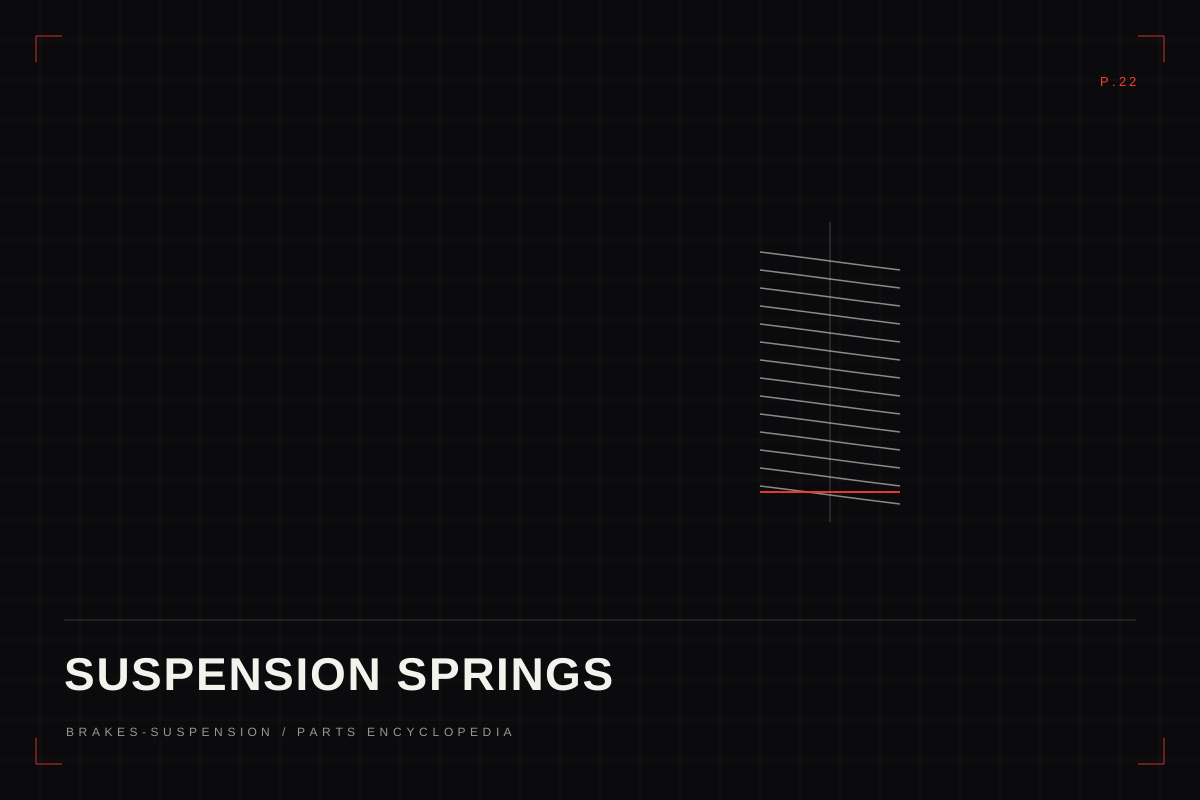
A suspension spring is a coil of steel wire with a known rate: how much force it takes to compress it a set distance. The spring holds the bike at the right height so the damper has travel to work with. If the spring is too soft, the bike sits low and bottoms out. Too stiff and it skips over bumps.
What it does
The spring supports the weight of the bike, rider and luggage. It also stores energy from bumps and returns it. The damper controls that return, but the spring sets the basic behaviour.
Spring rate is usually given in force per millimetre or kilograms per millimetre. Progressive springs change rate as they compress, which can help with varied loads. Linear springs are more predictable for a known weight.
How it works
When a wheel hits a bump, the spring compresses and stores energy. It then pushes back, and the damper slows the release. Preload adjusts the starting point of that travel, not the rate.
Sag is the difference between the fully extended length and the length with the bike and rider aboard. Measuring sag tells you whether the spring is in the right part of its travel and whether preload is appropriate.
Types and variations
- Linear springs. One rate throughout. Predictable and common on road bikes.
- Progressive springs. Rate increases with compression. Useful for bikes that carry varying loads.
- Dual-rate springs. Two sections with different spacing. A compromise between comfort and load capacity.
- Fork springs. Inside the front fork. Often replaced to match rider weight.
- Shock springs. Around the rear damper. Rate and length must match the shock.
Wear and failure signs
- Sag that is too high even with maximum preload, suggesting a tired spring.
- Free length shorter than the service limit.
- Rust, cracks or chipped coating on the coils.
- A bike that bottoms out on routine bumps with the correct load.
- A harsh ride that improves with less preload, suggesting the spring is too stiff.
- Uneven ride height after a spring change, often a mismatched pair.
Choosing a replacement
- Choose rate for the rider and typical load, not for the bike alone.
- Match free length, diameter and end type to the fork or shock.
- Replace fork springs as a pair and rear springs as a pair on twin-shock bikes.
- For a heavily loaded tourer, a higher rate and more preload range may be needed.
- Do not use preload to compensate for a spring that is far too soft. It reduces available droop and makes the ride harsh.
Fit and setup
- Measure sag with the rider aboard in riding gear and the bike at normal load.
- Adjust preload in small steps and recheck sag.
- Fit springs with the correct orientation. Some progressive springs are directional.
- Check that the spring seats properly and does not rub on the fork tube or shock body.
- Recheck damping after a spring change. A stiffer spring may need more rebound control.
Inspection and care
- Clean road salt and mud from the springs and coating.
- Check sag when your weight or luggage changes significantly.
- Inspect for rust at the coil contact points.
- Replace springs when free length is below the limit, not when the ride first feels different.
- Keep the damper in good condition so the spring can do its job.
Safety and limits
A broken spring can jam the suspension or damage the tire. Replace cracked or heavily rusted springs.
Compressed springs store energy. Use a proper spring compressor.
A bike that bottoms out easily can lose grip or damage the frame. Set the suspension for the load.
Questions
How do I know if my springs are worn?
Measure free length against the service limit and check sag with the rider aboard. A spring that needs maximum preload to reach the correct sag is tired.
Do progressive springs improve comfort?
They can help a bike that carries different loads, but they are not automatically more comfortable. Setup matters more than the spring type.
Can I change fork springs without changing the oil?
You can, but the oil has to come out to remove the spring on most forks. It makes sense to change the oil at the same time.
Why is my bike lower at the back after a spring change?
The new spring may have a different free length or rate. Check sag and the shock length before riding.