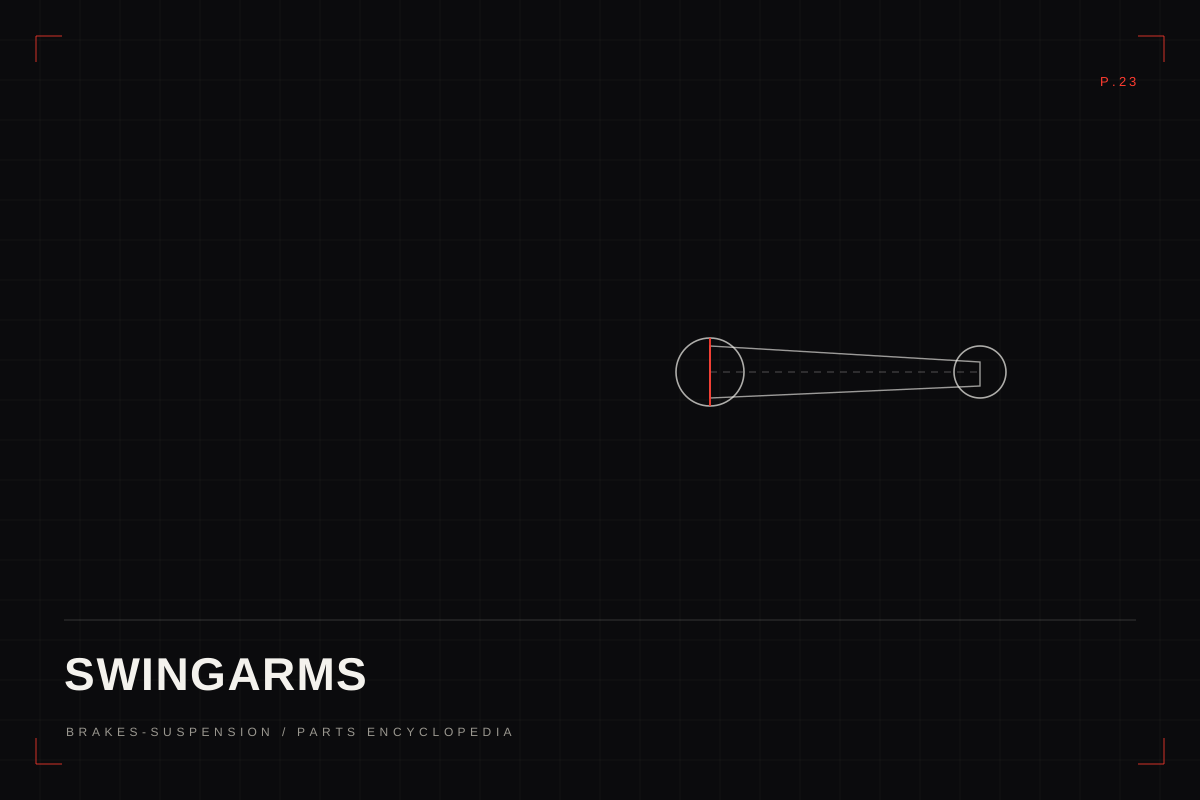
A swingarm pivots on the frame and holds the rear axle. It has to be stiff enough to keep the wheel in line under cornering and braking, and light enough not to upset the suspension. Most problems show up as play, a vague rear end or uneven tire wear.
What it does
The swingarm sets the rear wheel position and lets it move through the suspension travel. It carries drive force from the chain or shaft, braking force from the rear caliper and side load from cornering.
The pivot bearings allow that movement with minimal friction. On a linkage bike, the swingarm also connects to the shock through a set of links and bearings that need grease.
How it works
The swingarm rotates around the pivot bolt as the shock compresses and extends. The rear axle sits in slots or eccentric adjusters at the other end, which set chain tension and wheel alignment.
Stiffness comes from the arm's shape and material. A flexy swingarm lets the rear wheel steer slightly under load, which feels like a vague or wandering rear end. Cracks usually start near the pivot or the shock mount.
Types and variations
- Steel swingarm. Heavy but strong and easy to repair. Common on older and utility bikes.
- Aluminium swingarm. Lighter and stiffer. Common on modern bikes. Cracks are harder to repair.
- Single-sided swingarm. Holds the wheel on one side. Makes wheel removal easier, but adds complexity.
- Belt or shaft drive swingarm. Includes the drive housing. Service and alignment differ from a chain bike.
- Aftermarket swingarm. Changes length or stiffness. Needs matching shock, chain and brake line work.
Wear and failure signs
- Play at the pivot when the rear wheel is rocked side to side.
- A clunk over bumps from worn pivot or linkage bearings.
- Rust or a grease seal that has failed.
- Cracks near the pivot, shock mount or axle slots.
- Rear wheel misalignment, causing uneven chain and tire wear.
- A rear end that feels vague under power, suggesting flex or bearing play.
Choosing a replacement
- Match pivot width, axle size, shock mount and brake caliper mount. Swingarms are not universal.
- For a replacement, check chain adjustment range and wheelbase. A longer arm changes handling.
- Use the correct bearing and seal kit. Needle rollers need the right grease and preload.
- For a damaged aluminium arm, a specialist should assess whether it can be repaired safely.
- Do not fit a longer swingarm without considering the shock, chain length and brake line.
Fit and setup
- Support the bike so the rear is unloaded before removing the rear wheel or shock.
- Torque the pivot bolt to specification and check for free movement without play.
- Align the rear wheel with the adjusters and confirm with a straight edge or string line.
- Set chain tension with the bike loaded as the manual specifies.
- Check brake line and hose routing at full suspension extension.
Inspection and care
- Grease the pivot and linkage bearings at the recommended interval, sooner in wet conditions.
- Check for play at every rear tire change.
- Keep the chain adjuster threads clean and lubricated.
- Inspect for cracks after a drop or impact.
- Do not pressure wash directly at the bearing seals.
Safety and limits
A cracked or badly worn swingarm can fail under load. Stop riding if the rear end clunks or feels loose.
Rear wheel misalignment affects stability and chain life. Check it after every adjustment.
Swingarm and shock work needs the bike supported securely. A side stand is not enough.
Questions
How can I check swingarm bearings?
Put the bike on a stand, hold the rear wheel at twelve and six o'clock and rock it, then at three and nine. Any movement beyond the suspension travel suggests bearing play.
Do I need to remove the swingarm to grease the bearings?
On many bikes, yes, or at least to grease them properly. Some have remote grease points, but most need disassembly.
Can a cracked swingarm be welded?
Sometimes, by a specialist who understands the alloy and heat treatment. A poor weld can make the arm weaker. Replacement is often the safer choice.
Does a longer swingarm improve stability?
It can make the bike less wheelie-prone and more stable under power, but it also slows steering and changes the suspension leverage.