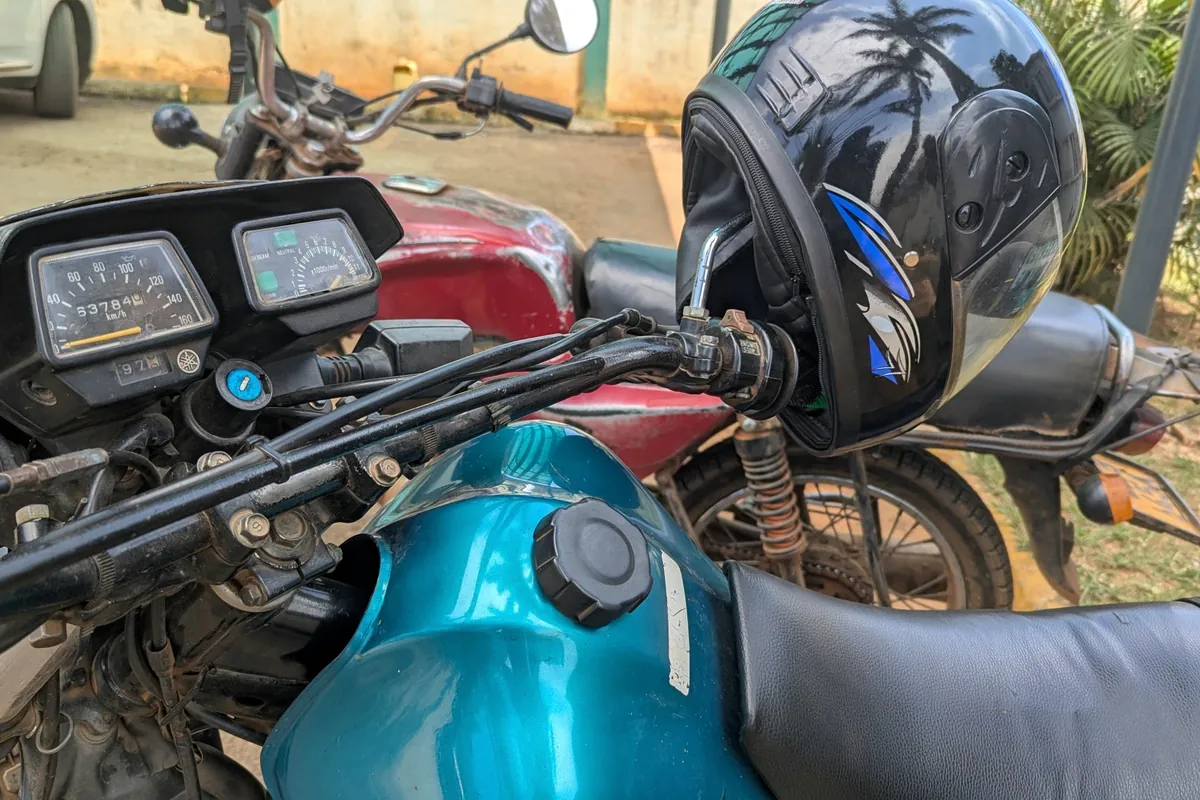
Handlebars are a lever. A wider bar gives more leverage and a slower steering feel. A taller rise sits the rider upright. A different bend changes wrist angle and where the controls fall. Small changes make a large difference over a long ride.
What it does
The bar transmits steering input from the rider to the fork. It also carries the controls, mirrors and often the instruments. The clamp holds it to the top yoke.
Bar diameter and wall thickness affect stiffness and vibration. A thicker bar at the clamp (for example 28.6 mm) can be stronger without being heavy. The grip area diameter is usually 22 mm.
How it mounts
The rider pushes one end and pulls the other to turn the front wheel. A wider bar increases the moment arm, so less force is needed, but the steering feels slower. A narrower bar feels quicker but needs more effort.
Rise and sweep set the wrist and shoulder angle. A bar with too much sweep puts the wrists at an odd angle. Too little sweep can make the reach uncomfortable. The correct bend depends on the rider's size and the bike's layout.
Materials and types
- Standard bar. A single tube with a rise and sweep. Common on naked and commuter bikes.
- Clip-on bars. Two separate bars clamped to the fork legs. Common on sport bikes.
- Fat bar. A larger diameter at the clamp for stiffness. Needs matching risers.
- Cross-braced bar. An extra brace for off-road use. Stiffer and stronger.
- Adjustable bar. Changes height or sweep. Useful for touring bikes.
Wear and failure signs
- A bar that has bent after a drop. Aluminium can crack rather than bend.
- Corrosion under the clamp or at the control mounts.
- A loose clamp that lets the bar move.
- Cracks at the clamp area or at a welded brace.
- Controls that hit the tank at full lock.
- Cables or brake lines that are too tight at full lock.
Choosing a part
- Match the clamp diameter, width, rise and sweep to the bike and the rider.
- Check that the controls, mirrors and cables fit the new bar.
- For a wider bar, check cable and brake line length at full lock.
- Choose aluminium for weight or steel for durability. Both can fail after a heavy impact.
- Do not fit a bar that puts the controls into the tank at full lock.
Fit and compatibility
- Fit the bar in the clamp with the marks aligned and torque the clamp bolts evenly.
- Position the controls so the levers fall naturally under the fingers.
- Check full lock clearance for the tank, screen and mirrors.
- Route cables and brake lines without tight bends or rubbing.
- Check the throttle return with the bars turned both ways.
Care and adjustment
- Check the clamp bolts at every service.
- Inspect for cracks after a drop.
- Keep the clamp area clean and dry.
- Replace a bent bar. Do not bend it back.
- Check cable and line condition after changing the bar.
Safety and limits
A cracked or loose bar can cause a loss of steering. Replace damaged bars.
A throttle that does not return with the bars turned is a serious fault. Check routing.
Do not overtighten the clamp. It can crush the bar and create a stress point.
Questions
Do wider bars make steering easier?
They give more leverage, so less effort is needed. The steering feels slower and the bars are more exposed in traffic.
Can I fit clip-ons to a standard bike?
Only with the correct fork diameter and clearance. The riding position and cable routing change significantly.
How do I know if my bars are bent?
Compare the two sides and check the control positions. A bent bar often makes one grip sit further forward or higher.
Do I need to change cables with a taller bar?
Often yes. Check the routing at full lock before riding.