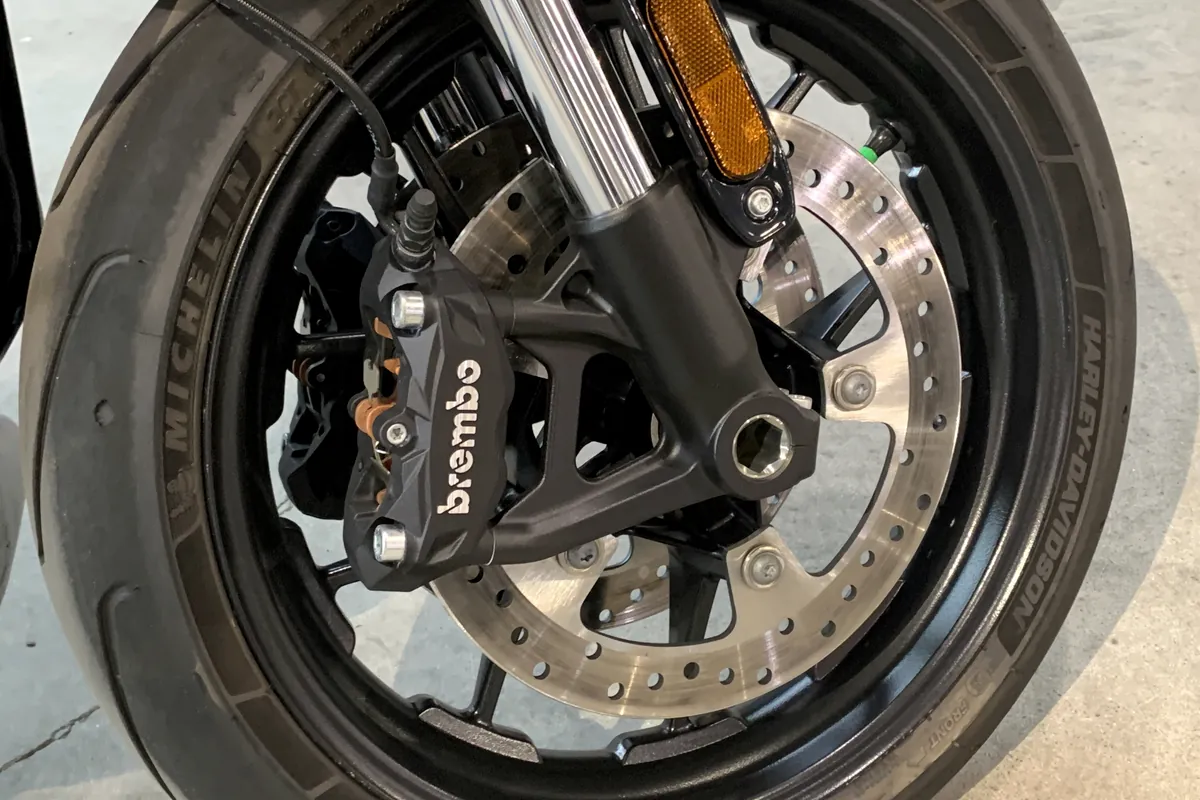
Brake lines look passive, but they expand slightly under pressure. Rubber lines expand more as they age, which is why an old bike can have a firm caliper and a spongy lever. A line also has to survive steering movement, fork travel and years of UV and ozone.
What it does
The line transfers fluid pressure from the master cylinder to the caliper. It must stay flexible enough to follow suspension and steering movement and strong enough not to burst at full pressure.
The fittings at each end matter as much as the hose. A banjo fitting with crushed washers or a flare fitting that is not seated will leak under pressure, often only when the lever is pulled hard.
How it works
Pressure pushes outward on the hose wall. A braided line restricts expansion, so more of the lever travel goes into moving the caliper pistons. That is why braided lines feel firmer, not because they create more pressure.
The line is routed through guides and clips to keep it away from hot parts and sharp edges. A line that rubs on a fork leg or the frame will fail from the outside in, even if the rubber looks sound elsewhere.
Types and variations
- Rubber line. Original equipment on many bikes. Flexible and cheap, but expands with age and can degrade internally.
- Braided stainless over PTFE. Low expansion and good abrasion resistance. Check that it has a protective outer coating if it rubs.
- Two-line kit. One line from the master to each caliper. Simpler routing and easier bleeding than a crossover.
- Crossover line. One line to a caliper, then over the mudguard to the other. Original on many twin-disc bikes.
- ABS hard lines. Rigid pipes with flexible sections at the ends. Do not replace with a simple braided kit unless the ABS routing is supported.
Wear and failure signs
- Cracks in the rubber outer cover, especially near fittings and bends.
- A bulge that appears when the lever is held.
- A soft or spongy lever that does not improve with bleeding.
- Fluid weeping at a banjo bolt, flare nut or crimp.
- A line rubbing on the fork leg, triple clamp or frame.
- A line that is too short at full fork extension or full steering lock.
Choosing a replacement
- Order a kit made for the bike's caliper and master arrangement, including the correct banjo angles.
- Decide between a two-line and a crossover kit. Two lines are easier to bleed; crossover keeps the original look.
- Check the outer coating. A bare braid can wear through paint and nearby hoses.
- For an ABS bike, confirm that the kit is compatible with the pump and sensor routing.
- Replace copper crush washers every time a banjo is opened.
Fit and setup
- Route the line exactly as the original, with clearance at full steering lock and full fork extension.
- Do not twist a braided line to make it fit. A twisted line stresses the fittings.
- Use new copper washers and hold the banjo square when tightening.
- Bleed the system and check for leaks at the fittings under full lever pressure.
- Check the line again after the first ride, when it has settled into its routing.
Inspection and care
- Inspect lines at every service, especially after a drop or a handlebar change.
- Keep the line away from exhaust heat and battery acid.
- Do not use a pressure washer close to the crimps.
- Replace rubber lines at the age the maker recommends, even if they look fine.
- Check the line after fitting bar risers or a different handlebar. The original length may no longer be enough.
Safety and limits
A burst brake line means no brakes. Replace cracked or bulging lines before riding.
Do not reuse crush washers or overtighten banjo bolts. Both cause leaks.
Braided lines can abrade nearby parts. Check clearance with the bars turned both ways.
Questions
Do braided lines improve braking?
They reduce expansion, so more lever travel reaches the caliper. The brakes do not gain power, but the lever feels firmer and more consistent.
How often should brake lines be replaced?
Follow the manufacturer. Rubber lines are often replaced at four to six years. Replace any line that is cracked, bulging or rubbing.
Can I fit a two-line kit to a bike with a crossover line?
Yes on many bikes, if the master cylinder has the right ports and the routing clears the fork and mudguard. Check the kit's instructions.
Why is my lever still soft after new lines?
Air trapped at the master, a leaking crush washer or a caliper that needs bleeding at the highest point. Some ABS systems need a tool to cycle the pump.