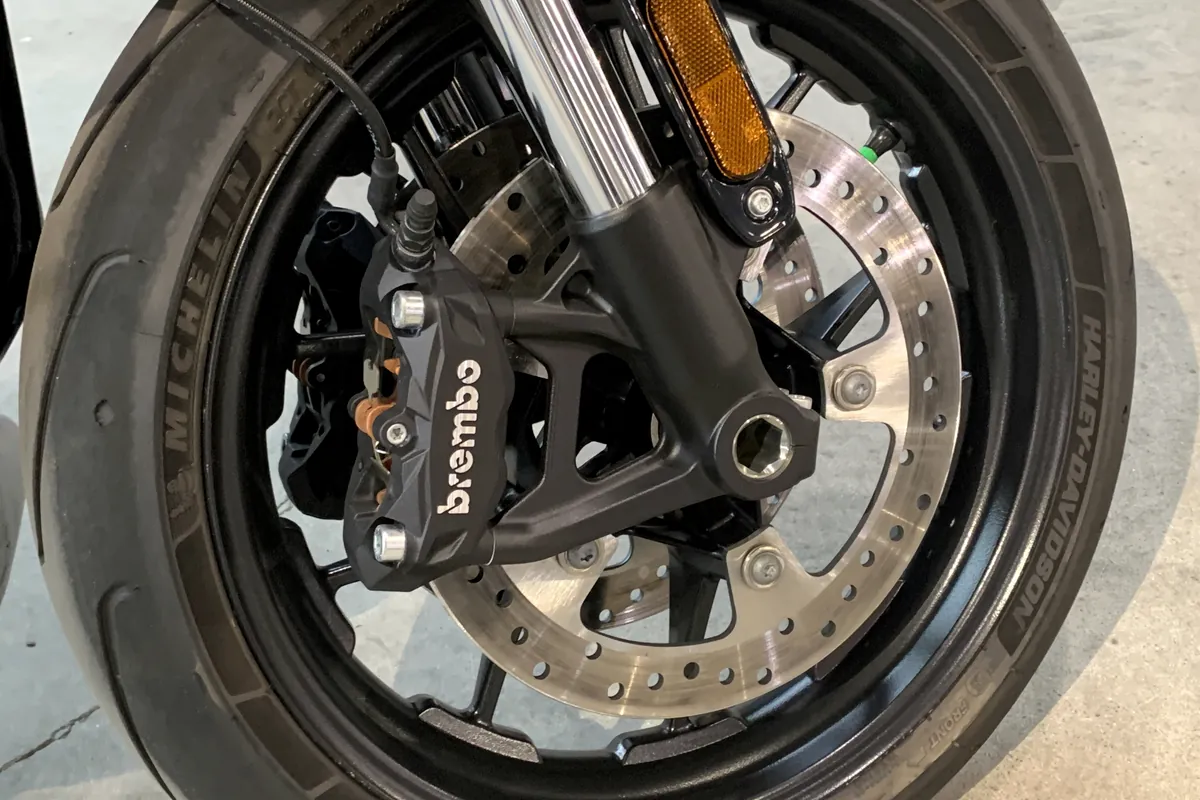
A master cylinder is a small pump. The lever pushes a piston, the piston pressurises fluid, and that pressure travels down the line to the caliper. The ratio between master bore and caliper piston area decides how much force arrives at the disc for a given lever pull.
What it does
The master cylinder creates pressure and holds the fluid reserve. It also contains the compensation port that lets fluid return to the reservoir as the brakes heat and the pads wear.
Bore size changes the hydraulic ratio. A smaller bore gives more pressure for the same lever force but more lever travel. A larger bore gives a firmer, shorter lever and less mechanical advantage.
How it works
When the lever moves, the piston passes the compensation port and closes the system. Further travel pressurises the fluid. A return spring brings the piston back when the lever is released, and the port opens again.
The reservoir is vented through a diaphragm so the fluid can move without drawing in dirt or moisture. A swollen or misplaced diaphragm can cause pressure to build and the brakes to drag.
Types and variations
- Axial master cylinder. Piston moves in line with the lever, mounted on the bar. Common on standard bikes.
- Radial master cylinder. Piston moves at right angles to the lever. Stiffer and often more precise.
- Integral reservoir. The reservoir is part of the body. Compact but harder to check.
- Remote reservoir. A separate reservoir connected by a hose. Common on performance and touring bikes.
- Mechanical and hydraulic clutch masters. Similar parts on the left bar. Do not mix brake and clutch fluid specifications.
Wear and failure signs
- A lever that slowly sinks toward the bar while held under pressure. Usually an internal seal bypassing.
- Fluid weeping at the pushrod or reservoir joint.
- A spongy lever that does not improve after bleeding.
- Black or cloudy fluid, or sediment in the reservoir.
- A swollen diaphragm or a reservoir cap that will not seal.
- Brakes that drag after the lever is released, often a blocked compensation port.
Choosing a replacement
- Match the bore and stroke to the caliper. A larger master with the same caliper reduces lever travel but increases effort.
- Check the lever ratio and the banjo bolt orientation. Radial and axial masters are not interchangeable without the right line.
- For a rebuild, use the correct seal kit. Brake fluid attacks many ordinary rubbers.
- Check that the reservoir, diaphragm and cap are available. A master with no service parts is a short-lived purchase.
- Do not fit a used master of unknown history to a bike you rely on.
Fit and setup
- Bench bleed or fill and bleed the master before connecting the line where possible.
- Use new copper washers on banjo fittings and torque them once.
- Set the lever free play so the compensation port can open when released.
- Check that the reservoir sits level and the diaphragm is not pinched.
- Bleed until the lever is firm, then check for leaks at full pressure.
Inspection and care
- Change brake fluid at the interval in the manual. Water absorbed by the fluid corrodes the bore.
- Keep the reservoir cap clean before opening it, so dirt does not fall in.
- Do not top up fluid to hide pad wear. The level drops as pads wear for a reason.
- Check the lever pivot and pushrod for wear at every service.
- Replace the diaphragm if it is stretched or cracked.
Safety and limits
A master cylinder that bypasses can leave you with no brakes under sustained pressure. Rebuild or replace it.
Brake fluid removes paint and irritates skin. Wear gloves and rinse spills with water.
Do not adjust the pushrod to remove all free play. It can block the compensation port and cause drag.
Questions
Why does my brake lever slowly sink?
A worn primary seal is the usual cause. Fluid passes the piston instead of going to the caliper. Rebuild the master cylinder and check for external leaks.
Can I upgrade to a radial master cylinder?
Yes, if the bore, lever ratio and line fit match the caliper and the bike. A radial master can improve feel, but the wrong bore makes it worse.
How often should brake fluid be changed?
Follow the manual, usually every one to two years. In a humid climate, test the fluid or change it on the shorter interval.
Do I need to bleed after topping up?
No, if you only added fluid to the reservoir. If the level dropped because of a leak or a line was opened, bleed the system.