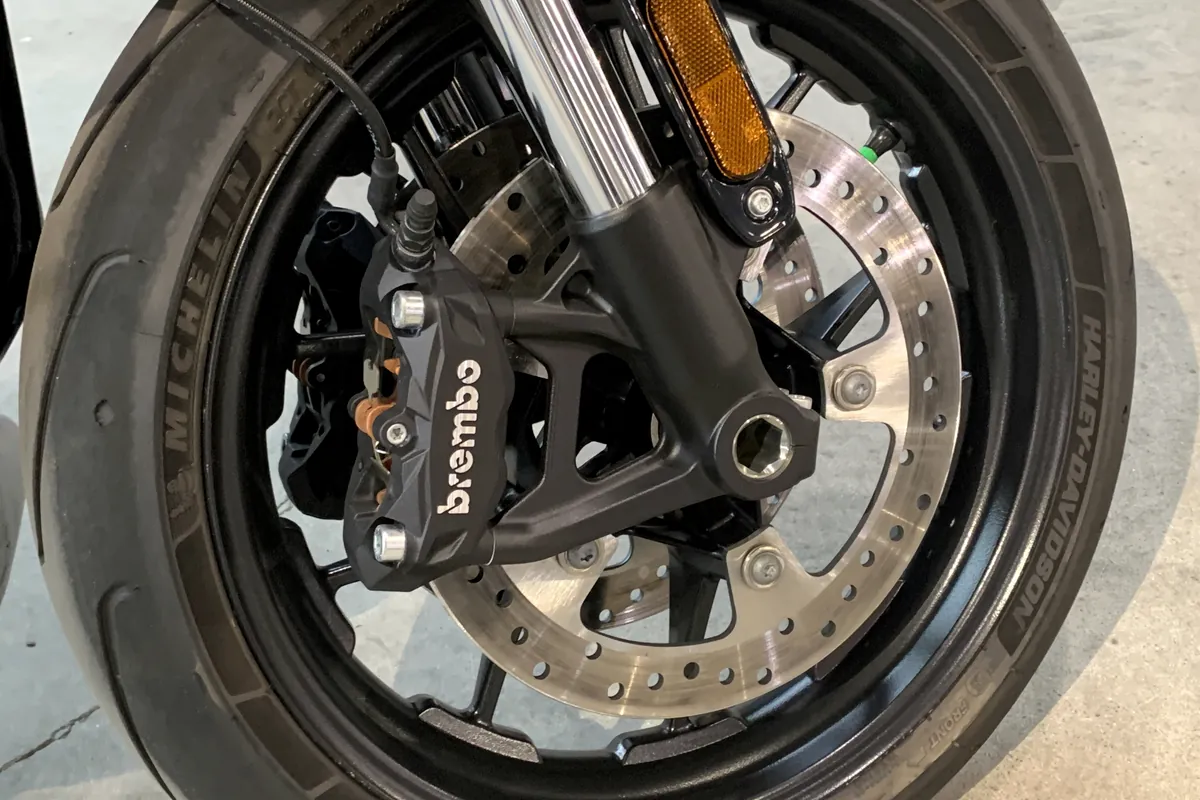
A brake disc looks like a flat steel ring, but its shape is calculated. Drilling and slots clear water and gas, the inner carrier saves weight and floating bobbins let the disc expand without warping. A disc below its minimum thickness has less metal to absorb heat, so it runs hotter and warps sooner.
What it does
The disc gives the pads a hard, flat surface to grip. It also stores the heat generated during braking and releases it to the air. Bigger discs and thicker discs hold more heat, which is why a worn disc fades earlier on a long descent.
The disc is mounted to the wheel hub. A fixed disc bolts directly to the hub. A floating disc uses bobbins so the friction ring can move slightly, which keeps the pads square and reduces drag as parts heat and expand.
How it works
The caliper squeezes the pads onto both faces of the ring. Friction slows the ring and the wheel with it. The drilling and slots break the film of water in the rain and give gas and dust somewhere to go.
Runout is measured with a dial gauge while the wheel turns. A disc that moves sideways more than the service limit pushes the pads back, giving a long lever and a pulsation through the brake.
Types and variations
- Fixed discs. One-piece ring and carrier. Simple and stiff. Common on commuter bikes.
- Floating discs. A separate ring on bobbins. Better alignment under heat and less drag.
- Semi-floating. Limited movement through springs or wave washers. A middle ground.
- Drilled and slotted. Holes or slots clear water and gas. Also change pad wear and noise.
- Wave discs. A scalloped outline. Mostly a styling and weight choice; check pad contact with the wave edge.
Wear and failure signs
- Thickness at or below the minimum stamped on the disc or listed in the manual.
- Visible ridges, deep scoring or a blue heat tint after heavy use.
- Runout beyond the limit, felt as pulsation at the lever.
- Loose or seized bobbins on a floating disc. A rattle at low speed can be normal; a disc that will not move is not.
- Cracks around drilled holes, usually after severe heat cycling.
- A worn step at the outer edge where the pad does not sweep.
Choosing a replacement
- Match diameter, thickness, offset and bolt pattern. A disc that fits the wheel may still sit at the wrong offset for the caliper.
- Check whether the bike uses a fixed or floating disc and whether the caliper expects that.
- Buy a disc rated for the bike's weight and use. Very light race discs are not a good choice for a loaded touring bike.
- Replace discs in pairs on the front. Mixed wear changes balance and feel.
- Fit new pads with a new disc, and bed them in together.
Fit and setup
- Clean the hub face and the disc mounting surface. A speck of grit creates runout.
- Tighten the mounting bolts in a cross pattern to the specified torque. Use new bolts if the manual says they are one-time parts.
- Check runout after fitting. If it is out, check the hub face before condemning the disc.
- On a floating disc, check that the bobbins move and the circlips are seated.
- Spin the wheel and listen for rubbing before the first ride.
Inspection and care
- Measure thickness with a micrometer at several points, not with a ruler at the edge.
- Keep brake cleaner off the wheel bearing seals and painted surfaces.
- Do not turn or skim a motorcycle disc unless the maker allows it. Most are too thin to machine.
- After a long descent, let the discs cool before washing the bike. Cold water on hot metal can warp a disc.
- Check the bobbins for free play at every pad change.
Safety and limits
A cracked or below-limit disc can fail under hard braking. Replace it rather than machining it.
Pulsation that gets worse is not a characteristic. It is a warning.
If a disc bolt is missing or loose, do not ride the bike.
Questions
How do I know if a disc is warped?
Measure runout with a dial gauge on the bike, or have a workshop check it. A pulsating lever and a front-end shudder are symptoms, but a sticking caliper or loose steering bearing can feel similar.
Can a disc be resurfaced?
Rarely. Motorcycle discs are thin and have little material to remove. If it is scored or below thickness, replace it.
Do floating discs rattle?
Some movement and a light rattle at low speed is normal. Excessive play, missing circlips or a ring that rocks visibly is not.
Should I replace both front discs together?
On a twin-disc front end, yes. Matching thickness and surface condition keeps braking even.