Model problems — Indonesia
Model Problems: The Same Symptom Means Something Different on Every Bike
100 guides that start with the machine you own, not a generic list. Each one explains how the symptom behaves on that model, what to check first and when to stop.

A Honda BeAT that will not start and a Kawasaki ZX-25R that will not start are not the same diagnosis. One has an air-cooled single, an ACG starter and a CVT; the other has an inline-four, four throttle bodies and a manual gearbox. The symptom is shared. The test order is not.
These pages are organised by model and symptom for that reason. Each guide names the configuration that matters, describes the safe checks an owner can make, then sets out the workshop tests that separate a cheap fault from an expensive one. Nothing here replaces a mechanic with the machine in front of them, but it should make the conversation shorter.
Model names and engine layouts are used to organise the guides. Where a model year or variant changes the answer, the article says so. No article claims a failure rate, a recall, a service interval or a repair price.
Start here Six common questions
A symptom, a machine, a test order
Each guide answers one search: why this model behaves this way, what an owner can check safely, and what a workshop should test next.
 Starting
BeAT starting fault, in test order
The BeAT is simple, but a no-start can come from the battery, an interlock, the fuel pump or the ignition. This guide separates them before any panel comes off.
Read the diagnosis ↗ Running
PCX 160 stalling, pattern by pattern
The PCX 160 stops at junctions by design when idle stop is active. A real stall leaves different clues, and the pattern tells you where to look.
Read the diagnosis ↗ Drivetrain
NMAX judder, source by source
The NMAX spends a lot of its life at low speed, which is exactly where a tired CVT shows up. A judder from a stop is a wear signal, not a reason to replace the belt blindly.
Read the diagnosis ↗ Drivetrain
R15 chain noise, checked in order
The R15 puts more load through its chain than a commuter, and a slightly slack chain becomes audible under acceleration long before it fails.
Read the diagnosis ↗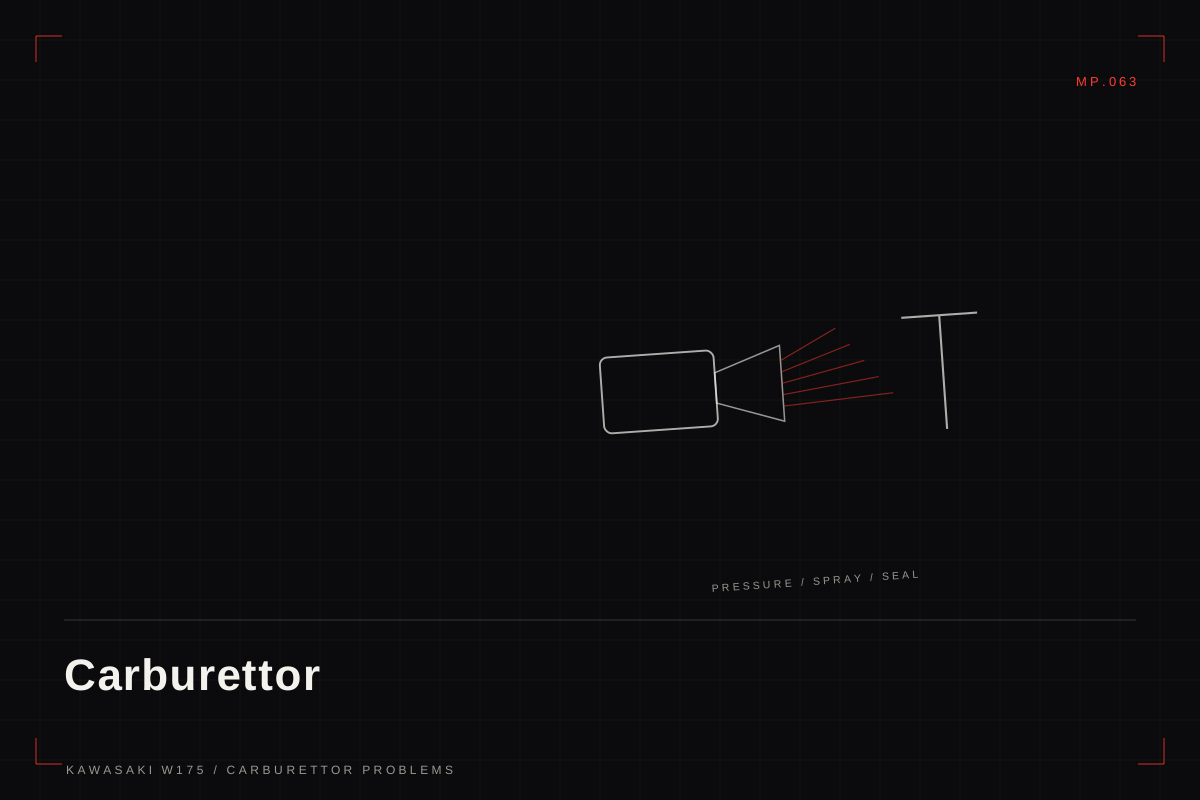 Fuel
W175 carb, rich or lean
A carburettor tells you what it is doing through the spark plug, the exhaust and the way the engine picks up. Read those before removing the bowl.
Read the diagnosis ↗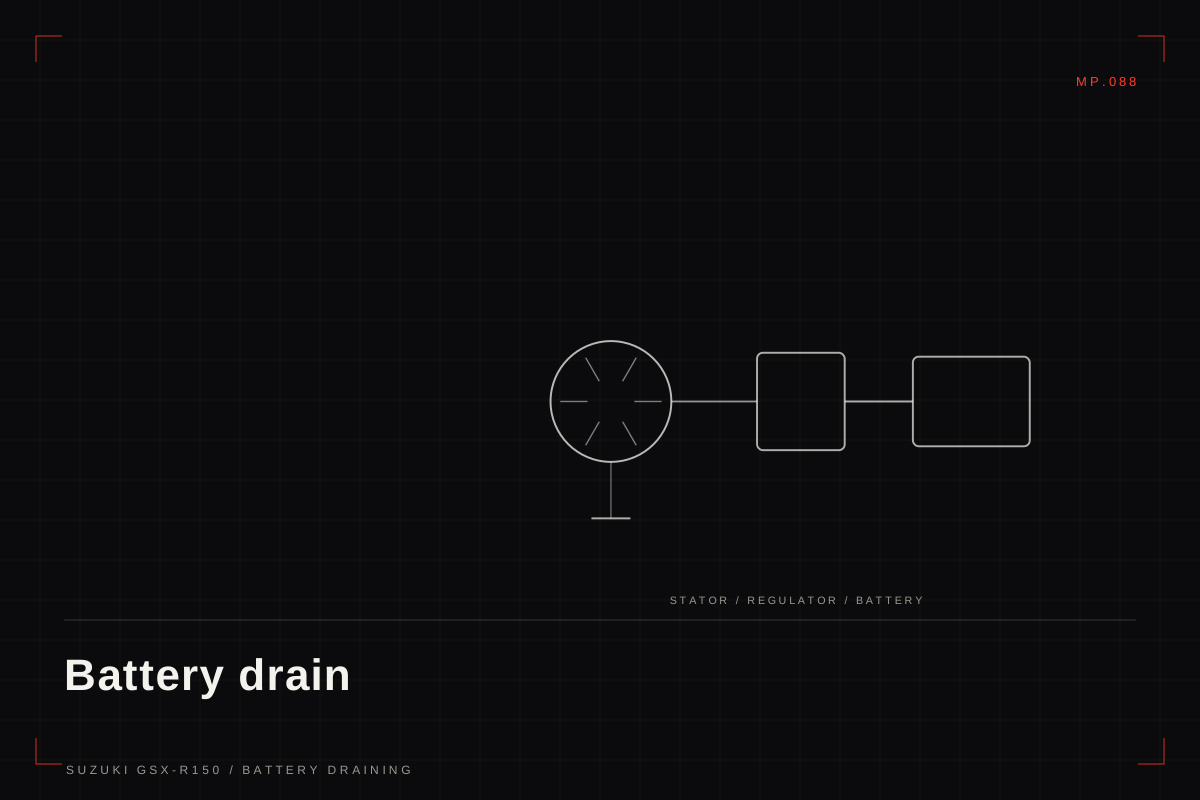 Electrical
GSX-R150 battery drain, three causes
A small battery, a keyless option on some variants and a busy accessory market. A flat battery is usually a load, a charger or a worn cell.
Read the diagnosis ↗100 guides
Brand
Model
Symptom
Library All guides
100 guides, grouped by the machine
Choose a brand, narrow to a model, then pick the symptom. Every card is a full page, not a placeholder.
01 Brand
Honda
30 guides across 5 models.
HONDA BeAT
Honda BeAT 110
StartingBeAT starting fault, in test order
The BeAT is simple, but a no-start can come from the battery, an interlock, the fuel pump or the ignition. This guide separates them before any panel comes off.
Read the diagnosis ↗ Running
BeAT stalling, pattern by pattern
A BeAT that dies at a junction, only when hot, or only after rain is giving you three different clues. The pattern is the diagnosis before the parts list.
Read the diagnosis ↗ Electrical
BeAT battery drain, three causes
A BeAT battery that keeps going flat is either worn out, not being charged or losing current while parked. The tests are cheap; the guesswork is not.
Read the diagnosis ↗ Drivetrain
BeAT CVT vibration, source by source
A BeAT that shudders away from a stop is not always asking for a new belt. The clutch, rollers, variator faces and mounts each produce a different vibration.
Read the diagnosis ↗ Performance
BeAT acceleration loss, split by cause
A BeAT that has lost its pull is either not making power or not putting it down. The test is to find which side of the engine-to-wheel chain is failing.
Read the diagnosis ↗ Fuel
BeAT fuel use, cause by cause
Fuel consumption complaints are usually about a change, not a brochure figure. Measure the change properly, then find the system that explains it.
Read the diagnosis ↗HONDA Scoopy
Honda Scoopy 110
 Starting
Scoopy no-start, in order
The Scoopy hides its electrics under styled panels. The no-start checks start with what you can hear and see, not with a screwdriver and a panel clip.
Read the diagnosis ↗ Cooling
Scoopy heat, air-cooled checks
The Scoopy has no radiator and no coolant. Overheating means the air path, the oil or the load has exceeded what the engine can shed. The checks are different.
Read the diagnosis ↗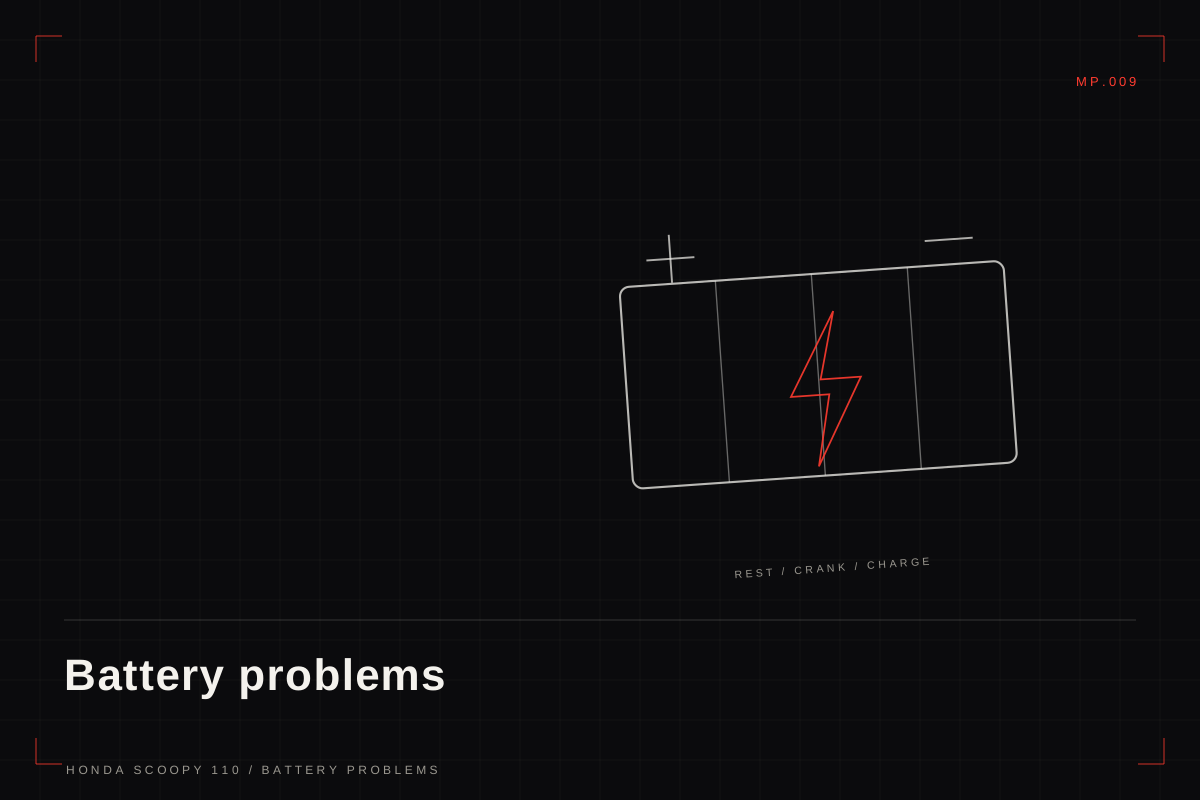 Electrical
Scoopy battery faults, tested
A Scoopy battery problem can be the battery, the terminals, the charging system or the idle-stop load. The order of testing matters more than the brand of the replacement.
Read the diagnosis ↗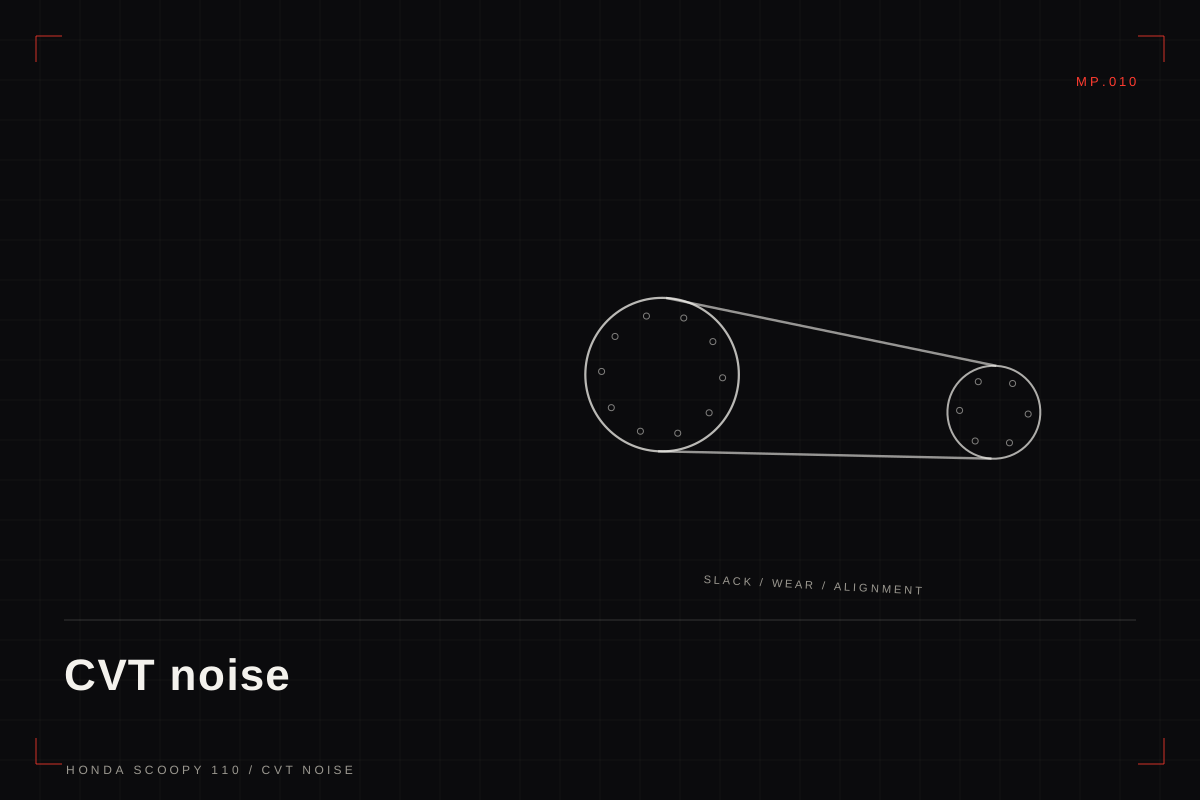 Drivetrain
Scoopy CVT noise, by sound
A chirp at take-off, a squeal at speed and a rumble on the overrun are three different CVT faults. Identifying the sound is half the diagnosis.
Read the diagnosis ↗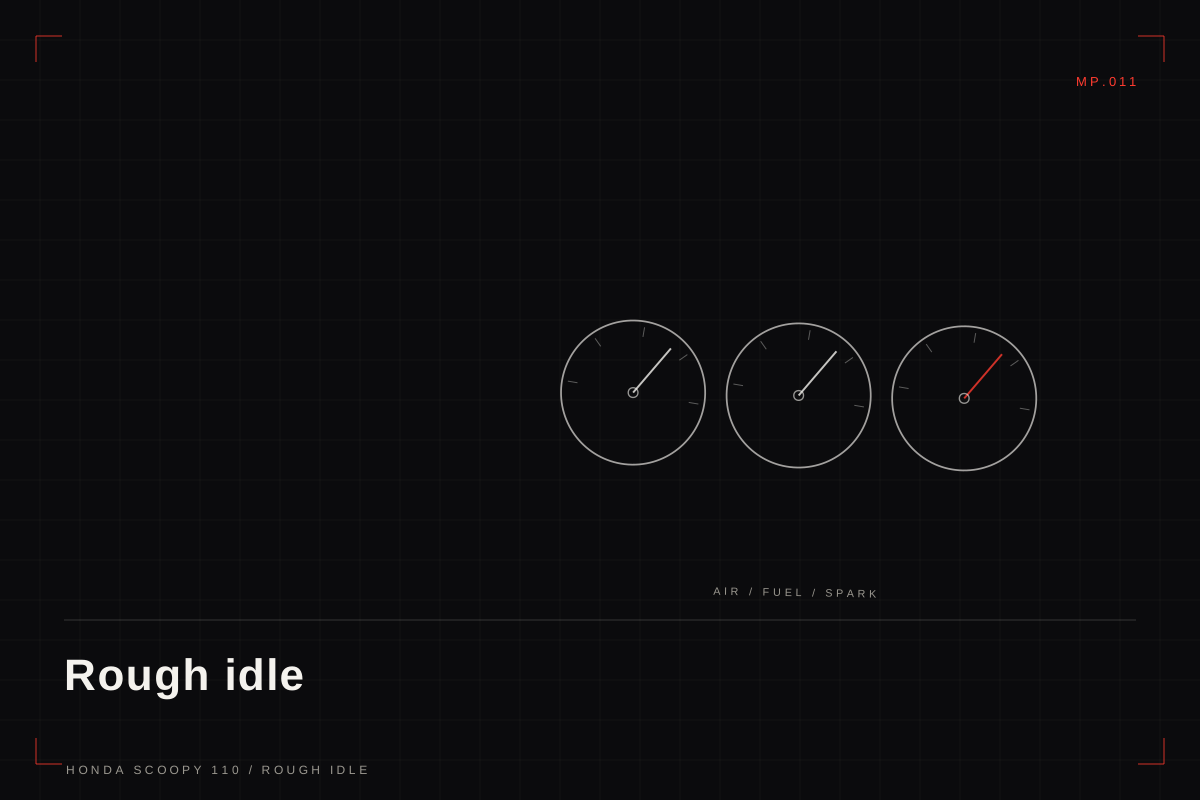 Running
Scoopy rough idle, cause by cause
An air-cooled single should idle with a steady, even beat. A Scoopy that hunts, shakes or smells rich at a stop is telling you where to look first.
Read the diagnosis ↗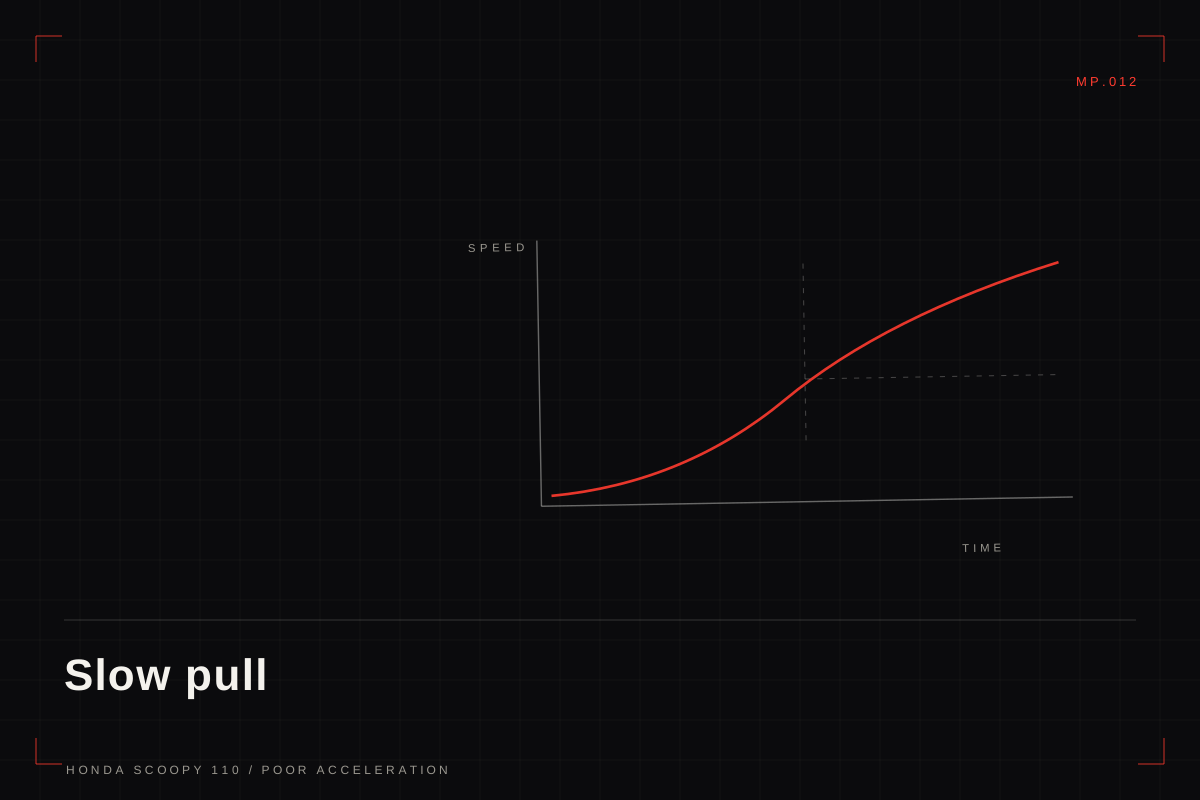 Performance
Scoopy slow acceleration, split by cause
A Scoopy that has lost its sparkle is usually losing drive somewhere between the piston and the road. The order of checks keeps the repair cheap.
Read the diagnosis ↗HONDA Vario 125
Honda Vario 125
 Starting
Vario 125 no-start, in order
The Vario 125 packs a liquid-cooled engine and modern electrics into a compact body. A no-start is usually a supply or interlock fault, not a mechanical failure.
Read the diagnosis ↗ Running
Vario 125 stalling, pattern by pattern
A liquid-cooled scooter can stall for reasons an air-cooled one cannot. Coolant, the radiator fan and the idle control all belong in the diagnosis.
Read the diagnosis ↗ Electrical
Vario 125 flat battery, three patterns
A keyless scooter never fully sleeps. A Vario 125 battery that dies while parked is losing capacity, losing charge or feeding a standby load that is larger than it should be.
Read the diagnosis ↗ Drivetrain
Vario 125 vibration, located by frequency
Not every shake comes from the CVT. A Vario 125 gives three different vibration signatures, and the test ride can tell them apart before a panel is removed.
Read the diagnosis ↗ Performance
Vario 125 lost pace, in order
A liquid-cooled 125 should hold its pace in traffic. When it stops, the cause is usually drag or drive wear before it is the engine.
Read the diagnosis ↗ Fuel
Vario 125 fuel use, checked in order
Fuel consumption is a ratio, not a feeling. Two measured tanks and five cheap checks will find most Vario 125 complaints before a scanner is needed.
Read the diagnosis ↗HONDA Vario 160
Honda Vario 160
 Cooling
Vario 160 overheating, step by step
The Vario 160 has a radiator, a fan and a coolant pump. Overheating is a system fault, and the first rule is never to open the cap when hot.
Read the diagnosis ↗ Drivetrain
Vario 160 shudder under load
The Vario 160's extra torque exposes a tired CVT sooner. A shudder that appears only with a passenger is a different clue from one that appears at a steady speed.
Read the diagnosis ↗ Electrical
Vario 160 battery, load by load
A Vario 160 asks more of its battery than a simple commuter. Idle stop, keyless entry and accessories all draw current that the charging system must replace.
Read the diagnosis ↗ Starting
Vario 160 no-start, three branches
The Vario 160 gives you three clues in the first minute: panel brightness, pump prime and brake light. Use them before removing a panel.
Read the diagnosis ↗ Running
Vario 160 stall or idle stop?
The Vario 160 can switch off at a junction by design. A stall is different, and the difference decides whether you need a workshop or the owner's manual.
Read the diagnosis ↗ Performance
Vario 160 lost pace, in order
The Vario 160 has enough power for city traffic and a passenger. If it feels flat, the ratio and the rolling gear usually explain it before the engine does.
Read the diagnosis ↗HONDA PCX 160
Honda PCX 160
 Starting
PCX 160 no-start, in order
The PCX 160 hides its battery and fuses behind bodywork. The no-start checks start with the key, the panel and the pump, not with a screwdriver.
Read the diagnosis ↗RunningPCX 160 stalling, pattern by pattern
The PCX 160 stops at junctions by design when idle stop is active. A real stall leaves different clues, and the pattern tells you where to look.
Read the diagnosis ↗ Electrical
PCX 160 battery drain, three causes
A keyless PCX never fully sleeps. A flat battery is either a worn battery, a charging fault or a standby load that is larger than the design allows.
Read the diagnosis ↗ Drivetrain
PCX 160 judder, source by source
The PCX 160 is heavier than a small commuter, so the clutch works harder at low speed. A judder from a stop is a wear signal with a short list of causes.
Read the diagnosis ↗ Cooling
PCX 160 overheating, step by step
The PCX 160 is liquid-cooled and often ridden at sustained speed. Overheating is a system fault, and the first rule is never to open the cap when hot.
Read the diagnosis ↗ Fuel
PCX 160 fuel use, cause by cause
The PCX 160 is a heavier scooter with a larger engine. Its economy depends on how it is ridden, how it is loaded and whether the CVT and cooling system are healthy.
Read the diagnosis ↗02 Brand
Yamaha
30 guides across 5 models.
YAMAHA NMAX 155
Yamaha NMAX 155
 Starting
NMAX no-start, in order
A NMAX that will not start rarely has a VVA fault. The key system, the battery and two switches account for most no-starts, and they are the quickest to check.
Read the diagnosis ↗ Running
NMAX stalling, pattern by pattern
A NMAX that dies at a junction is usually losing idle control, coolant performance or fuel pressure. The VVA system is a convenient suspect and an uncommon culprit.
Read the diagnosis ↗ Electrical
NMAX battery drain, three causes
A NMAX with a keyless system and idle stop asks more of its battery than a simple commuter. A flat battery is either worn, undercharged or feeding a standby load.
Read the diagnosis ↗DrivetrainNMAX judder, source by source
The NMAX spends a lot of its life at low speed, which is exactly where a tired CVT shows up. A judder from a stop is a wear signal, not a reason to replace the belt blindly.
Read the diagnosis ↗ Performance
NMAX lost pace, in order
A NMAX that feels flat is usually losing drive through the CVT or fighting rolling drag. The VVA system is a feature to understand, not the first part to replace.
Read the diagnosis ↗ Fuel
NMAX fuel use, cause by cause
A NMAX is efficient for its size, but city traffic, a passenger and a worn CVT can move the figure a long way. Measure the change before diagnosing it.
Read the diagnosis ↗YAMAHA Aerox 155
Yamaha Aerox 155
 Starting
Aerox no-start, traced from the dash
The Aerox hides its battery and fuses behind sport bodywork. The fastest diagnosis comes from the dash, the brake light and the pump whine, not from removing a side panel.
Read the diagnosis ↗ Running
Aerox stalling, judged by conditions
An Aerox that dies in a queue, at a closed throttle or on a hot afternoon is giving three separate clues. The conditions matter more than the model's reputation.
Read the diagnosis ↗ Electrical
Aerox battery drain, audited
A sport scooter collects accessories. Every charger, alarm and tracker is a small load, and together they can empty a healthy battery over a week of short rides.
Read the diagnosis ↗ Drivetrain
Aerox judder, judged under load
The Aerox rewards a firm throttle, and that is exactly when a worn CVT complains. Whether the judder appears only under load tells you which part is struggling.
Read the diagnosis ↗ Performance
Aerox lost pace, solo and loaded
A sporty body does not change the physics. An Aerox that feels flat is losing drive, fighting drag or running short of air, and a two-run road test tells you which.
Read the diagnosis ↗ Cooling
Aerox overheating, cause by cause
The Aerox cools well when moving and struggles when stopped. That difference is the first clue, and it costs nothing to observe.
Read the diagnosis ↗YAMAHA Fazzio
Yamaha Fazzio 125
 Starting
Fazzio no-start, in order
The Fazzio does not crank like an older scooter. Riders often assume it has failed when it is simply waiting for a signal or a better battery.
Read the diagnosis ↗ Running
Fazzio stalling, judged by pattern
The assist system can make a stop feel different from an older scooter. It cannot make a healthy engine cut out, and the pattern of the stall proves it.
Read the diagnosis ↗ Electrical
Fazzio battery, load and test
The assist system charges and discharges the same battery that starts the scooter. That makes battery condition more visible here than on a simple commuter.
Read the diagnosis ↗ Drivetrain
Fazzio CVT noise, sorted by sound
A squeal, a rattle and a slap come from three different parts of the same transmission. Naming the noise correctly is half the repair.
Read the diagnosis ↗ Performance
Fazzio lost pace, in order
The assist system adds a useful push at low speed. It cannot compensate for a soft tyre, a dragging brake or a worn belt, and expecting it to is how repairs start in the wrong place.
Read the diagnosis ↗ Fuel
Fazzio fuel use, checked in order
A light scooter is sensitive to small changes. A soft tyre or a worn belt can move the figure more than a sensor ever would.
Read the diagnosis ↗YAMAHA XSR155
Yamaha XSR155
 Starting
XSR155 no-start, in order
A manual bike can refuse to start for reasons a scooter never has: clutch position, neutral, a stand that is down. Those checks cost seconds.
Read the diagnosis ↗ Running
XSR155 stalling, cause by cause
A manual bike stalls for reasons a scooter cannot, and the rider is sometimes part of the diagnosis. Separating the two saves a workshop visit.
Read the diagnosis ↗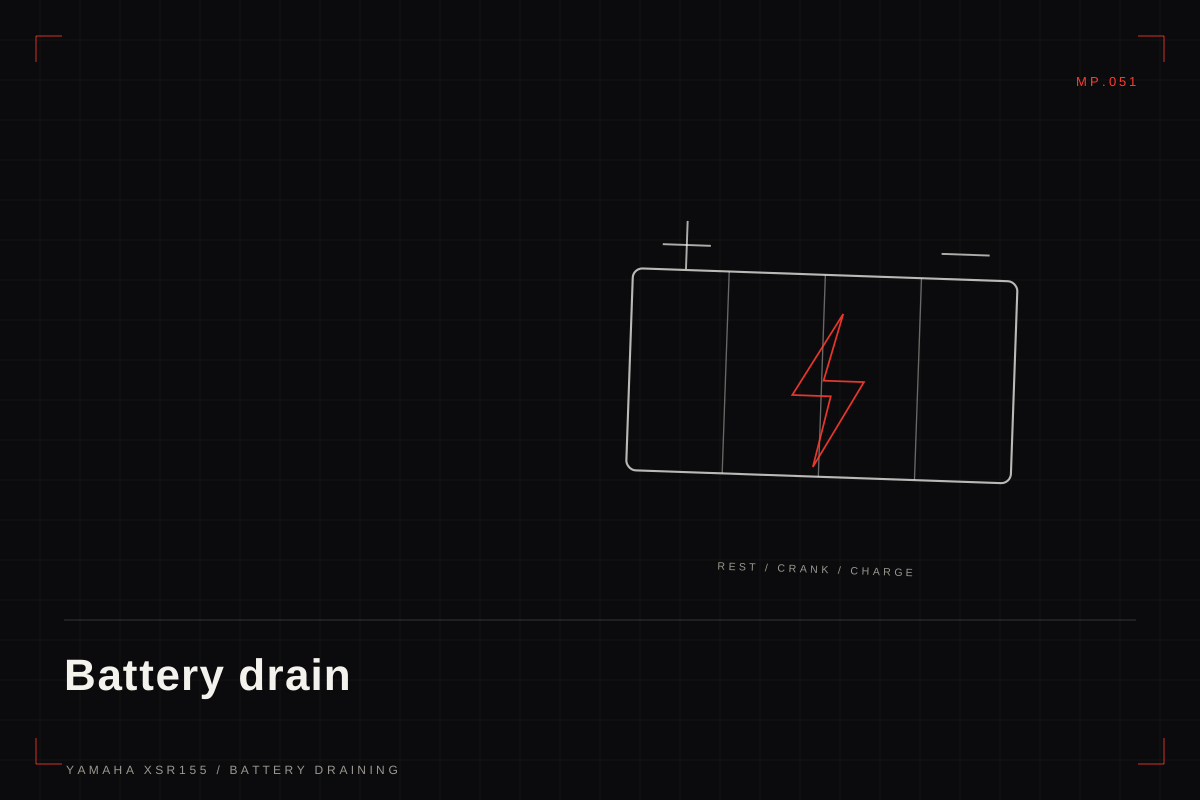 Electrical
XSR155 battery drain, step by step
A naked 155 has a small battery and a small charging margin. A tracker or a charger left live can empty it in a week of short rides.
Read the diagnosis ↗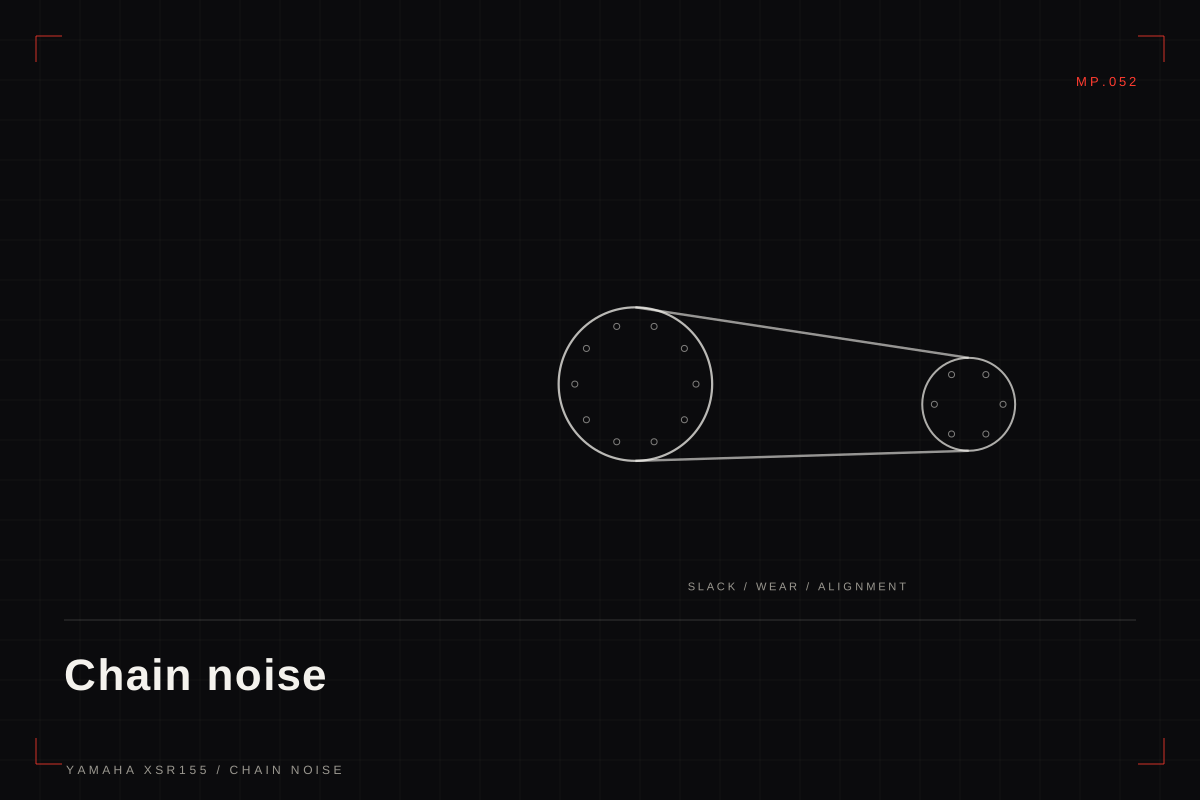 Drivetrain
XSR155 chain noise, checked in order
A chain is the cheapest final drive to maintain and one of the most expensive to neglect. The type of noise tells you which part has worn.
Read the diagnosis ↗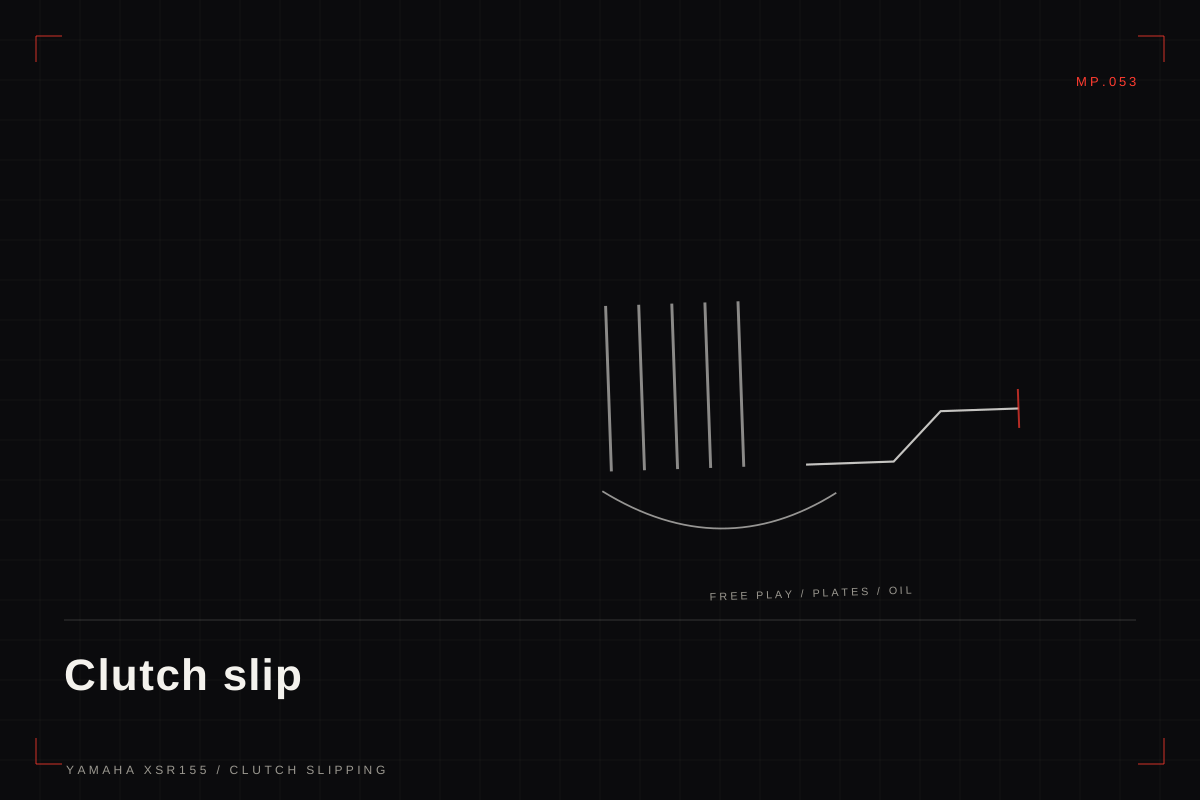 Drivetrain
XSR155 clutch slip, cause by cause
A slipping clutch is not always worn out. Free play, oil and cable routing can produce the same symptom on a healthy set of plates.
Read the diagnosis ↗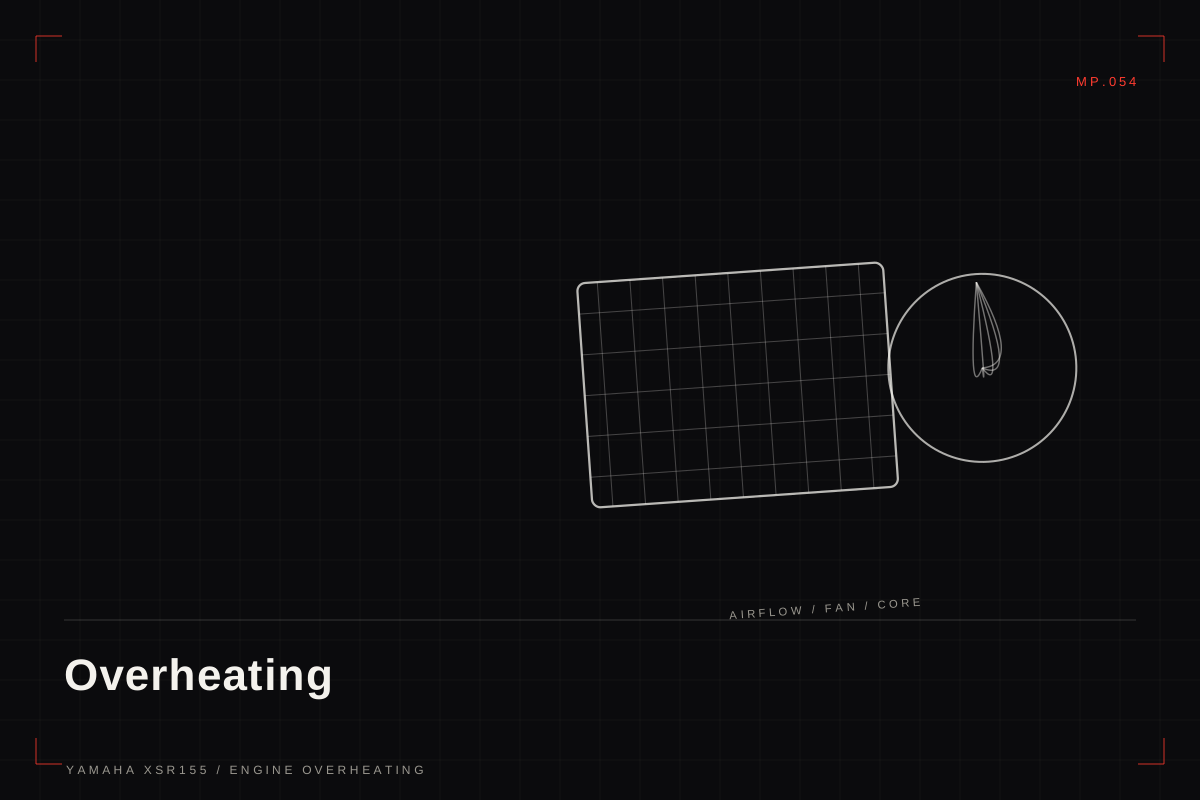 Cooling
XSR155 overheating, step by step
A naked bike has good airflow at speed and none at a red light. Overheating that only happens in a queue is a fan and radiator story.
Read the diagnosis ↗YAMAHA R15
Yamaha R15
 Starting
R15 no-start, in order
A fully faired bike punishes guesswork. Most no-starts are decided by a switch or the battery, long before a fairing bolt needs to come out.
Read the diagnosis ↗ Running
R15 stalling, cause by cause
A high-revving 155 can stall for reasons a commuter never shows: a hot engine at a light, a rushed clutch and a lean idle.
Read the diagnosis ↗ Electrical
R15 battery drain, three causes
A sport bike with a small battery and a big accessory market. A tracker or alarm can be the difference between a strong start and a flat battery.
Read the diagnosis ↗DrivetrainR15 chain noise, checked in order
The R15 puts more load through its chain than a commuter, and a slightly slack chain becomes audible under acceleration long before it fails.
Read the diagnosis ↗ Drivetrain
R15 clutch slip, cause by cause
A sport bike is ridden harder, so a marginal clutch shows up sooner. Adjustment and oil are still the first suspects, not the last.
Read the diagnosis ↗ Cooling
R15 overheating, step by step
The R15's fairing helps at speed and hinders at a standstill. Where the temperature rises tells you which side of that trade-off has failed.
Read the diagnosis ↗03 Brand
Kawasaki
20 guides across 4 models.
KAWASAKI W175
Kawasaki W175
 Starting
W175 no-start, in order
A carburettor engine has a start ritual a fuel-injected one does not. Most W175 no-starts are decided by the tap, the choke and a flooded bowl.
Read the diagnosis ↗ Running
W175 stalling, cause by cause
A carburettor engine stalls in a different way from an injected one. The idle circuit is physical, and the pilot jet is often the whole story.
Read the diagnosis ↗FuelW175 carb, rich or lean
A carburettor tells you what it is doing through the spark plug, the exhaust and the way the engine picks up. Read those before removing the bowl.
Read the diagnosis ↗ Drivetrain
W175 chain noise, checked in order
The W175 has a simple chain drive and a modest output. Noise is usually maintenance, not a failed part, and the checks take minutes.
Read the diagnosis ↗ Running
W175 rough idle, cause by cause
A carburettor idle is a balance of fuel, air and a closed throttle. When it hunts, one of those three has changed.
Read the diagnosis ↗KAWASAKI Ninja 250
Kawasaki Ninja 250
 Starting
Ninja 250 no-start, in order
A parallel twin can start on one cylinder, which means a no-start and a rough start are different faults. The first checks stay the same.
Read the diagnosis ↗ Running
Ninja 250 stalling, cause by cause
A twin idles on both cylinders, so a stall that feels mild can be one cylinder dropping out. The pattern tells you which.
Read the diagnosis ↗ Cooling
Ninja 250 overheating, step by step
Two cylinders share one radiator, so a partly blocked core shows up under load rather than at idle. Where the temperature rises tells you which part has failed.
Read the diagnosis ↗ Drivetrain
Ninja 250 chain noise, checked in order
A 250 twin puts more torque through the chain than a commuter single. A slightly slack chain becomes audible under acceleration first.
Read the diagnosis ↗ Drivetrain
Ninja 250 clutch slip, cause by cause
The parallel twin makes its torque lower in the rev range than a 155 single, so a marginal clutch slips in a different place. Adjust before replacing.
Read the diagnosis ↗KAWASAKI KLX150
Kawasaki KLX150
 Starting
KLX150 no-start, off-road causes first
A dual-sport bike fails differently. Mud in a connector, water in a float bowl and a plug cap full of grit cause no-starts that never happen to a road bike.
Read the diagnosis ↗ Running
KLX150 stalling, trail and road
A dirt bike stalls constantly in technical going, and most of those stalls are the rider. The ones that are not have a small set of causes.
Read the diagnosis ↗ Fuel
KLX150 carb, dirt-bike causes
A road carburettor mainly suffers from stale fuel. A dirt carburettor suffers from grit, water and a filter that does not seal, and those arrive far faster.
Read the diagnosis ↗ Drivetrain
KLX150 chain noise, off-road checks
Long suspension travel changes how chain slack is measured, and mud changes how fast the chain wears. Both matter more here than on a road bike.
Read the diagnosis ↗ Chassis
KLX150 suspension noise, by location
A dual-sport bike is expected to make some noise. The useful question is which joint is moving when it should not.
Read the diagnosis ↗KAWASAKI ZX-25R
Kawasaki Ninja ZX-25R
 Starting
ZX-25R no-start, in order
Four cylinders, four coils and four injectors give a no-start more places to hide. The order of checks is still the same, and the battery comes first.
Read the diagnosis ↗ Running
ZX-25R stalling, by pattern
A small-capacity four makes its power high up and has very little torque at walking pace. Stalls in traffic are common, and most are not faults.
Read the diagnosis ↗ Cooling
ZX-25R overheating, step by step
A 250cc four makes its power by turning fast, and turning fast makes heat. The cooling system has to work at both ends of the speed range.
Read the diagnosis ↗ Drivetrain
ZX-25R chain noise, checked in order
A high-revving four puts its torque through a chain that also has to survive hard acceleration. Noise usually means adjustment or wear, and both are measurable.
Read the diagnosis ↗ Drivetrain
ZX-25R clutch slip, cause by cause
A high-revving four can mask a slipping clutch with noise. The test is simple: pick a gear, open the throttle and compare revs with road speed.
Read the diagnosis ↗04 Brand
Suzuki
20 guides across 4 models.
SUZUKI Satria F150
Suzuki Satria F150
 Starting
Satria F150 no-start, in order
The Satria's compact body hides the battery and the fuse box, so the cheap checks are also the quick ones. Do them before a single panel clip is moved.
Read the diagnosis ↗ Running
Satria F150 stalling, by pattern
An underbone is ridden in traffic more than most bikes. That makes the conditions of the stall more useful than the stall itself.
Read the diagnosis ↗ Cooling
Satria F150 overheating, in order
An underbone wraps its radiator in close-fitting panels. At walking pace that leaves the fan to do all the work, and a small fault becomes a temperature warning.
Read the diagnosis ↗ Drivetrain
Satria F150 chain noise, checked in order
An underbone covers a lot of kilometres in stop-start traffic. The chain sees constant load changes and collects road spray, so maintenance decides its life.
Read the diagnosis ↗ Drivetrain
Satria F150 clutch slip, cause by cause
An underbone is often ridden with a pillion and a load. That extra torque finds a marginal clutch before a solo commute would.
Read the diagnosis ↗SUZUKI GSX-R150
Suzuki GSX-R150
 Starting
GSX-R150 no-start, in order
A faired sport bike punishes guesswork. Most no-starts are decided by a switch or the battery, and neither needs a panel removed.
Read the diagnosis ↗ Running
GSX-R150 stalling, by pattern
The fairing changes the cooling behaviour and the riding position changes the clutch behaviour. Both matter when the engine cuts out.
Read the diagnosis ↗ElectricalGSX-R150 battery drain, three causes
A small battery, a keyless option on some variants and a busy accessory market. A flat battery is usually a load, a charger or a worn cell.
Read the diagnosis ↗ Cooling
GSX-R150 overheating, step by step
A faired 150 cools well at speed and struggles in a queue. Where the gauge rises tells you which part of the system to check.
Read the diagnosis ↗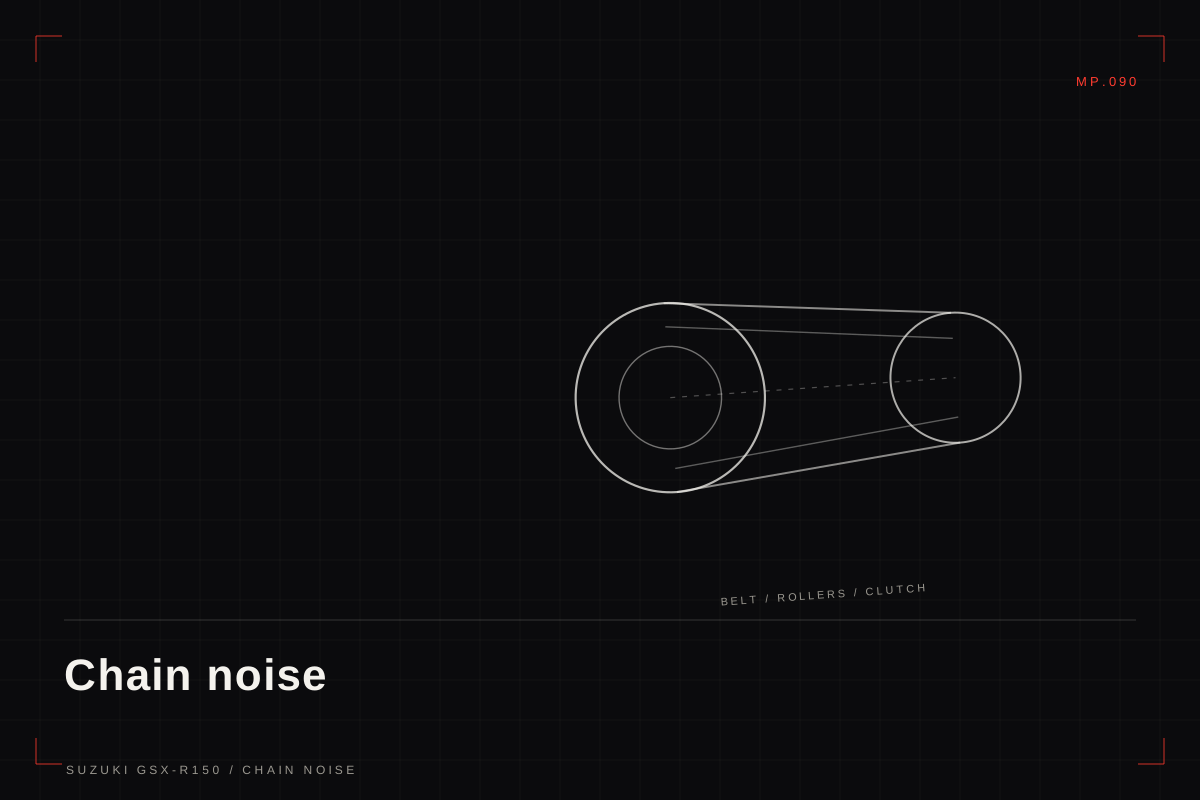 Drivetrain
GSX-R150 chain noise, checked in order
A sport 150 is ridden harder than a commuter and its chain is partly hidden. Noise usually means adjustment or wear, and both are measurable.
Read the diagnosis ↗SUZUKI GSX-S150
Suzuki GSX-S150
 Starting
GSX-S150 no-start, in order
The naked version of the 147.3cc single is easier to diagnose than its faired sibling. You can see the loom, the battery box and the switch gear without removing a panel.
Read the diagnosis ↗ Running
GSX-S150 stalling, by pattern
An upright naked 150 is a city bike, and city riding is stop-start. The stall pattern tells you whether the rider, the idle or the heat is responsible.
Read the diagnosis ↗ Cooling
GSX-S150 overheating, step by step
No fairing means you can see the radiator, the hoses and the fan. That makes the first checks quick, and it makes a blocked core easier to spot.
Read the diagnosis ↗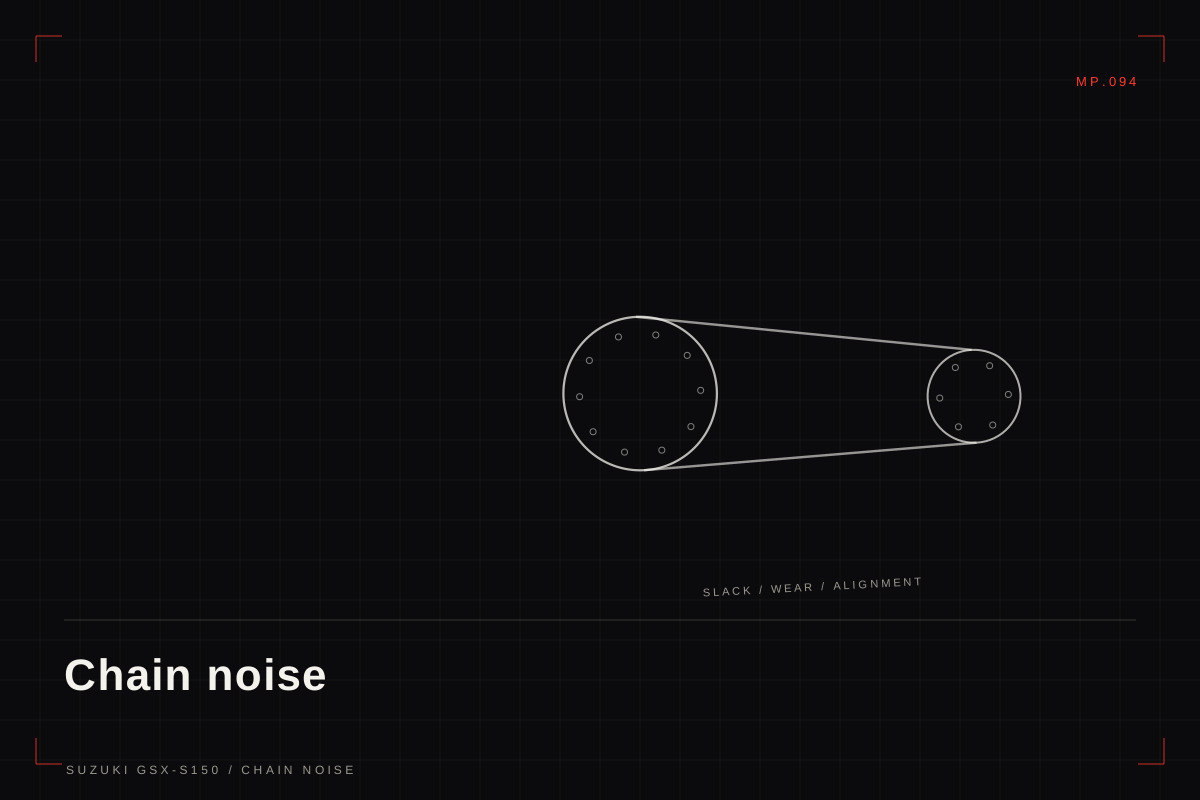 Drivetrain
GSX-S150 chain noise, checked in order
An exposed chain on a naked bike is easy to inspect. That makes noise a maintenance question in most cases, not a mystery.
Read the diagnosis ↗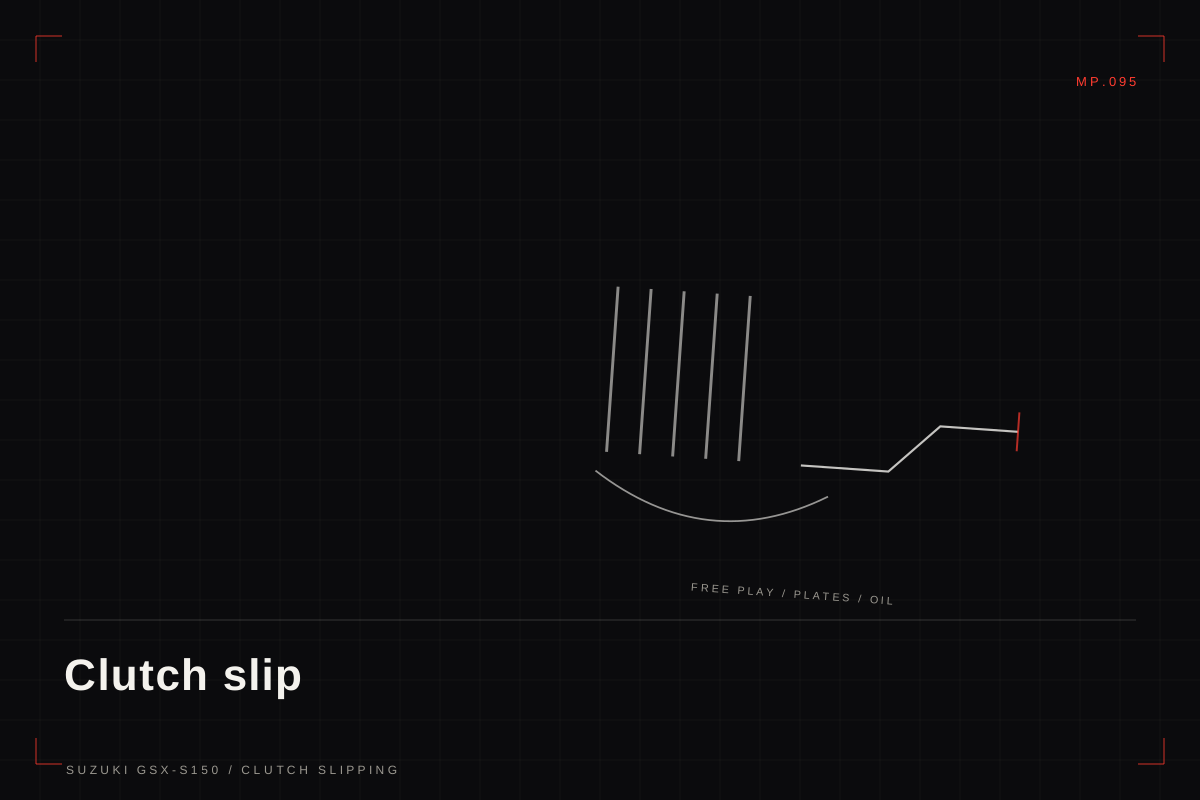 Drivetrain
GSX-S150 clutch slip, cause by cause
Most slipping clutches on a city 150 are adjustment or oil problems. The plates are the last suspect, not the first.
Read the diagnosis ↗SUZUKI Burgman 125EX
Suzuki Burgman Street 125EX
 Starting
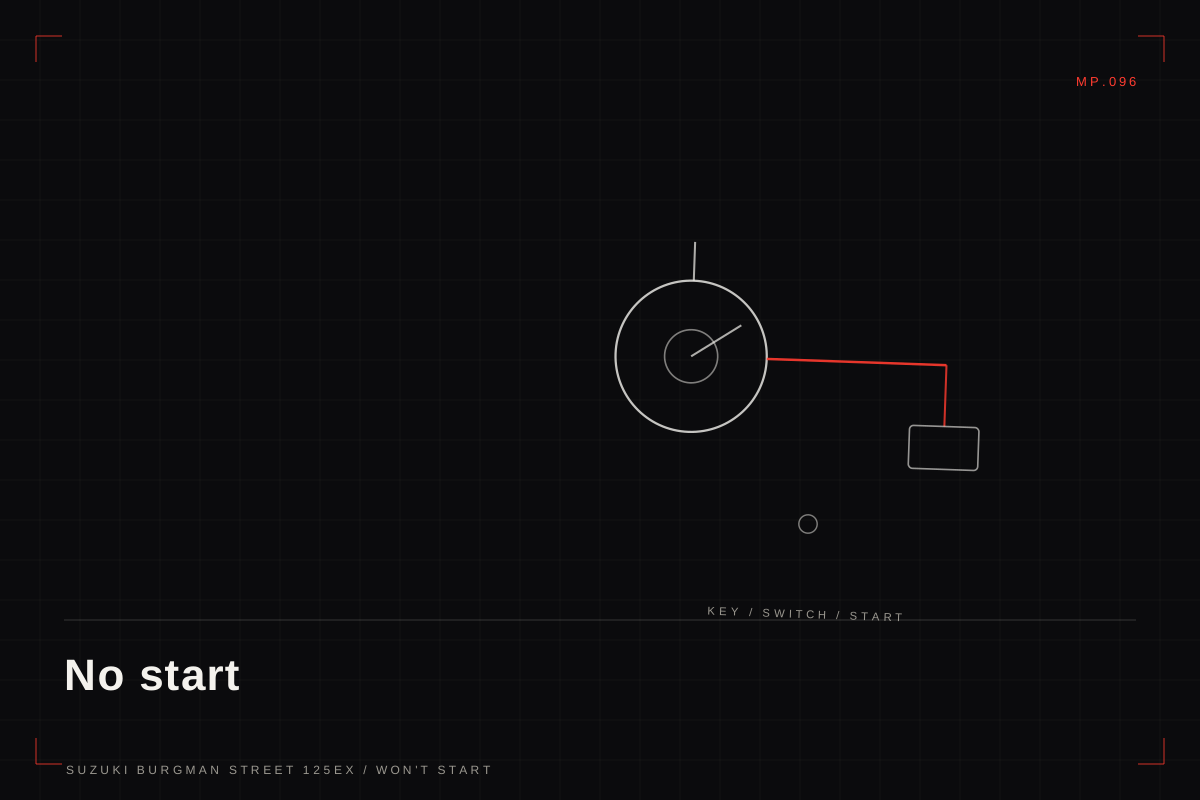
Burgman 125EX no-start, in order
A scooter starts only when it believes a brake is held and the stand is up. Those two signals, and the battery, decide most no-starts.
Read the diagnosis ↗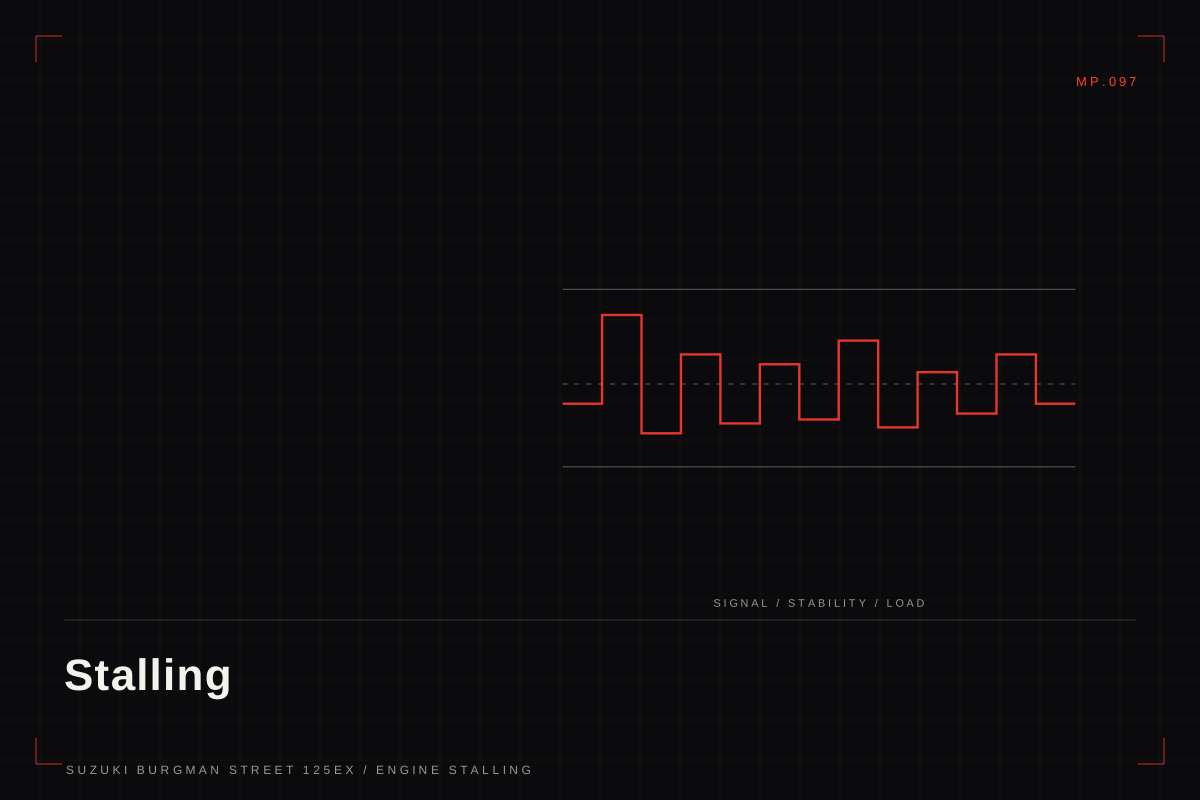 Running
Burgman 125EX stalling, by pattern
A large scooter with a small air-cooled engine works hard at low speed. Heat and CVT drag show up earlier than on a light commuter.
Read the diagnosis ↗ Drivetrain
Burgman 125EX judder, judged under load
A big scooter with a small engine puts load on the CVT from the moment you pull away. Judder that only appears with a passenger is a load symptom.
Read the diagnosis ↗ Drivetrain
Burgman 125EX CVT noise, by sound
A squeal, a rattle and a slap come from three different parts of the same transmission. Naming the noise correctly is half the repair.
Read the diagnosis ↗ Performance
Burgman 125EX lost pace, in order
The Burgman carries more body and more weight than a small commuter. A 125cc engine moving that mass will never feel quick, and that is not a fault.
Read the diagnosis ↗No guide matches those filters.
Workshop Next step
When the test needs a bench
These guides separate what you can check at home from what needs a lift, a meter, a compression gauge or a diagnostic scanner. If the symptom involves fuel, brakes, a hot engine or a noise you cannot place, stop riding and have it inspected.